Loading...
Done
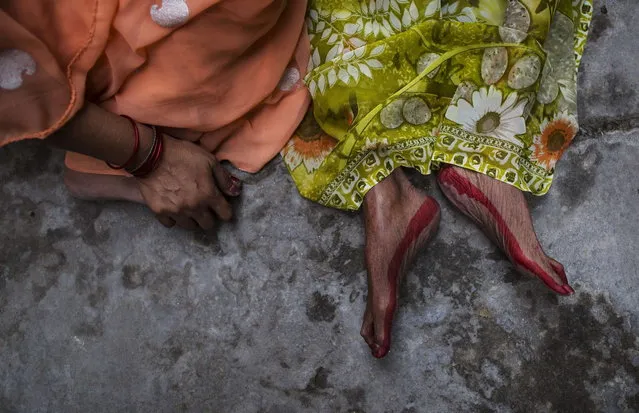
A relative (L) of Champa Devi, 88, sits next to her body, minutes after her death at Mukti Bhavan (Salvation House) at Varanasi, in the northern Indian state of Uttar Pradesh, June 21, 2014. (Photo by Danish Siddiqui/Reuters)

A relative (L) of Champa Devi, 88, sits next to her body, minutes after her death at Mukti Bhavan (Salvation House) at Varanasi, in the northern Indian state of Uttar Pradesh, June 21, 2014. The city of Varanasi, on the banks of the River Ganges, is widely considered Hinduism's holiest city and many Hindus believe that dying there and having their remains scattered in the Ganges allows their soul to escape a cycle of death and rebirth, attaining “moksha” or salvation. “Mukti Bhavan” or “Salvation House”, is a charity-run hostel that caters for people who wish to come to Varanasi to die. Guests can normally stay up to two weeks after which, if they haven't yet passed away, they are gently asked to leave. (Photo by Danish Siddiqui/Reuters)
Details
24 Jul 2014 12:32:00
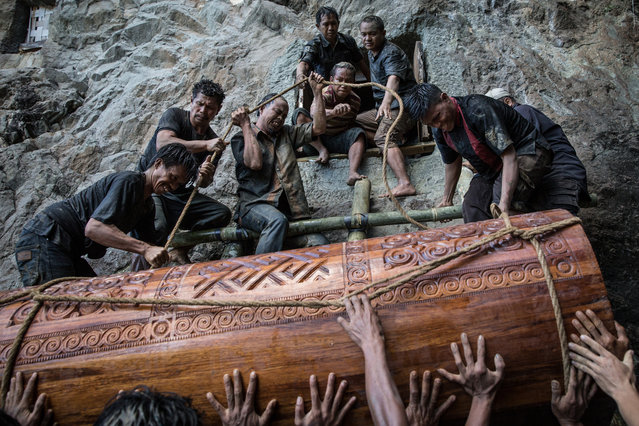
It is said that Torajans are people who “live to die”. For this Indonesian ethnic group, funerals are such extravagant events that they sometimes attract tourists. Families can postpone burials years (and the deceased are considered sick and hosted at home until the funeral) until the family can raise enough money and gather as many relatives as possible. And then it’s a jubilant multiday social event with a parade, dances and animal sacrifices. Agung Parameswara photographed these funerary practices when he traveled to South Sulawesi province, where the Torajans live. But often, their funeral isn’t the last time the dead are seen. In August, crypts are opened, coffins are slid back out and bodies delicately unsheathed. This tender ritual is known as Ma’Nene, which is customarily performed every few years. (Photo by Agung Parameswara/The Washington Post)

It is said that Torajans are people who “live to die”. For this Indonesian ethnic group, funerals are such extravagant events that they sometimes attract tourists. Families can postpone burials years (and the deceased are considered sick and hosted at home until the funeral) until the family can raise enough money and gather as many relatives as possible. And then it’s a jubilant multiday social event with a parade, dances and animal sacrifices. Agung Parameswara photographed these funerary practices when he traveled to South Sulawesi province, where the Torajans live. (Photo by Agung Parameswara/The Washington Post)
Details
06 Oct 2016 09:15:00


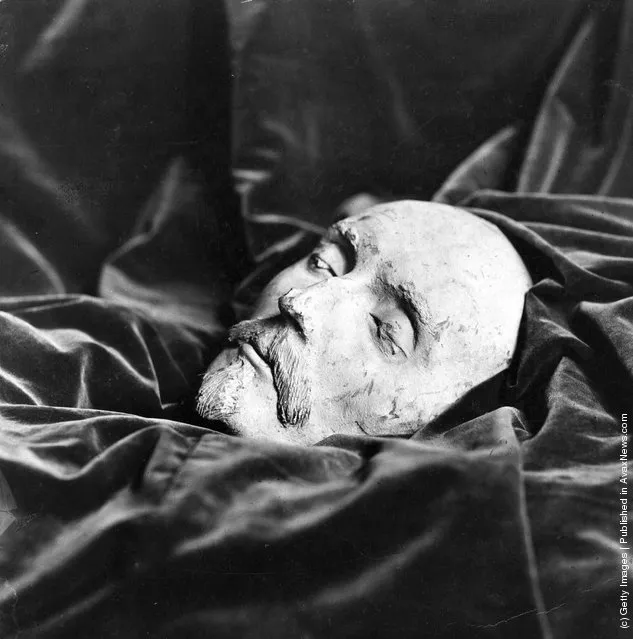
A death mask thought to be that of English dramatist William Shakespeare (1566–1616). Found by Dr. Ludwig Becker in Mainz in 1849, the mask was linked to Shakespeare because of its 1616 date and its supposed facial resemblance to the writer. A rival theory, however, maintains that the mask is more likely to be that of English poet Ben Johnson. (Photo by Hulton Archive/Getty Images). Circa 1900
Details
23 Jun 2011 10:19:00
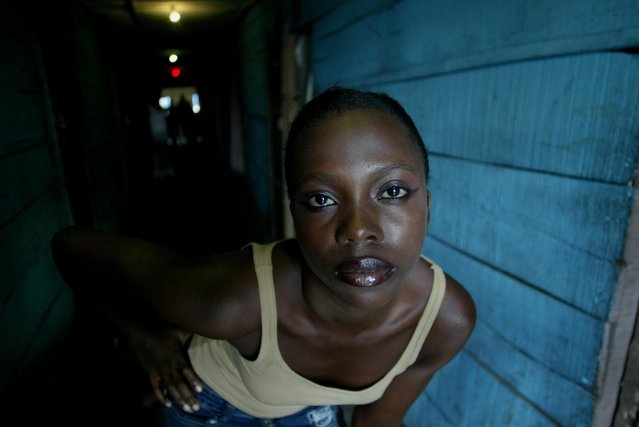
There has been a steady rise in young students and unemployed graduates who use s*x to earn cash. (Photo by Ton Koene/Exclusivepix Media)

Tens of thousands of HIV positive prostitutes in the slums of Lagos to ensure a rapid spread of the epidemic. “If you arrive by car, you can smell the HIV virus outside”, joked my driver as we are on track to Badia a criminal slums of Lagos. Badia is a corruption of “Bad Area”. Nigerians have a lack of everything, except black humor. The poor West African country Nigeria, with a population of 140 million people, after India and South Africa the highest number of people with HIV / AIDS. (Photo by Ton Koene/Exclusivepix Media)
Details
04 Feb 2017 01:01:00
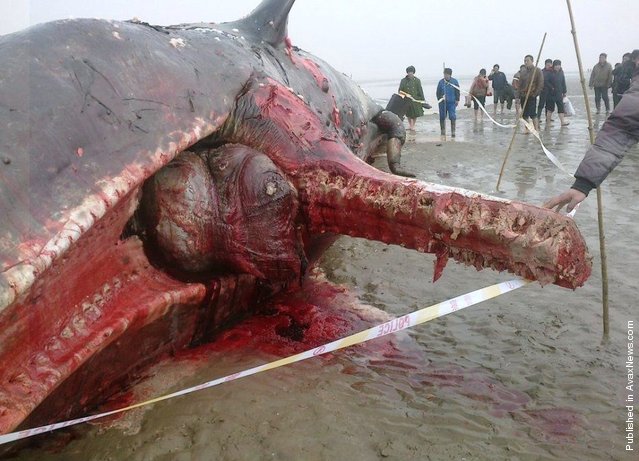
A dead sperm whale is seen on the beach on March 18, 2012 in Yancheng, Jiangsu Province of China

A dead sperm whale is seen on the beach on March 18, 2012 in Yancheng, Jiangsu Province of China. Four giant sperm whales, which were found beached on the beach of Xintan Salt Field on Friday, died on Saturday despite rescue efforts. (Photo by ChinaFotoPress)
Details
19 Mar 2012 12:30:00
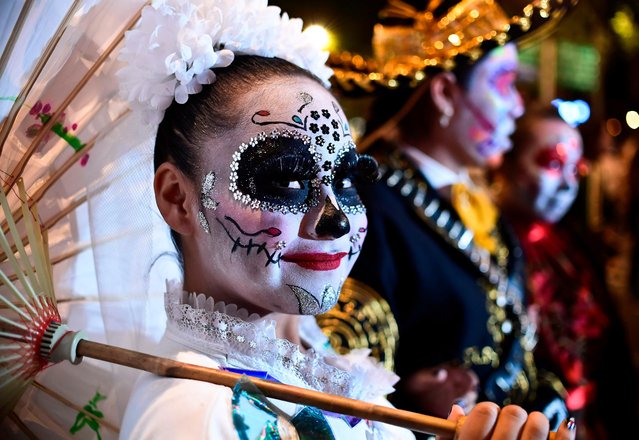
People fancy dressed as “Catrina” take part in the “Catrinas Parade” along Reforma Avenue, in Mexico City on October 22, 2017. (Photo by Ronaldo Schemidt/AFP Photo)

People fancy dressed as “Catrina” take part in the “Catrinas Parade” along Reforma Avenue, in Mexico City on October 22, 2017. Mexicans get ready to celebrate the Day of the Dead highlighting the character of La Catrina which was created by cartoonist Jose Guadalupe Posada, famous for his drawings of typical local, folkloric scenes, socio- political criticism and for his illustrations of “skeletons” or skulls, including La Catrina. (Photo by Ronaldo Schemidt/AFP Photo)
Details
24 Oct 2017 08:18:00
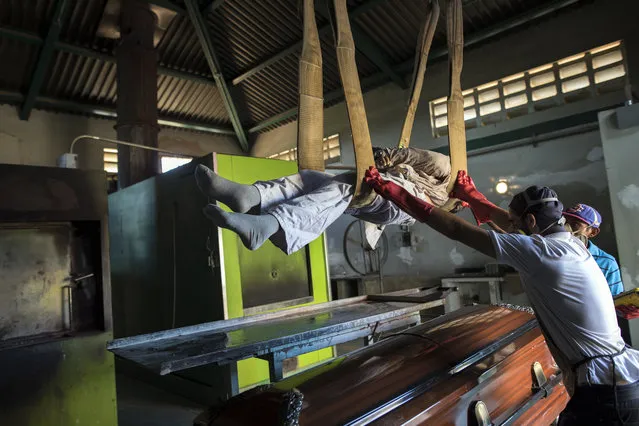
Cemetery workers lift a corpse from a coffin to a metal plate as they prepare the body for cremation at a cemetery in Maracaibo, Venezuela, November 27, 2019. Some overcome the financial burden of a relative's death by renting caskets, a cheaper option than buying one. (Photo by Rodrigo Abd/AP Photo)

Cemetery workers lift a corpse from a coffin to a metal plate as they prepare the body for cremation at a cemetery in Maracaibo, Venezuela, November 27, 2019. Some overcome the financial burden of a relative's death by renting caskets, a cheaper option than buying one. (Photo by Rodrigo Abd/AP Photo)
Details
28 Dec 2019 00:01:00
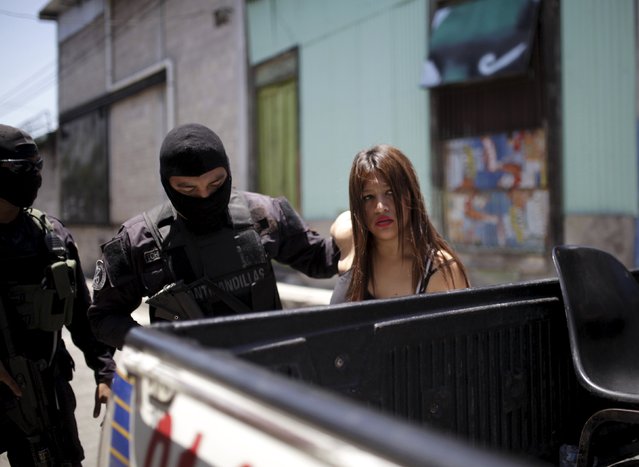
A police officer detains a woman on suspicion of collaborating with the 18th street gang during a "Safe House" operation at the Concepcion neighbourhood in San Salvador, July 2, 2015. Salvadoran police make “Safe House” operations at dangerous neighbourhoods of the capital to prevent murders, according to local media. (Photo by Jose Cabezas/Reuters)

A police officer detains a woman on suspicion of collaborating with the 18th street gang during a "Safe House" operation at the Concepcion neighbourhood in San Salvador, July 2, 2015. Salvadoran police make “Safe House” operations at dangerous neighbourhoods of the capital to prevent murders, according to local media. (Photo by Jose Cabezas/Reuters)
Details
23 Jan 2016 13:00:00