Loading...
Done
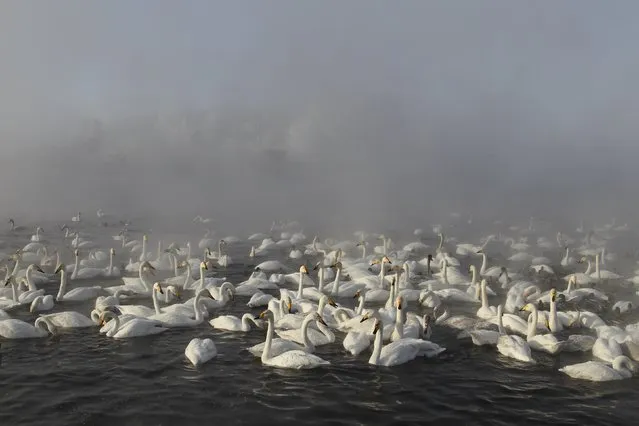
Swans swim over a lake, with the air temperature at about minus 35 degrees Celsius (minus 31 degrees Fahrenheit) as steam ascends above the water during sunset near the village of Urozhainy, Sovetsky district of Altai region, January 26, 2015. (Photo by Andrei Kasprishin/Reuters)

Swans swim over a lake, with the air temperature at about minus 35 degrees Celsius (minus 31 degrees Fahrenheit) as steam ascends above the water during sunset near the village of Urozhainy, Sovetsky district of Altai region, January 26, 2015. About 600 swans annually migrate to the lake, which is heated by warm springs, where they spend their winter being fed by yagers, which helps them to survive the severe cold. (Photo by Andrei Kasprishin/Reuters)
Details
28 Jan 2015 11:40:00


Racing driver J. Gaal at the wheel of car number 26 at the RAC Tourist Trophy, run, for the first time, over the Four Inch Course on the Isle of Man, 17th September 1908. Gaal is racing in waterproofs. (Photo by Topical Press Agency/Hulton Archive/Getty Images)
Details
21 Jun 2011 12:55:00
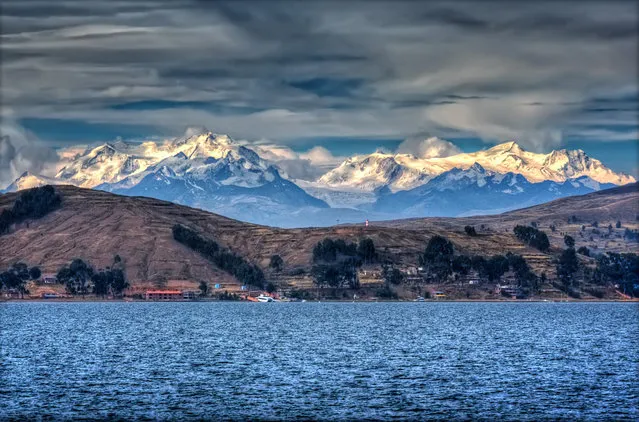
Lake Titicaca

Titicaca or Titiqaqa is a large, deep lake in the Andes on the border of Peru and Bolivia. By volume of water, it is the largest lake in South America. Lake Maracaibo has a larger surface area, though some consider it to be a large brackish bay due to its direct connection with the sea.
Details
22 Jul 2015 12:20:00
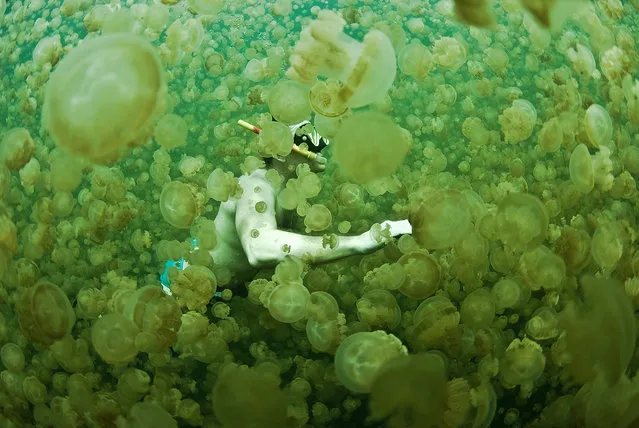
Jellyfish Lake

Jellyfish Lake (Palauan: Ongeim'l Tketau, “Fifth Lake”) is a marine lake located on Eil Malk island in Palau. Eil Malk is part of the Rock Islands, a group of small, rocky, mostly uninhabited islands in Palau's Southern Lagoon, between Koror and Peleliu. There are about 70 other marine lakes located throughout the Rock Islands. Jellyfish Lake is one of Palau's most famous dive (snorkeling only) sites. It is notable for the millions of golden jellyfish which migrate horizontally across the lake daily.
Details
02 Feb 2014 12:23:00
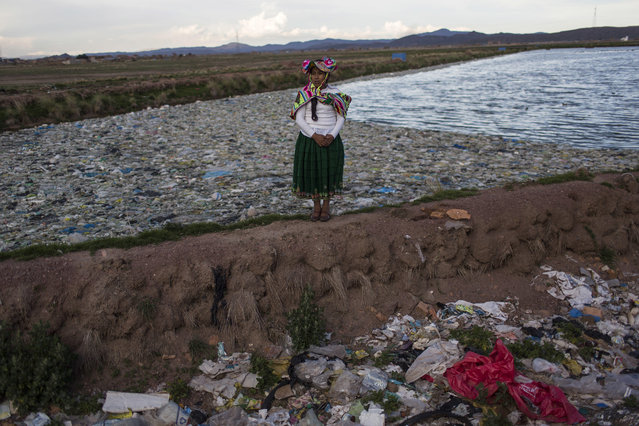
In this February 1, 2017 photo, environmental activist Maruja Inquilla poses for a photo next to a Municipal waste treatment plant with water that flows into Lake Titicaca, in Juliaca, in the Puno region of Peru. “If the frogs could talk they would say, This is killing me”," said Inquilla, who recently showed up at the Puno governor's house carrying plastic bags filled with hundreds of dead frogs in protest. (Photo by Rodrigo Abd/AP Photo)

In this February 1, 2017 photo, environmental activist Maruja Inquilla poses for a photo next to a Municipal waste treatment plant with water that flows into Lake Titicaca, in Juliaca, in the Puno region of Peru. “If the frogs could talk they would say, This is killing me”," said Inquilla, who recently showed up at the Puno governor's house carrying plastic bags filled with hundreds of dead frogs in protest. (Photo by Rodrigo Abd/AP Photo)
Details
04 Mar 2017 00:02:00
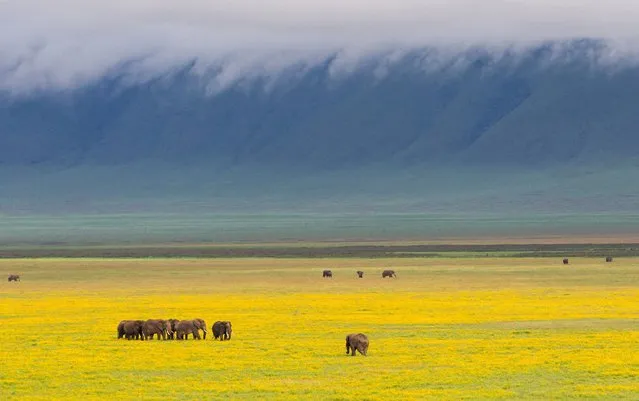
Ngorongoro Crater (Tanzania). At 610m deep and 260 sq km, this is the largest unflooded caldera in the world. A blue-green vision from above it's a haven for engangered wildlife and Maasai livestock. The crater was formed three million years ago when a giant volcano, which could have been as high as Kilimanjaro, exploded and collapsed. The caldera formed the concentric fractures in the crust cracked down to a magma reservoir deep underground. (Photo by John Bryant/Getty Images)

Ngorongoro Crater (Tanzania). At 610m deep and 260 sq km, this is the largest unflooded caldera in the world. A blue-green vision from above it's a haven for engangered wildlife and Maasai livestock. The crater was formed three million years ago when a giant volcano, which could have been as high as Kilimanjaro, exploded and collapsed. The caldera formed the concentric fractures in the crust cracked down to a magma reservoir deep underground. (Photo by John Bryant/Getty Images)
Details
28 Mar 2014 08:08:00


An young exhibitor chases his wayward pig during the Great Yorkshire Show on July 12, 2011 in Harrogate, England. The annual Great Yorkshire Show has attracted a record number of 12,700 livestock entries over the three day event. The show now in its 153rd year is Britain's leading agricultural gathering, where over 125,000 visitors come to celebrate the farming community and their way of life. (Photo by Christopher Furlong/Getty Images)
Details
13 Jul 2011 09:52:00
Boats of fishermen are seen on the dried Poopo lakebed in the Oruro Department, south of La Paz, Bolivia, December 17, 2015. (Photo by David Mercado/Reuters)

Boats of fishermen are seen on the dried Poopo lakebed in the Oruro Department, south of La Paz, Bolivia, December 17, 2015. Lake Poopo in Bolivia, the Andean nation's formerly second largest after the famed Titicaca, has dried up entirely. With the water now gone, animals have died off in the millions, according to studies. And the local families, having lost much of their sustenance, have been forced to migrate. (Photo by David Mercado/Reuters)
Details
20 Dec 2015 08:04:00