Loading...
Done
Revelers look at a cellphone during the annual street block party know as “Explode Coracao” on the third day of Carnival on February 19, 2023 in Sao Paulo, Brazil. According to the São Paulo City Council, during Carnival week more than 500 street blocks (blocos de rua) are held and more than 15 million people are expected to participate in them. Created in 2017, Explode Coracao is one of the most popular street blocks and attracted 150,000 revelers in its last edition, before the pandemic, in 2020. (Photo by Alexandre Schneider/Getty Images)

Revelers look at a cellphone during the annual street block party know as “Explode Coracao” on the third day of Carnival on February 19, 2023 in Sao Paulo, Brazil. According to the São Paulo City Council, during Carnival week more than 500 street blocks (blocos de rua) are held and more than 15 million people are expected to participate in them. Created in 2017, Explode Coracao is one of the most popular street blocks and attracted 150,000 revelers in its last edition, before the pandemic, in 2020. (Photo by Alexandre Schneider/Getty Images)
Details
22 Feb 2023 04:58:00
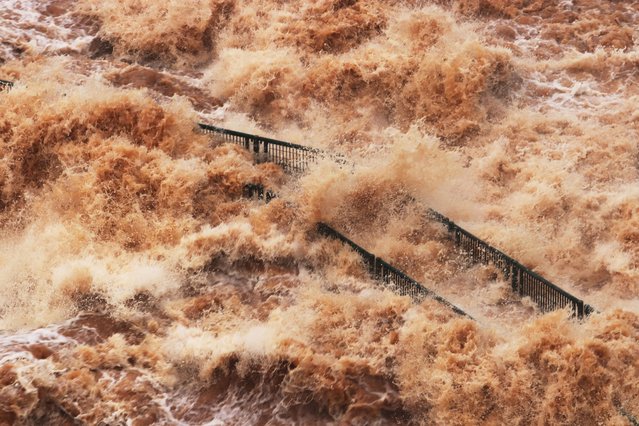
View of the visitor walkway at the Iguazu Falls, which was destroyed by the strong current of the river on the triple border between Brazil, Argentina and Paraguay, on October 30, 2023. The Falls are flowing at over 24 million liters of water per second, according to hydrological monitoring by Companhia Paranaense de Energia (Copel). This is the second highest flow since 1997, when monitoring became automatic and was measured hourly. (Photo by Christian Rizzi/AFP Photo)

View of the visitor walkway at the Iguazu Falls, which was destroyed by the strong current of the river on the triple border between Brazil, Argentina and Paraguay, on October 30, 2023. The Falls are flowing at over 24 million liters of water per second, according to hydrological monitoring by Companhia Paranaense de Energia (Copel). This is the second highest flow since 1997, when monitoring became automatic and was measured hourly. (Photo by Christian Rizzi/AFP Photo)
Details
21 Dec 2024 03:30:00
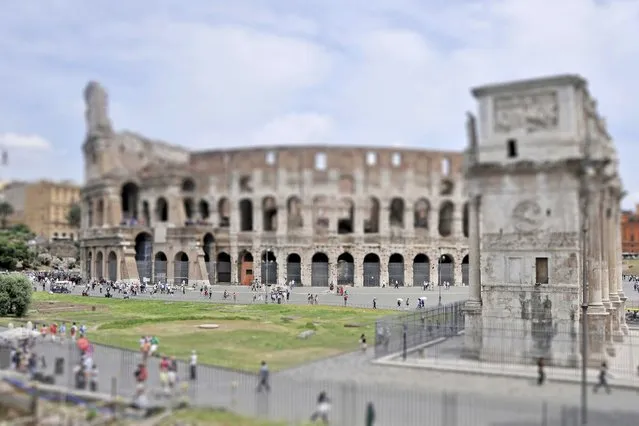
Coliseum, Rome. (Photo by Richard Silver)

Richard Silver's photographs show us the world's biggest sights like Machu Picchu in Peru or Copacabana in Brazil. His photos, however, are not simply depictions of the landmarks but planned, artistic visual constructions that, with their playful combinations of sharpness and blur, create new worlds of experience. Photo: Coliseum, Rome. (Photo by Richard Silver)
Details
04 May 2013 11:19:00
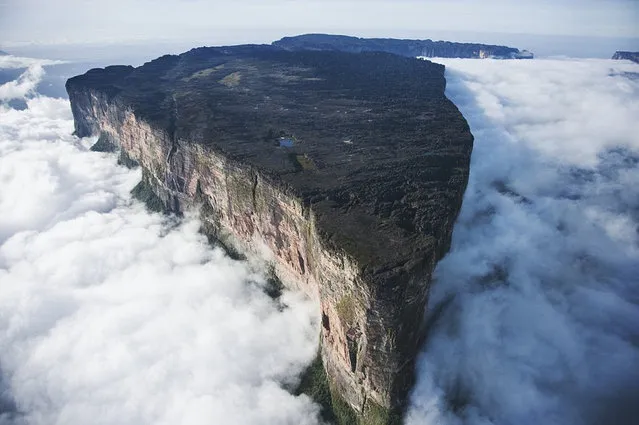
Mount Roraima

Mount Roraima (Spanish: Monte Roraima, also known as Tepuy Roraima and Cerro Roraima; Portuguese: Monte Roraima [ˈmõtʃi ʁoˈɾajmɐ]) is the highest of the Pakaraima chain of tepui plateau in South America. First described by the English explorer Sir Walter Raleigh in 1596, its 31 km2 summit area is defended by 400-metre-tall cliffs on all sides. The mountain includes the triple border point of Venezuela, Brazil and Guyana.
Details
11 Sep 2012 08:04:00
A model presents a creation in a subway station during the Sao Paulo Fashion Week in Sao Paulo October 27, 2013. (Photo by Paulo Whitaker/Reuters)

“It’s Fashion Week in Sao Paulo, Brazil and you don’t have to be a celebrity or a designer to check out these couture pieces. Subway stations were used as improvised catwalks in order to give the general public a chance to see these creations up close and at the price of a subway fare”. – Reuters. Photo: A model presents a creation in a subway station during the Sao Paulo Fashion Week in Sao Paulo October 27, 2013. (Photo by Paulo Whitaker/Reuters)
Details
31 Oct 2013 07:18:00
A dog dressed like of a bee is seen during the “Blocao” dog carnival in Rio de Janeiro. (Photo by Silvia Izquierdo/AP Photo)

A dog dressed like of a bee is seen during the “Blocao” dog carnival in Rio de Janeiro, Brazil, Sunday, February 16, 2014. About 100 dogs have had their day at a pre-Carnival bash in Rio de Janeiro. A 10-man brass band and a singer belting out Rio's anthem song “Cidade Maravilhosa” (Marvelous City) kicked off the four-footed fest as dog owners gathered to party down with pooches on Copacabana beach Sunay. (Photo by Silvia Izquierdo/AP Photo)
Details
18 Feb 2014 14:50:00
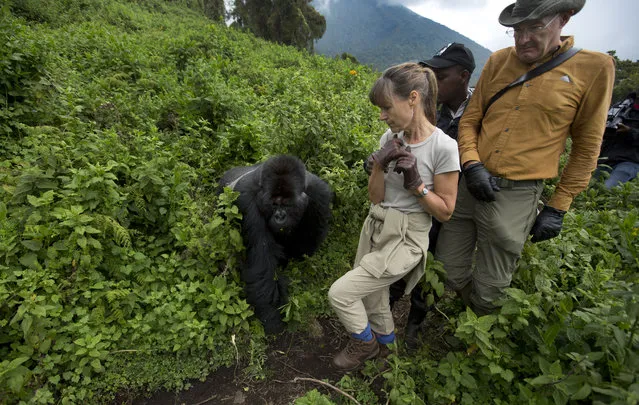
In this photo taken Friday, September 4, 2015, tourists Sarah and John Scott from Worcester, England, take a step back as a male silverback mountain gorilla from the family of mountain gorillas named Amahoro, which means “peace” in the Rwandan language, unexpectedly steps out from the bush to cross their path in the dense forest on the slopes of Mount Bisoke volcano in Volcanoes National Park, northern Rwanda. (Photo by Ben Curtis/AP Photo)

In this photo taken Friday, September 4, 2015, tourists Sarah and John Scott from Worcester, England, take a step back as a male silverback mountain gorilla from the family of mountain gorillas named Amahoro, which means “peace” in the Rwandan language, unexpectedly steps out from the bush to cross their path in the dense forest on the slopes of Mount Bisoke volcano in Volcanoes National Park, northern Rwanda. Deep in Rwanda's steep-sloped forest, increasing numbers of tourists are heading to see the mountain gorillas, a subspecies whose total population is an estimated 900 and who also live in neighboring Uganda and Congo, fueling an industry seen as key to the welfare of the critically endangered species as well as Rwanda's economy. (Photo by Ben Curtis/AP Photo)
Details
18 Sep 2015 14:55:00
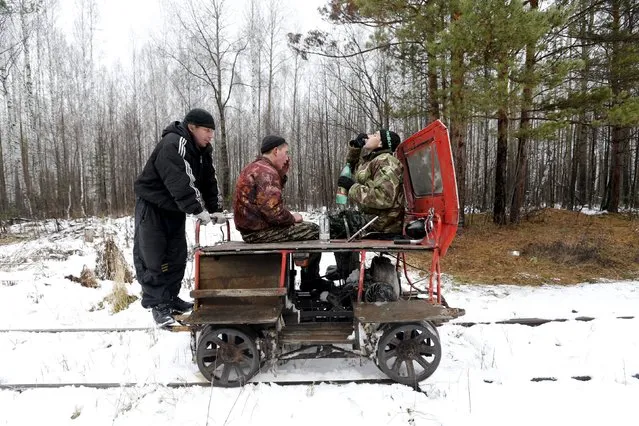
(L-R) A man nicknamed "Barcelona", Alexey Bolotov and Alexey Jakushin drink vodka as they travel by a pioneer motorised railcar on their way to Kalach, Sverdlovsk region, Russia October 18, 2015. The "pioneer," a light auxiliary rail vehicle, is a popular form of transport among people who live along the Alapayevsk railway. (Photo by Maxim Zmeyev/Reuters)

(L-R) A man nicknamed "Barcelona", Alexey Bolotov and Alexey Jakushin drink vodka as they travel by a pioneer motorised railcar on their way to Kalach, Sverdlovsk region, Russia October 18, 2015. The "pioneer," a light auxiliary rail vehicle, is a popular form of transport among people who live along the Alapayevsk railway. In a remote corner of the Urals region at the end of a narrow-gauge railway is Kalach, population about a dozen. Three decades ago 600 people called the village home, but the local forestry industry suffered as the former Soviet Union imploded and people moved away in search of work. In Kalach today there are no telephones, no mobile reception and only a few hours of electricity a day. (Photo by Maxim Zmeyev/Reuters)
Details
15 Nov 2015 08:06:00