Loading...
Done
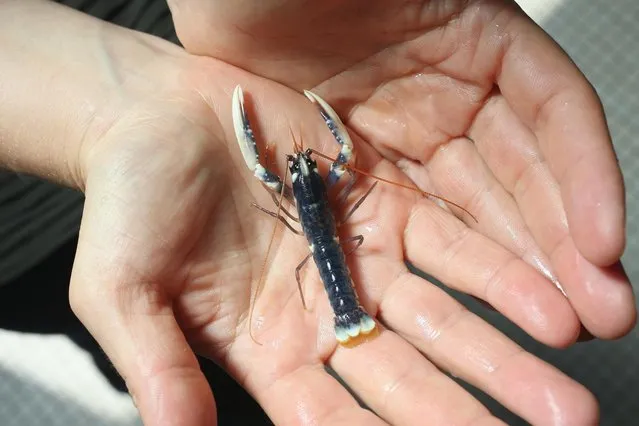
Isabel Schmalenbach, an environmental scientist with the Helgoland Biological Institute (Biologische Anstalt Helgoland), part of the Alfred Wegener Institute for Polar and Marine Research, holds a one-year old baby European lobster (Homarus gammarus) raised at the institute on August 3, 2013 on Helgoland Island, Germany. (Photo by Sean Gallup/Getty Images)

Isabel Schmalenbach, an environmental scientist with the Helgoland Biological Institute (Biologische Anstalt Helgoland), part of the Alfred Wegener Institute for Polar and Marine Research, holds a one-year old baby European lobster (Homarus gammarus) raised at the institute on August 3, 2013 on Helgoland Island, Germany. Later in the day Schmalenbach and her colleagues released a total of 415 one-year old lobsters into the North Sea as part of an effort to repopulate the lobster population around Helgoland (also called Heligoland). In the 19th century local fishermen caught up to 80,000 lobsters a year in the surrounding waters, combined with the heavy allied bombing of the island during and after World War II, as well as other environmental factors, decimated the lobster population. (Photo by Sean Gallup)
Details
05 Aug 2013 08:39:00
Ko Min, 26, manually extracts oil from one of three 300 feet deep wells he works on in the Minhla township of the Magwe district October 27, 2013. Everyday, Ko Min makes around $30 extracting crude oil from three small wells after he bought rights to use them for close to $1000 from a farmer who owns the land. (Photo by Damir Sagolj/Reuters)

Ko Min, 26, manually extracts oil from one of three 300 feet deep wells he works on in the Minhla township of the Magwe district October 27, 2013. Everyday, Ko Min makes around $30 extracting crude oil from three small wells after he bought rights to use them for close to $1000 from a farmer who owns the land. In Myanmar, an impoverished country rich with natural resources, people from poor communities find ways to supplement their income by exploiting such resources, such as the Minhla township, traditionally rich with oil, often using primitive and dangerous methods. (Photo by Damir Sagolj/Reuters)
Details
21 Apr 2014 10:06:00
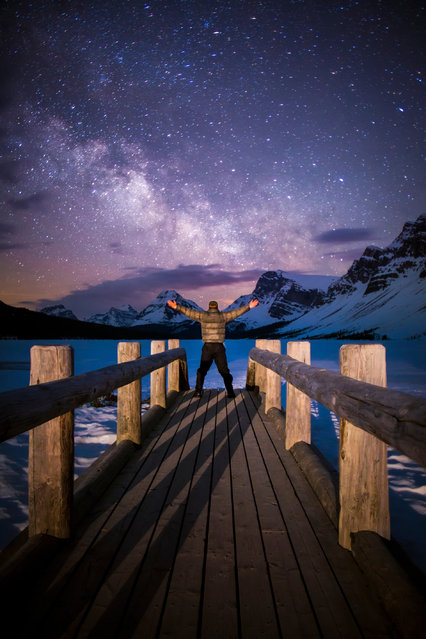
Paul Zizka in “Galactic Gateway”, Bow Lake, Banff National Park, May 11, 2013. (Photo by Paul Zizka/Caters News)

“These are the stunning shots of one photographer who is putting everyday “selfies” to shame. Paul Zizka, 34, began experimenting with night photography just two years ago and immediately became fascinated with the spectacular scenes he discovered. To create something more unique he started adding himself into the shot – as well as showing others the beautiful surroundings he had been exploring. Using lengthy exposure, the photographer felt that featuring himself in some of his shots – the night sky illuminating the mountains around him – created a relationship between the central figure in the image and the nature around him”. – Caters News. Photo: Paul Zizka in “Galactic Gateway”, Bow Lake, Banff National Park, May 11, 2013. (Photo by Paul Zizka/Caters News)
Details
22 May 2014 04:38:00
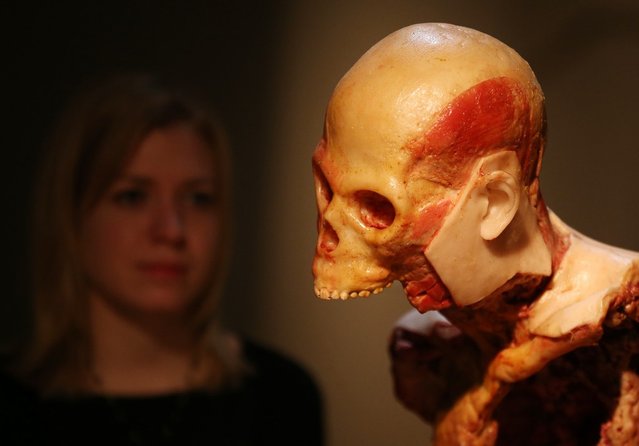
An artwork entitled 'Are you still mad at me ?' by John Isaacs is displayed at the Death: A Self-portrait exhibition at the Wellcome Collection on November 14, 2012 in London, England. The exhibition showcases 300 works from a unique collection by Richard Harris, a former antique print dealer from Chicago, devoted to the iconography of death. The display highlights art works, historical artifacts, anatomical illustrations and ephemera from around the world and opens on November 15, 2012 until February 24, 2013.  (Photo by Peter Macdiarmid)

An artwork entitled “Are you still mad at me?” by John Isaacs is displayed at the Death: A Self-portrait exhibition at the Wellcome Collection on November 14, 2012 in London, England. The exhibition showcases 300 works from a unique collection by Richard Harris, a former antique print dealer from Chicago, devoted to the iconography of death. The display highlights art works, historical artifacts, anatomical illustrations and ephemera from around the world and opens on November 15, 2012 until February 24, 2013. (Photo by Peter Macdiarmid)
Details
15 Nov 2012 09:41:00
Music student Daniele Gonzalez, (centre row, L), and Australian musician Susie Park from the Minnesota Orchestra (centre row, 2nd L), react during a rehearsal in Havana, May 15, 2015. (Photo by Alexandre Meneghini/Reuters)

Music student Daniele Gonzalez, (centre row, L), and Australian musician Susie Park from the Minnesota Orchestra (centre row, 2nd L), react during a rehearsal in Havana, May 15, 2015. The Minnesota Orchestra will offer two concerts in Havana and is the first major U.S. orchestra to play in Cuba since 1999. The trip cost nearly $1 million. It was underwritten by Marilyn Carlson Nelson, an heir to the Carlson hotel company fortune, and her husband Glen. The U.S. government gave special permission for a direct charter flight from Minneapolis to Havana for the event, putting 4 tons of equipment and 160 people on an Airbus 330. (Photo by Alexandre Meneghini/Reuters)
Details
17 May 2015 11:34:00
Brave slackliners have been pictured walking the ropes above Rio de Janeiro, Brazil on August 15, 2016, with the half a mile drop showing the city in all its glory. The stunning shots show the daredevils tread across an eighty-two-foot-long high line on Pedra da Gvea mountain with an amazing sunrise illuminating the city landscape behind. (Photo by Rafael Moura/Caters News Agency)

Brave slackliners have been pictured walking the ropes above Rio de Janeiro, Brazil on August 15, 2016, with the half a mile drop showing the city in all its glory. The stunning shots show the daredevils tread across an eighty-two-foot-long high line on Pedra da Gvea mountain with an amazing sunrise illuminating the city landscape behind. (Photo by Rafael Moura/Caters News Agency)
Details
25 Aug 2016 09:55:00
Mrs. Marie Graskamp of Milwaukee shows the different positions one might assume when entering the bomb shelter in Milwaukee  September 3, 1958. This circular entrance is about three feet in diameter. This is the entrance (according to the builders) that would connect to the cellar of a home assuming the shelter was in the ground for added protection. (Photo by AP Photo)

Mrs. Marie Graskamp of Milwaukee shows the different positions one might assume when entering the bomb shelter in Milwaukee September 3, 1958. This circular entrance is about three feet in diameter. This is the entrance (according to the builders) that would connect to the cellar of a home assuming the shelter was in the ground for added protection. If a bombing should occur, all members of family would proceed to the cellar and then through the circular port into the shelter. (Photo by AP Photo)
Details
04 Sep 2015 12:44:00
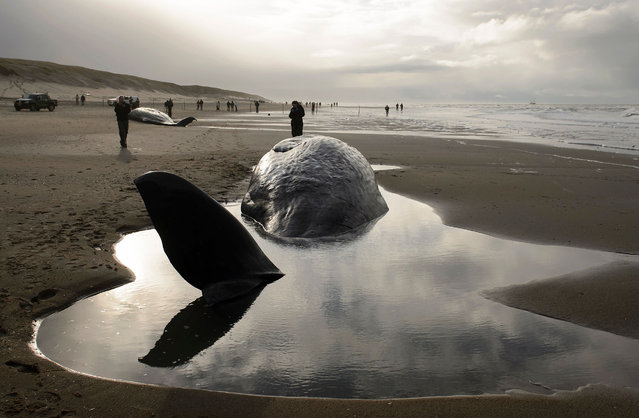
People stand near beached sperm whales on January 13, 2016, after they became stranded on the Dutch island of Texel the day before. Five sperm whales which became stranded on Texel have died, officials said January 13. Experts said the beached whales had already been badly injured and their chances of survival were poor. Volunteers tried to save them but called off their efforts late in the night because of bad weather and darkness, ANP news agency said. (Photo by Remko de Waal/AFP Photo/ANP)

People stand near beached sperm whales on January 13, 2016, after they became stranded on the Dutch island of Texel the day before. Five sperm whales which became stranded on Texel have died, officials said January 13. Experts said the beached whales had already been badly injured and their chances of survival were poor. Volunteers tried to save them but called off their efforts late in the night because of bad weather and darkness, ANP news agency said. (Photo by Remko de Waal/AFP Photo/ANP)
Details
17 Dec 2017 04:51:00