Loading...
Done
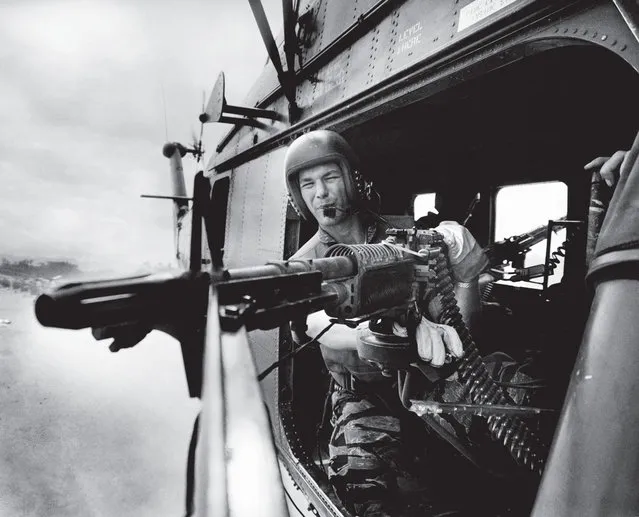
Man your battle stations: The crew chief of helicopter Yankee Papa 13, lance corporal James C. Farley, mans an M-60 machine gun during a mission near Da Nang, Vietnam on March 31, 1965. (Photo by Larry Burrows/Time & Life Pictures)

In the spring of 1965, within weeks of 3,500 American Marines arriving in Vietnam, a 39-year-old Briton named Larry Burrows began work on a feature for LIFE magazine, chronicling the day-to-day experience of U.S. troops on the ground – and in the air – in the midst of the rapidly widening war. The photographs in this gallery focus on a calamitous March 31, 1965, helicopter mission; Burrows’ “report from Da Nang”, featuring his pictures and his personal account of the harrowing operation, was published two weeks later as a now-famous cover story in the April 16, 1965, issue of LIFE.

Photo: Man your battle stations: The crew chief of helicopter Yankee Papa 13, lance corporal James C. Farley, mans an M-60 machine gun during a mission near Da Nang, Vietnam on March 31, 1965. (Photo by Larry Burrows/Time & Life Pictures)
Details
07 Apr 2013 07:08:00
A driver maneuvers his classic American car along a wet road as a wave crashes against the Malecon in Havana, Cuba on Thursday. Hurricane Sandy blasted across eastern Cuba as a potent Category 2 storm and headed for the Bahamas after causing at least two deaths in the Caribbean. (Photo by Ramon Espinosa/Associated Press)

A driver maneuvers his classic American car along a wet road as a wave crashes against the Malecon in Havana, Cuba on Thursday. Hurricane Sandy blasted across eastern Cuba as a potent Category 2 storm and headed for the Bahamas after causing at least two deaths in the Caribbean. (Photo by Ramon Espinosa/Associated Press)
Details
29 Oct 2012 11:14:00
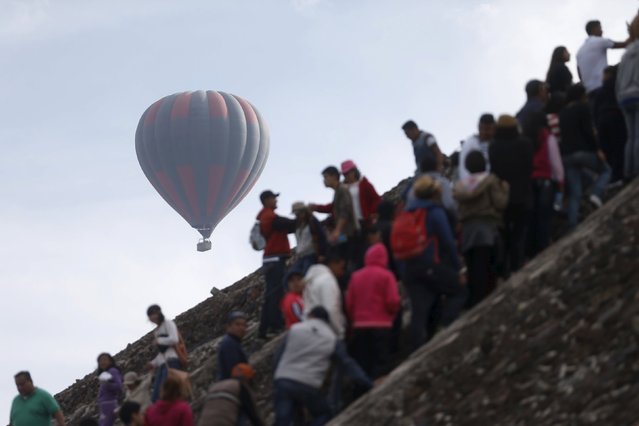
A hot air ball balloon floats past while people stand in line to climb the Pyramid of the Sun and welcome the spring equinox in the pre-hispanic city of Teotihuacan, on the outskirts of Mexico City, Mexico, March 20, 2016. Spring equinox in Teotihuacán is an annual event which takes place around the 20th and 21st of March at the pre-Hispanic site of Teotihuacán, Mexico. This event is mirrored by other similar events in other pre-Hispanic sites such as Chichén Itzá and Malinalco, Mexico State. (Photo by Edgard Garrido/Reuters)

A hot air ball balloon floats past while people stand in line to climb the Pyramid of the Sun and welcome the spring equinox in the pre-hispanic city of Teotihuacan, on the outskirts of Mexico City, Mexico, March 20, 2016. Spring equinox in Teotihuacán is an annual event which takes place around the 20th and 21st of March at the pre-Hispanic site of Teotihuacán, Mexico. This event is mirrored by other similar events in other pre-Hispanic sites such as Chichén Itzá and Malinalco, Mexico State. (Photo by Edgard Garrido/Reuters)
Details
21 Mar 2016 13:01:00
Freshmen in Zhengzhou Institute of Aeronautical Industry Management head bottles of mineral water for upright stand during military training on September 17, 2015 in Zhengzhou, Henan Province of China. More than 6,800 freshmen in the school are required to take part in the military training. (Photo by ChinaFotoPress/ChinaFotoPress via Getty Images)

Freshmen in Zhengzhou Institute of Aeronautical Industry Management head bottles of mineral water for upright stand during military training on September 17, 2015 in Zhengzhou, Henan Province of China. More than 6,800 freshmen in the school are required to take part in the military training. (Photo by ChinaFotoPress/ChinaFotoPress via Getty Images)
Details
02 Oct 2015 08:02:00
A General Atomics MQ-9 Reaper stands on the runway during “Black Dart”, a live-fly, live fire demonstration of 55 unmanned aerial vehicles, or drones, at Naval Base Ventura County Sea Range, Point Mugu, near Oxnard, California July 31, 2015. (Photo by Patrick T. Fallon/Reuters)

A General Atomics MQ-9 Reaper stands on the runway during “Black Dart”, a live-fly, live fire demonstration of 55 unmanned aerial vehicles, or drones, at Naval Base Ventura County Sea Range, Point Mugu, near Oxnard, California July 31, 2015. (Photo by Patrick T. Fallon/Reuters)
Details
02 Aug 2015 13:02:00
In this Tuesday, June 4, 2019, photo, a Yamanote Line train travels above commuters walking across the crossing during evening rush hours in the Shinjuku district of Tokyo. Operated by the East Japan Railway Co., the Yamanote Line in Tokyo makes a loop around the center of the city, connecting 29 stations that include key stops such as Shinjuku, Shibuya and Ikebukuro. A complete loop of about an hour offers scenes of Japanese daily lives. (Photo by Jae C. Hong/AP Photo)

In this Tuesday, June 4, 2019, photo, a Yamanote Line train travels above commuters walking across the crossing during evening rush hours in the Shinjuku district of Tokyo. Operated by the East Japan Railway Co., the Yamanote Line in Tokyo makes a loop around the center of the city, connecting 29 stations that include key stops such as Shinjuku, Shibuya and Ikebukuro. A complete loop of about an hour offers scenes of Japanese daily lives. (Photo by Jae C. Hong/AP Photo)
Details
27 Jun 2019 00:03:00
A woman falls while slipping on ice during freezing rain on Roosevelt Island, a borough of Manhattan, in New York January 5, 2014. New York City was hit on Friday by the first severe winter storm of 2014 and was still in the grip of sub-freezing weather on Sunday morning. The woman got up and walked away from the fall. (Photo by Zoran Milich/Reuters)

A woman falls while slipping on ice during freezing rain on Roosevelt Island, a borough of Manhattan, in New York January 5, 2014. New York City was hit on Friday by the first severe winter storm of 2014 and was still in the grip of sub-freezing weather on Sunday morning. The woman got up and walked away from the fall. (Photo by Zoran Milich/Reuters)
Details
07 Jan 2014 08:49:00
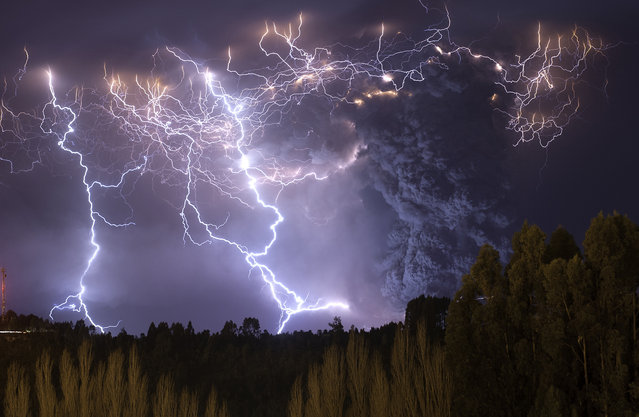
The eruption of Cordon Caulle began on June 4, 2011, located in the Region of Los Rios in Chile. For about 12 months, people and animals became accustomed to living with the daily fall of ash, which also caused problems in the air traffic in South America. The explosions and lightning during first days of the eruption could be seen from hundreds of miles around. This photograph was taken on the second night of eruption from the town of Lago Ranco. (Photo and caption by Francisco Negroni/National Geographic Traveler Photo Contest)

The eruption of Cordon Caulle began on June 4, 2011, located in the Region of Los Rios in Chile. For about 12 months, people and animals became accustomed to living with the daily fall of ash, which also caused problems in the air traffic in South America. The explosions and lightning during first days of the eruption could be seen from hundreds of miles around. This photograph was taken on the second night of eruption from the town of Lago Ranco. (Photo and caption by Francisco Negroni/National Geographic Traveler Photo Contest)

ATTENTION! All pictures are presented in high resolution. To see Hi-Res images – just TWICE click on any picture. In other words, click small picture – opens the BIG picture. Click BIG picture – opens VERY BIG picture.
Details
23 Jun 2013 11:24:00