Loading...
Done
A woman washes clothes at a shelter for families displaced by gang violence at the Saint Yves Church in Port-au-Prince, Haiti on July 26, 2021. (Photo by Ricardo Arduengo/Reuters)

A woman washes clothes at a shelter for families displaced by gang violence at the Saint Yves Church in Port-au-Prince, Haiti on July 26, 2021. (Photo by Ricardo Arduengo/Reuters)
Details
16 Aug 2021 07:39:00
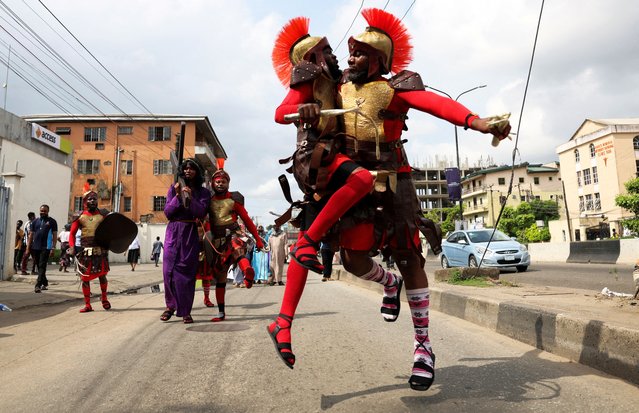
Members of St. Dominic Catholic Church take part in a re-enactment of the crucifixion of Jesus Christ, on Good Friday in Yaba, Lagos, Nigeria, on April 18, 2025. (Photo by Sodiq Adelakun/Reuters)

Members of St. Dominic Catholic Church take part in a re-enactment of the crucifixion of Jesus Christ, on Good Friday in Yaba, Lagos, Nigeria, on April 18, 2025. (Photo by Sodiq Adelakun/Reuters)
Details
09 May 2025 03:45:00
Rays of the misty sunrise swathe Christ Church in the village of Brockham in Surrey, UK on September 29, 2025. Colder temperatures are expected in the early part of the day with mist and fog clearing later in the south. (Photo by Peter Macdiarmid/The Times)

Rays of the misty sunrise swathe Christ Church in the village of Brockham in Surrey, UK on September 29, 2025. Colder temperatures are expected in the early part of the day with mist and fog clearing later in the south. (Photo by Peter Macdiarmid/The Times)
Details
08 Dec 2025 06:53:00
Larissa Neto, a muse of the Unidos da Tijuca Samba School, poses as she wears a carnival dress in Sao Goncalo near Rio de Janeiro, Brazil, February 3, 2016. (Photo by Ricardo Moraes/Reuters)

Larissa Neto, a muse of the Unidos da Tijuca Samba School, poses as she wears a carnival dress in Sao Goncalo near Rio de Janeiro, Brazil, February 3, 2016. Rio de Janeiro's carnival parades are known the world over for the glitz and glamour, high-tech allegorical floats and shimmering bodies, which battle it out each year for the championship title. Each school is fronted by the Queen of the Drums, who dances alongside the raging percussion, and her court of sparkling, sculpted dancers known as “muses”. (Photo by Ricardo Moraes/Reuters)

Details
05 Feb 2016 10:52:00
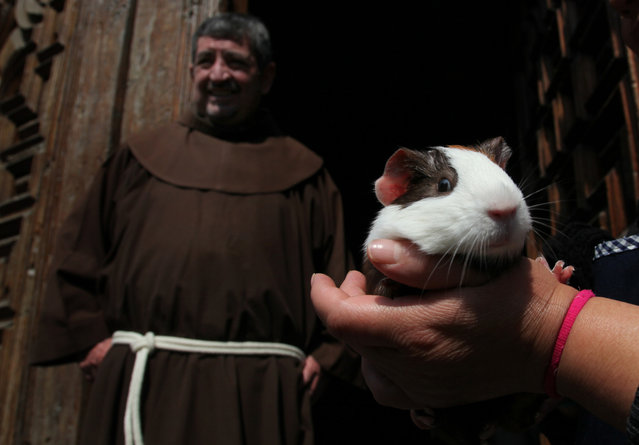
A pet owner holds his guinea pig named Riec as Father Francisco bestows a blessing on the pet rodent during a feast day Mass in honor of Saint Anthony, the patron saint of animals, at the Saint Fernando church, in Mexico City, Saturday, January 17, 2015. (Photo by Marco Ugarte/AP Photo)

A pet owner holds his guinea pig named Riec as Father Francisco bestows a blessing on the pet rodent during a feast day Mass in honor of Saint Anthony, the patron saint of animals, at the Saint Fernando church, in Mexico City, Saturday, January 17, 2015. Many people in Mexico bring their pets to churches to be blessed by the priest on this day. (Photo by Marco Ugarte/AP Photo)
Details
18 Jan 2015 13:32:00
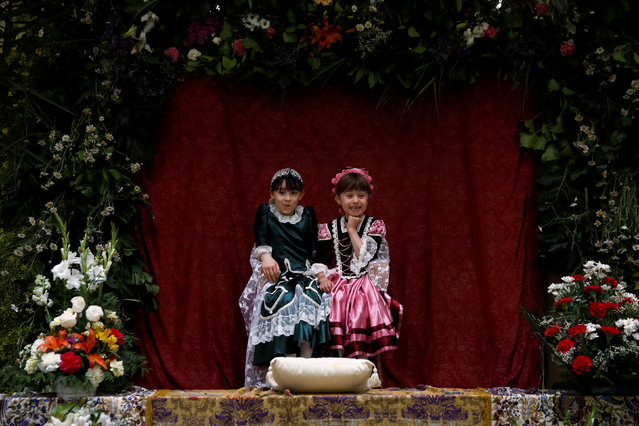
“Maya” girl Ines de la Paloma, 9, (L), sits with her friend Nuria Sanchez Caballero, 6, at an altar during “Las Mayas” festivity in Madrid, Spain, May 8, 2016. “Las Mayas” festival is held annually at the beginning of May to celebrate the awakening of nature in Spring. Young girls are chosen to become “Mayas” and sit at altars decorated with flowers so that people can admire them. The “Mayas” are dressed in traditional costumes, often displaying shawls and a wreath of flowers on their heads. (Photo by Susana Vera/Reuters)

“Maya” girl Ines de la Paloma, 9, (L), sits with her friend Nuria Sanchez Caballero, 6, at an altar during “Las Mayas” festivity in Madrid, Spain, May 8, 2016. “Las Mayas” festival is held annually at the beginning of May to celebrate the awakening of nature in Spring. Young girls are chosen to become “Mayas” and sit at altars decorated with flowers so that people can admire them. (Photo by Susana Vera/Reuters)
Details
11 May 2016 11:36:00
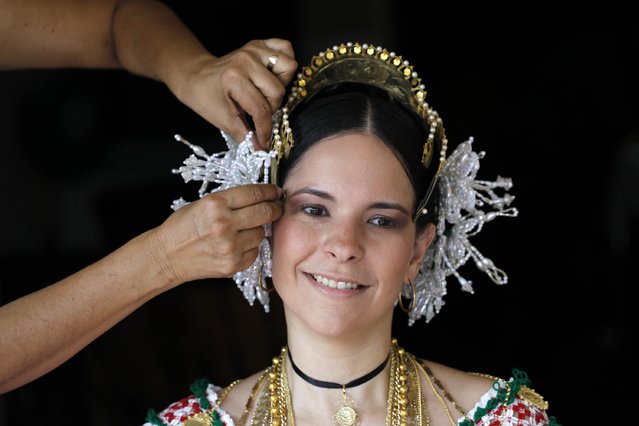
A woman is helped with adorning her hair with jewelry, part of the traditional clothing known as “Pollera”, before the annual Thousand Polleras parade in Las Tablas, in the province of Los Santos January 10, 2015. According to local residents, the Pollera dates back to the 18th century and was worn by the Spanish lower classes. (Photo by Carlos Jasso/Reuters)

A woman is helped with adorning her hair with jewelry, part of the traditional clothing known as “Pollera”, before the annual Thousand Polleras parade in Las Tablas, in the province of Los Santos January 10, 2015. According to local residents, the Pollera dates back to the 18th century and was worn by the Spanish lower classes. Today, it has become the Panamanian national costume. The dress is made entirely by hand and the jewellery worn is pure gold and worth thousands of dollars. (Photo by Carlos Jasso/Reuters)
Details
12 Jan 2015 15:46:00
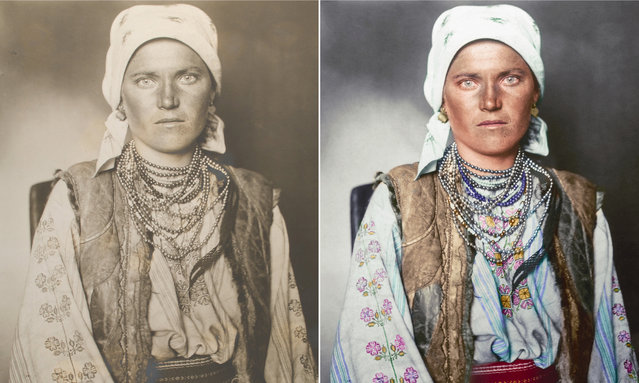
A Ruthenian woman circa 1906 from the region historically inhabiting the kingdom of the Rus, incorporating parts of modern-day Slavic speaking countries. Her outfit consists of a shirt and underskirt made from linen embroidered with traditional floral-based patterns. (Photo by Augustus Francis Sherman/New York Public Library/The Guardian)

Many of the 12 million people who entered the US through New York’s Ellis Island wore traditional dress from their homelands. Here: A Ruthenian woman circa 1906 from the region historically inhabiting the kingdom of the Rus, incorporating parts of modern-day Slavic speaking countries. Her outfit consists of a shirt and underskirt made from linen embroidered with traditional floral-based patterns. (Photo by Augustus Francis Sherman/New York Public Library/The Guardian)
Details
03 Oct 2016 09:15:00