Burlesque performer Tallulah Talons dances in the “Pandemic Burlesque” show presented by Tallulah Talons at Club Cumming on March 18, 2021 in New York City. Like many other New York City nightlife venues, the club was shuttered in March 2020 due to the Covid-19 pandemic, but it continued to host cabaret and comedy shows via live stream for most of the year. The venue reintroduced on-site outdoor events in late December 2020. (Photo by Angela Weiss/AFP Photo)
Actors and dancers perform during the press rehearsal for the “ARISE Grand Show” at the Friedrichstadt-Palast theater in Berlin, Germany, 15 September 2021. Premiere of the show is scheduled for 16 September and will amaze vistors with “extravagant costumes, breathtaking stage sets and artistic excellence” until February 2022 as the theater promises on its website. (Photo by Filip Singer/EPA/EFE)
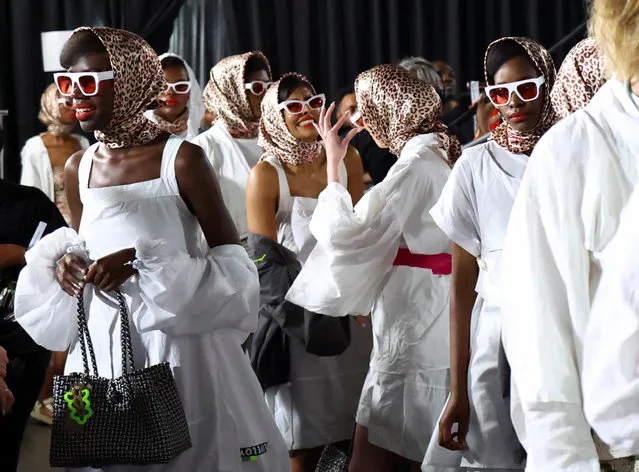
Models wait in backstage during the second day of the South African Fashion Week (SAFW), at the Mall of Africa in Johannesburg, South Africa on October 21, 2022. (Photo by Siphiwe Sibeko/Reuters)
Highland dancers perform on Thursday, August 4, 2022 on the Esplanade of Edinburgh Castle at this year's Royal Edinburgh Military Tattoo. After a two-year hiatus the Tattoo returns with the 2022 show titled “Voices” with over 800 performers and includes international performances from Mexico, The United States, Switzerland and New Zealand. (Photo by Jane Barlow/PA Images via Getty Images)
A demonstrator participates in a chant outside the Main Building on campus with hundreds of other students. Professors, students, and supporters of UT-Austin demonstrate on campus, Thursday, April 25, 2024, in Austin. (Photo by Ricardo B. Brazziell/Austin American-Statesman via AP Photo)
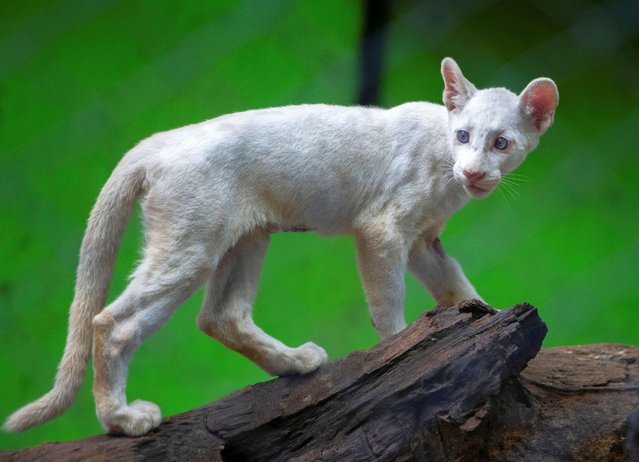
Itzae, a three-and-a-half-month-old albino puma cub, walks in its enclosure as it is being presented to the public for the first time, at the Thomas Belt Zoo, in Juigalpa, Nicaragua on November 10, 2023. (Photo by Maynor Valenzuela/Reuters)
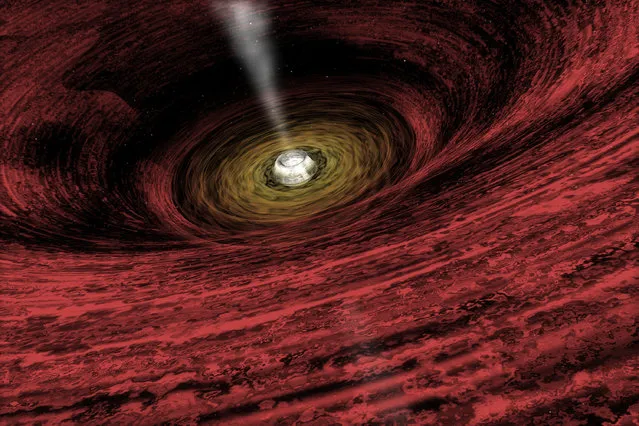
An artist's impression of a growing supermassive black hole located in the early Universe is seen in this NASA handout illustration released on June 15, 2011. Using the deepest X-ray image ever taken, astronomers found the first direct evidence that massive black holes were common in the early universe. This discovery from NASA's Chandra X-Ray Observatory shows that very young black holes grew more aggressively than previously thought, in tandem with the growth of their host galaxies. (Photo by Reuters/NASA/Chandra X-Ray Observatory/A.Hobart)