Loading...
Done
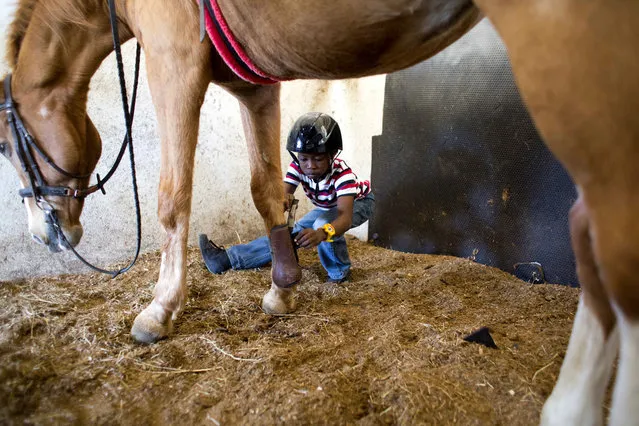
In this January 7, 2017 photo, Judeley Hans Debel squats down to remove a boot from Tic Tac, holding out his prosthetic leg after his therapeutic riding lesson at the Chateaublond Equestrian Center in Petion-Ville, Haiti. Anne-Rose Schoen, who founded the equestrian center, said perhaps the most important thing about therapeutic riding is it makes youngsters happy in a country where disabled people face enormous challenges. (Photo by Dieu Nalio Chery/AP Photo)

In this January 7, 2017 photo, Judeley Hans Debel squats down to remove a boot from Tic Tac, holding out his prosthetic leg after his therapeutic riding lesson at the Chateaublond Equestrian Center in Petion-Ville, Haiti. Anne-Rose Schoen, who founded the equestrian center, said perhaps the most important thing about therapeutic riding is it makes youngsters happy in a country where disabled people face enormous challenges. (Photo by Dieu Nalio Chery/AP Photo)
Details
13 Jan 2017 08:10:00
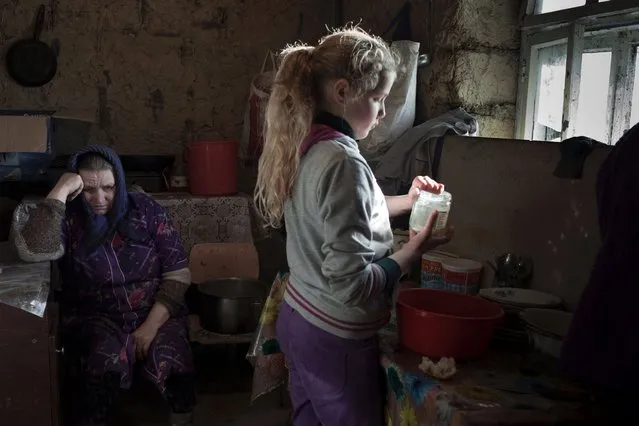
According to the U.S. government, Moldova, one of the poorest countries in Europe, depends on about $1.6 billion annually sent back from the roughly one million Moldovans who left for work in in Europe, Russia, and other former Soviet Bloc countries. Photographer Myriam Meloni went to Moldova to document what she refers to as “social orphans” – children whose parents have emigrated to another country in search of a job and a better future for their families. Here: Lulia is seen washing dishes in her grandmother's house, where she lives. (Photo by Myriam Meloni)

According to the U.S. government, Moldova, one of the poorest countries in Europe, depends on about $1.6 billion annually sent back from the roughly one million Moldovans who left for work in in Europe, Russia, and other former Soviet Bloc countries. Photographer Myriam Meloni went to Moldova to document what she refers to as “social orphans” – children whose parents have emigrated to another country in search of a job and a better future for their families. Here: Lulia is seen washing dishes in her grandmother's house, where she lives. (Photo by Myriam Meloni)
Details
12 Mar 2016 14:57:00
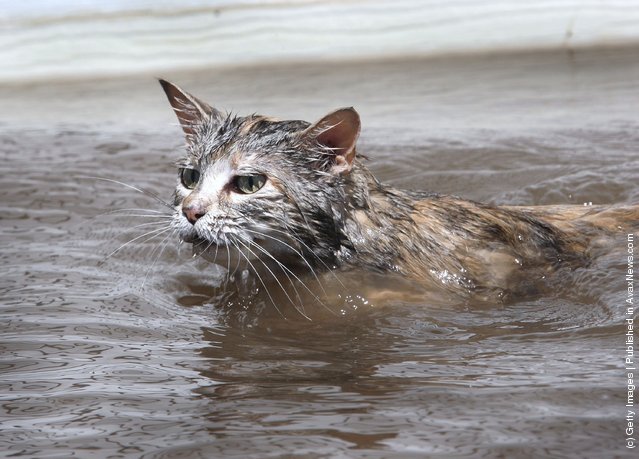
A stranded cat swims through flood water searching for dry land June 16, 2008 in Oakville, Iowa

A stranded cat swims through flood water searching for dry land June 16, 2008 in Oakville, Iowa. (Photo by Scott Olson/Getty Images)
Details
01 Aug 2011 13:50:00
“Woman with Umbrella in Rain” by Raimund von Stillfried. Artist: Kusakabe Kimbei (Japanese, 1841–1934), 1870s. (Photo courtesy of The Metropolitan Museum of Art)

“Woman with Umbrella in Rain” by Raimund von Stillfried. Artist: Kusakabe Kimbei (Japanese, 1841–1934), 1870s. Commercial photography studios in Meiji-era Japan were renowned for the subtlety and refinement of their coloring techniques. This hand-tinted image of a young woman caught in a heavy rainstorm achieved its naturalistic effect by knitting together multiple strands of artifice: the greenery in the foreground was a studio prop; the flaps of the kimono were suspended by thin wires to create the impression of a strong wind; and long, diagonal marks were made on the negative to suggest streaks of rain. (Photo courtesy of The Metropolitan Museum of Art)
Details
12 May 2013 10:13:00
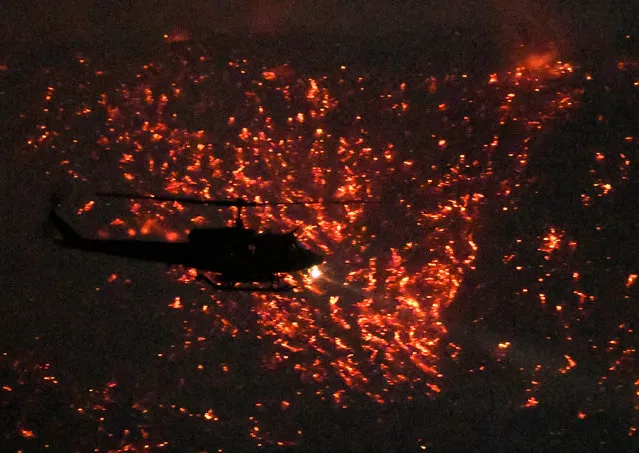
A helicopter is silhouetted by glowing embers as it makes a water drop at the “Old Fire”, which burned in Calabasas, California, U.S., June 4, 2016. (Photo by Gene Blevins/Reuters)

A helicopter is silhouetted by glowing embers as it makes a water drop at the “Old Fire”, which burned in Calabasas, California, U.S., June 4, 2016. (Photo by Gene Blevins/Reuters)
Details
07 Jun 2016 13:17:00
A woman picks marigold flowers used to make garlands and offer prayers, before selling them to the market for the Tihar festival, also called Diwali, in Kathmandu, Nepal October 17, 2017. (Photo by Navesh Chitrakar/Reuters)

A woman picks marigold flowers used to make garlands and offer prayers, before selling them to the market for the Tihar festival, also called Diwali, in Kathmandu, Nepal on October 17, 2017. (Photo by Navesh Chitrakar/Reuters)
Details
18 Oct 2017 09:07:00
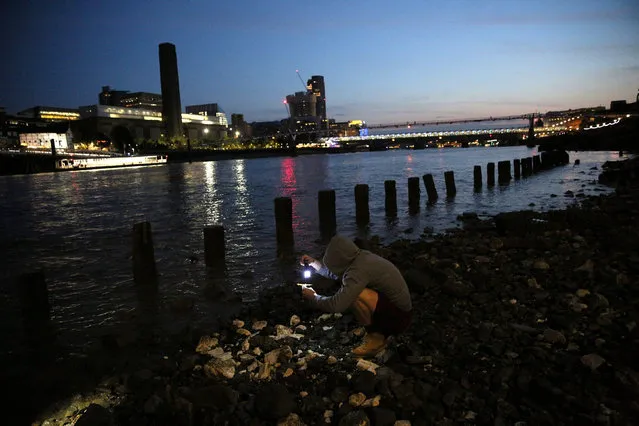
A mudlark uses a torch to look for items on the bank of the River Thames in London, Britain June 06, 2016. Mudlarking is believed to trace its origins to the 18th and 19th century, when scavengers searched the Thames' shores for items to sell. These days, history and archaeology fans are the ones hoping to find old relics such as coins, ceramics, artifacts or everyday items from across centuries. They wait for the low tide and then scour specific areas of exposed shores. "If you're in a field you could be out all day long, with the river you're restricted to about two or three hours," mudlark Nick Stevens said. While many just use the naked eye for their searches, others rely on metal detectors for which a permit from the Port of London Authority is needed. Digging also requires consent. (Photo by Neil Hall/Reuters)

A mudlark uses a torch to look for items on the bank of the River Thames in London, Britain June 06, 2016. Mudlarking is believed to trace its origins to the 18th and 19th century, when scavengers searched the Thames' shores for items to sell. These days, history and archaeology fans are the ones hoping to find old relics such as coins, ceramics, artifacts or everyday items from across centuries. their finds with the Portable Antiquities Scheme. Any item over 300 years old must be recorded. (Photo by Neil Hall/Reuters)
Details
27 Aug 2016 10:43:00
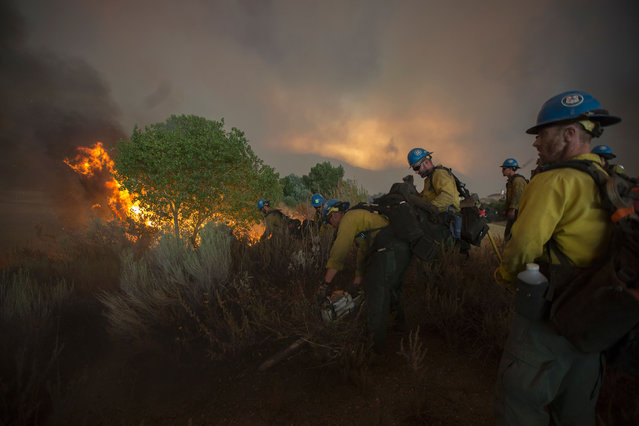
Firefighters of the Texas Canyon Hotshot crew fight the Sand Fire on July 23 2016 near Santa Clarita, California. Fueled by temperatures reaching about 108 degrees fahrenheit, the wildfire began yesterday has grown to 11,000 acres. (Photo by David McNew/AFP Photo)

Firefighters of the Texas Canyon Hotshot crew fight the Sand Fire on July 23 2016 near Santa Clarita, California. Fueled by temperatures reaching about 108 degrees fahrenheit, the wildfire began yesterday has grown to 11,000 acres. (Photo by David McNew/AFP Photo)
Details
25 Jul 2016 11:13:00