Loading...
Done
African Car Made From Woven Raffia Palm

This car from Nigeria is made from woven raffia palm cane and sports no nav system, no airbags
Details
14 Jan 2013 13:52:00
Iranian athlete Maryam Toosi practises on the rooftop of her apartment building following  the closure of sports facilities as part of measures aimed at containing the COVID-19 coronavirus, in Iran's capital Tehran on May 19, 2020. The coronavirus pandemic has forced the world's athletes to keep fit in confinement. The novel coronavirus has claimed the lives of nearly 7,200 people in Iran, making it the deadliest outbreak in the Middle East. The government ordered the closure of sports facilities in mid-March as part of measures aimed at containing the virus. (Photo by Atta Kenare/AFP Photo)

Iranian athlete Maryam Toosi practises on the rooftop of her apartment building following the closure of sports facilities as part of measures aimed at containing the COVID-19 coronavirus, in Iran's capital Tehran on May 19, 2020. The coronavirus pandemic has forced the world's athletes to keep fit in confinement. The novel coronavirus has claimed the lives of nearly 7,200 people in Iran, making it the deadliest outbreak in the Middle East. The government ordered the closure of sports facilities in mid-March as part of measures aimed at containing the virus. (Photo by Atta Kenare/AFP Photo)
Details
29 Jul 2020 00:01:00
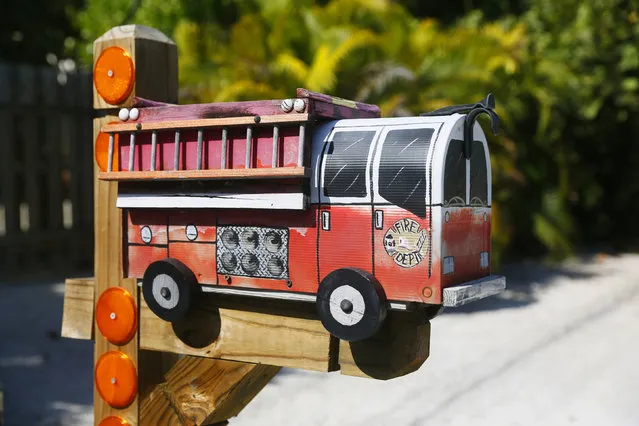
A mailbox in the shape of a fire truck is seen along the highway US-1 in the Lower Keys near Marathon in Florida, July 11, 2014. (Photo by Wolfgang Rattay/Reuters)

The Florida Keys are famous for their diving, but they are less well known for another quirky attraction: the mailboxes residents use to decorate their driveways. From a fiberglass manatee in lipstick to a small white church, Reuters photographer Wolfgang Rattay documented this unusual aspect of local culture as he drove along the Ocean Highway that connects the islands. Photo: A mailbox in the shape of a fire truck is seen along the highway US-1 in the Lower Keys near Marathon in Florida, July 11, 2014. (Photo by Wolfgang Rattay/Reuters)
Details
03 Aug 2014 07:25:00
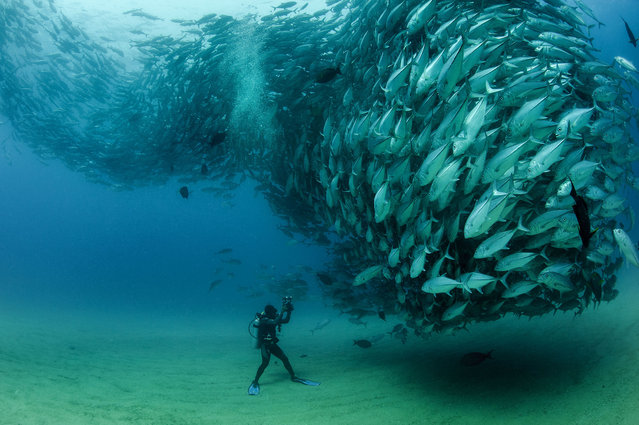
The school of fish gather in front of diver David Castro with his camera

Californian photographer and conservationist Octavio Aburto had spent years photographing the school in Cabo Pulmo National Park, Mexico – and had been trying to capture this exact shot for three years. “Together with my friend David Castro, we were diving with a large group of Bigeye travellies at Cabo Pulmo National Park, Mexico. Thousands of fish forming a ball during the reproduction courtship. In the afternoon, these fish congregate to form a large spawning aggregation around the reefs of the National Park”. (Photo and caption by Octavio Aburto)
Details
10 Feb 2014 08:34:00


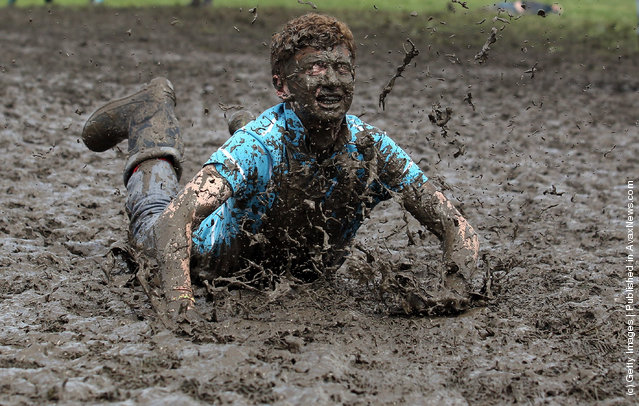
Tom Wilder, 17 from Kent, dives in the mud at the Glastonbury Festival site at Worthy Farm, Pilton on June 23, 2011 in Glastonbury, England. Music fans had to brave more rain today at the five-day festival which opened yesterday. This year the festival will feature headline acts U2, Coldplay and Beyonce. The festival, which started in 1970 when several hundred hippies paid 1 GBP to watch Marc Bolan, has grown into Europe's largest music festival attracting more than 175,000 people over five days. (Photo by Matt Cardy/Getty Images)

Details
24 Jun 2011 10:01:00
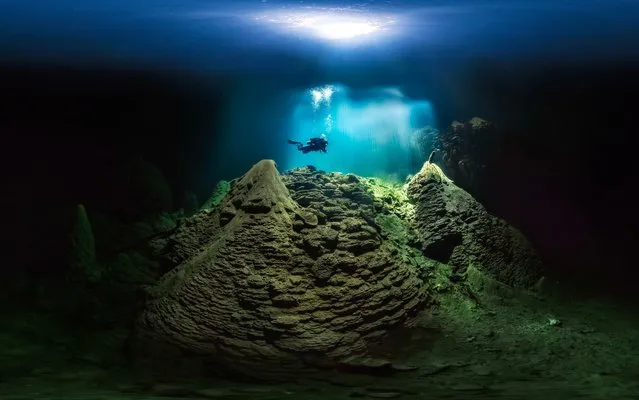
Cave Diver, Anhumas Abyss, Bonito, Brazil: The Anhumas Abyss is an underground cavern with a crystal-clear lake below, more than 260 feet (79 m) deep. A visitor must enter through a narrow opening at the top of the chamber and rappel into the cave. Snorkeling and scuba diving in the lake reveal amazing scenery. Distinctive, conical limestone stalagmites and stalactites occupy the lake and the surrounding area, some reaching 65 feet (20 m) high. “One must rappel about 235 feet (72 m) to get down into this deep lake. The photo was taken at a depth of 50 feet (15 m). It was a challenge to create the image because of the high contrast, plus the diver could not see into the darkness, making communication impossible”. (Photo by Marcio Cabral/Nature’s Best Photography Awards 2017)

Cave Diver, Anhumas Abyss, Bonito, Brazil: The Anhumas Abyss is an underground cavern with a crystal-clear lake below, more than 260 feet (79 m) deep. A visitor must enter through a narrow opening at the top of the chamber and rappel into the cave. Snorkeling and scuba diving in the lake reveal amazing scenery. Distinctive, conical limestone stalagmites and stalactites occupy the lake and the surrounding area, some reaching 65 feet (20 m) high. (Photo by Marcio Cabral/Nature’s Best Photography Awards 2017)
Details
26 Oct 2017 08:10:00
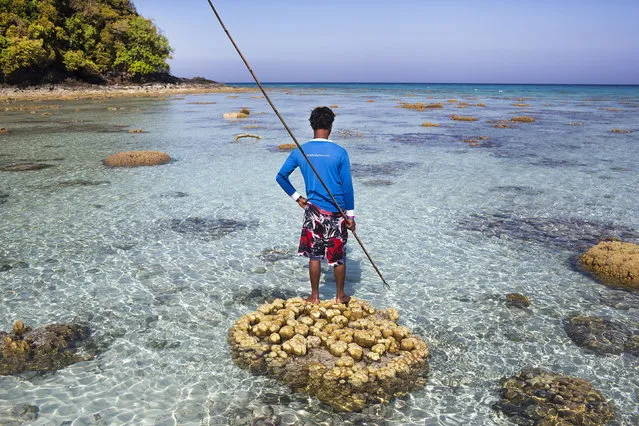
Hook, an indigenous Moken man, holds a three-pronged throwing spear and searches for fish in the waters of Ko Surin National Park. March 1, 2013 – Ko Surin, Thailand. (Photo by Taylor Weidman/zReportage via ZUMA Press)

“For centuries, the Moken sea nomads have traveled the islands between Thailand and Myanmar fishing and foraging for food on the sea floor. Throughout the Mergui Archipelago, Moken migrate in flotillas of Kabangs (traditional boat of the Moken people), stopping at different islands and beaches. Expert freedivers, the Moken have adapted physically to an aquatic life, developing unique characteristics that let them see better and hold their breath longer while underwater”. – Taylor Weidman. Photo: Hook, an indigenous Moken man, holds a three-pronged throwing spear and searches for fish in the waters of Ko Surin National Park. March 1, 2013 – Ko Surin, Thailand. (Photo by Taylor Weidman/zReportage via ZUMA Press)
Details
24 Mar 2014 06:45:00
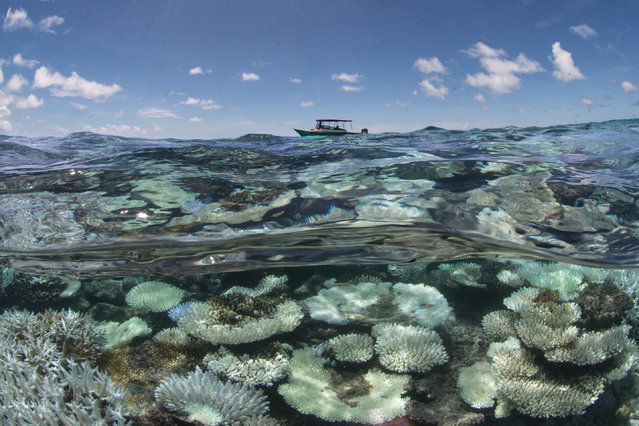
In this May 2016 photo released by The Ocean Agency/XL Catlin Seaview Survey, a boat sails near a coral reef that has been bleached white by heat stress in the Maldives. (Photo by The Ocean Agency/XL Catlin Seaview Survey via AP Photo)

In this May 2016 photo released by The Ocean Agency/XL Catlin Seaview Survey, a boat sails near a coral reef that has been bleached white by heat stress in the Maldives. oral reefs, unique underwater ecosystems that sustain a quarter of the world's marine species and half a billion people, are dying on an unprecedented scale. Scientists are racing to prevent a complete wipeout within decades. (Photo by The Ocean Agency/XL Catlin Seaview Survey via AP Photo)
Details
14 Mar 2017 00:05:00