Loading...
Done
Male members of the Zeleziar folk dance group whip and water the local girls dressed in traditional clothing, during Easter in Bociar, Slovakia on April 1, 2024. Boys and younger men visit the houses of young girls, whip them with fresh-cut decorated wickers and sprinkle water on them. By tradition, the whipping should give the girls strength, health, and abundance throughout the whole year. (Photo by Robert Nemeti/Anadolu via Getty Images)

Male members of the Zeleziar folk dance group whip and water the local girls dressed in traditional clothing, during Easter in Bociar, Slovakia on April 1, 2024. Boys and younger men visit the houses of young girls, whip them with fresh-cut decorated wickers and sprinkle water on them. By tradition, the whipping should give the girls strength, health, and abundance throughout the whole year. (Photo by Robert Nemeti/Anadolu via Getty Images)
Details
18 Aug 2025 03:18:00
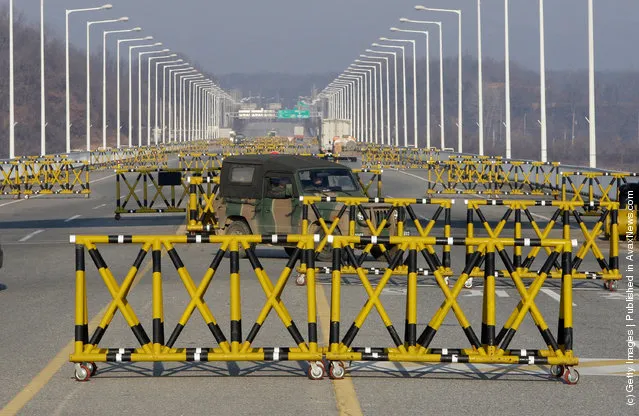
South Korean soldiers walk along barricades at the military check point, near the Demilitarized zone (DMZ) separating South and North Korea

A South Korean military vehicle drives past barricades at the military check point, near the Demilitarized zone (DMZ) separating South and North Korea on December 20, 2011 in Paju, South Korea. (Photo by Chung Sung-Jun/Getty Images)
Details
20 Dec 2011 13:29:00
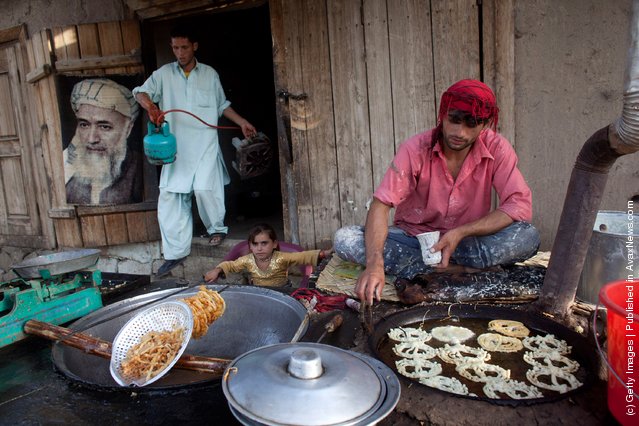
Afghans Prepare For Eid ul-Fitr

“Eid ul-Fitr, Eid al-Fitr, Id-ul-Fitr, or Id al-Fitr, often abbreviated to Eid, is a Muslim holiday that marks the end of Ramadan, the Islamic holy month of fasting (sawm). Eid is an Arabic word meaning “festivity”, while Fiṭr means “breaking (the fast)”. The holiday celebrates the conclusion of the twenty nine or thirty days of dawn-to-sunset fasting during the entire month of Ramadan. The first day of Eid, therefore, falls on the first day of the month Shawwal”. – Wikipedia
Details
30 Aug 2011 12:05:00
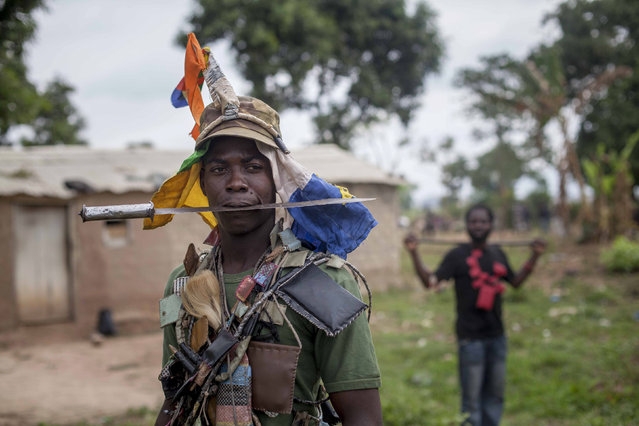
Anti-balaka fighters from the town of Bossembele patrol in the Boeing district of Bangui, Central African Republic, February 24, 2014. (Photo by Camille Lepage/Reuters)

“Camille Lepage, a 26-year-old French photojournalist who had spent months documenting deadly conflict in Central African Republic has been killed, the French presidency said Tuesday, May 13. Lepage, a freelance photographer whose work was published in major French and American newspapers, died in western Central African Republic not far from the border with Cameroon, authorities said”. – Associated Press. Photo: Anti-balaka fighters from the town of Bossembele patrol in the Boeing district of Bangui, Central African Republic, February 24, 2014. (Photo by Camille Lepage/Reuters)
Details
18 May 2014 08:54:00
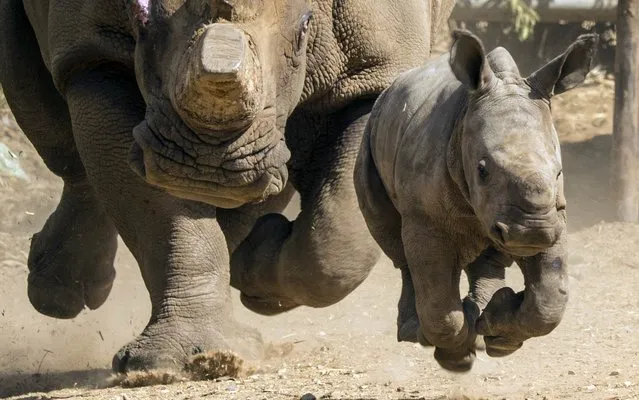
A newly born female White Rhino runs alongside her mother  in Ramat Gan Safari Park near Tel Aviv, Israel, on September 3, 2014. (Photo by Ariel Schalit/AP Photo)

A newly born female White Rhino runs alongside her mother in Ramat Gan Safari Park near Tel Aviv, Israel, on September 3, 2014. She was born three weeks ago, after more than twenty years without a female White Rhino birth in the Safari, Sagit Horowitz, the safari spokeswoman said. (Photo by Ariel Schalit/AP Photo)
Details
06 Sep 2014 12:35:00
A chevrotain or mouse deer feeds in its enclosure at Zurich Zoo, Zurich, Switzerland, October 17, 2012. (Photo by Patrick B. Kraemer/AP)

A chevrotain or mouse deer feeds in its enclosure at Zurich Zoo, Zurich, Switzerland, October 17, 2012. (Photo by Patrick B. Kraemer/AP)
Details
27 Oct 2012 12:21:00
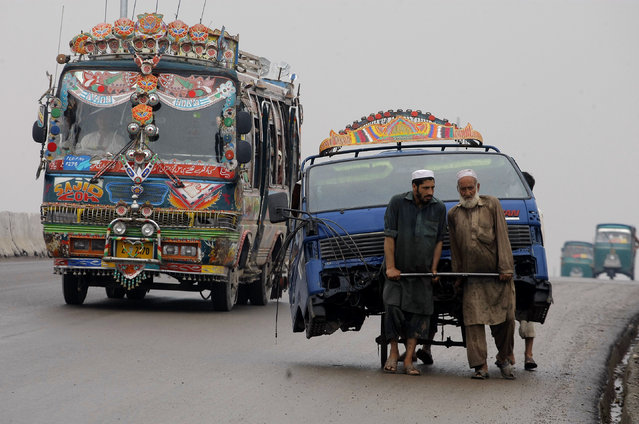
Pakistani laborers transport the front portion of a vehicle using a handcart at a road in Peshawar, Pakistan, Monday, August 3, 2015. (Photo by Mohammad Sajjad/AP Photo)

Pakistani laborers transport the front portion of a vehicle using a handcart at a road in Peshawar, Pakistan, Monday, August 3, 2015. (Photo by Mohammad Sajjad/AP Photo)
Details
04 Aug 2015 12:09:00
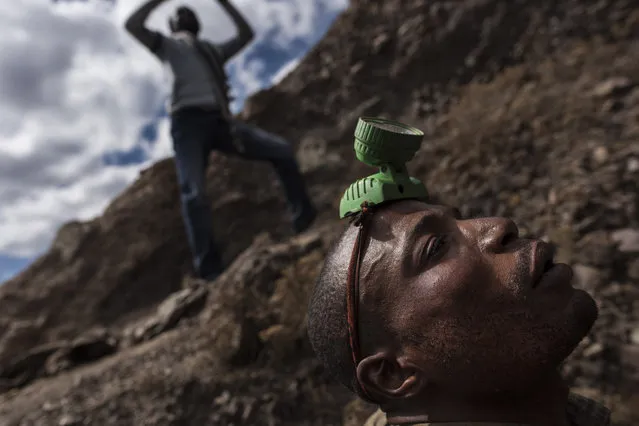
A “creuseur”, or digger, a plastic lantern on his head, readies to enter a copper and cobalt mine in Kawama, Democratic Republic of Congo on June 8, 2016. Cobalt is used in the batteries for electric cars and mobile phones. Working conditions are dangerous, often with no safety equipment or structural support for the tunnels. The diggers say they are paid on average US$2-3/day. (Photo by Michael Robinson Chavez/The Washington Post)

A “creuseur”, or digger, a plastic lantern on his head, readies to enter a copper and cobalt mine in Kawama, Democratic Republic of Congo on June 8, 2016. Cobalt is used in the batteries for electric cars and mobile phones. Working conditions are dangerous, often with no safety equipment or structural support for the tunnels. The diggers say they are paid on average US$2-3/day. (Photo by Michael Robinson Chavez/The Washington Post)
Details
30 Dec 2016 10:29:00