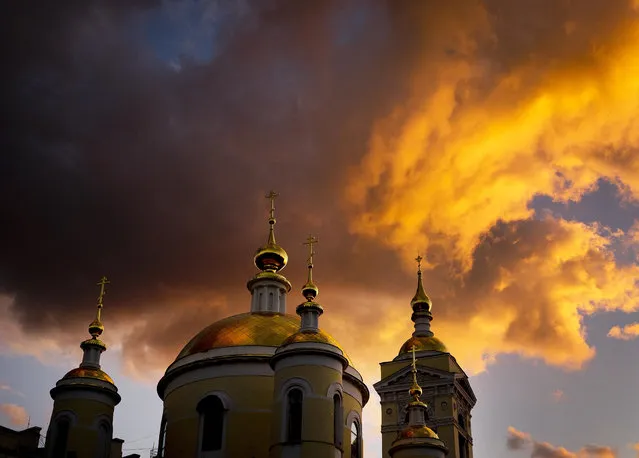
In this Tuesday, June 19, 2018 filer, clouds are illuminated by the sun setting sun over a church during the 2018 soccer World Cup in Podolsk near Moscow, Russia. (Photo by Michael Probst/AP Photo)
Hundreds of flamingos take flight in the Rift Valley in East Africa early September 2024. The birds gather in the region’s saline lakes to eat the blue-green algae that grows in abundance. The red-orange pigment in the algae is what gives them their distinctive pink plumage. They also use the site to breed. (Photo by Alexandre and Chloe Bes/Naturagency/Solent News)
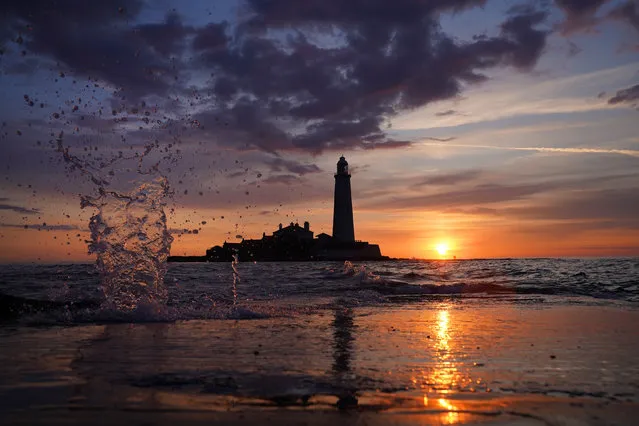
The sunrises at 04.25am at St Mary's Lighthouse in Whitley Bay, on the North East coast of England on Tuesday, June 20, 2023, the day before Summer Solstice – the longest day of the year. (Photo by Owen Humphreys/PA Images via Getty Images)
At the 50th anniversary of the Hartford Automobile Club a 1914 Mercer with an economical wind screen, looking like a large magnifying glass, designed to offer minimum wind resistance. Brass is used instead of chrome for the “shiny” parts, circa 1955. (Photo by Three Lions)
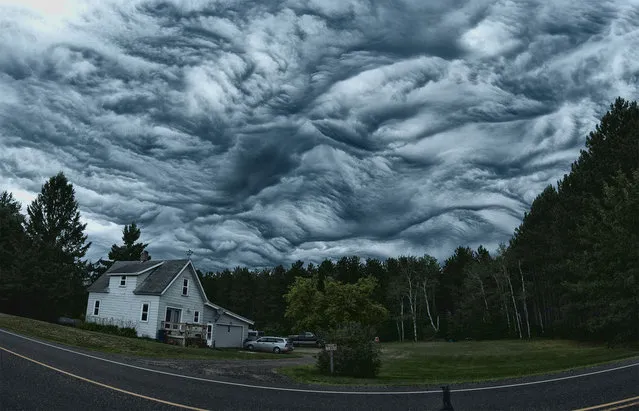
Undulatus asperatus (or alternately, asperatus) is a cloud formation, proposed in 2009 as a separate cloud classification by the founder of the Cloud Appreciation Society. If successful it will be the first cloud formation added since cirrus intortus in 1951 to the International Cloud Atlas of the World Meteorological Organization. The name translates approximately as “roughened or agitated waves”.