Loading...
Done
Japan's computer giant Fujitsu employee displays the world's first personal computer with Intel's RealSense 3D camera “FMV Esprimo” in Tokyo on October 9, 2014. The new desktop PC with 23-inch LCD display can make avatars which mimic the user's look and motion for chatting on the Internet. (Photo by Yoshikazu Tsuno/AFP Photo)

Japan's computer giant Fujitsu employee displays the world's first personal computer with Intel's RealSense 3D camera “FMV Esprimo” in Tokyo on October 9, 2014. The new desktop PC with 23-inch LCD display can make avatars which mimic the user's look and motion for chatting on the Internet. (Photo by Yoshikazu Tsuno/AFP Photo)
Details
11 Oct 2014 13:12:00
A woman looks towards part of an artwork called “Lichen! Libido! (London!) Chastity!” by Anthea Hamilton, one of the four artists shortlisted for the Turner Prize 2016, as it is displayed at the Tate Britain gallery in London, Monday, September 26, 2016. The Turner Prize aims to promote public debate around new developments in contemporary British art. (Photo by Kirsty Wigglesworth/AP Photo)

A woman looks towards part of an artwork called “Lichen! Libido! (London!) Chastity!” by Anthea Hamilton, one of the four artists shortlisted for the Turner Prize 2016, as it is displayed at the Tate Britain gallery in London, Monday, September 26, 2016. The Turner Prize aims to promote public debate around new developments in contemporary British art. (Photo by Kirsty Wigglesworth/AP Photo)
Details
27 Sep 2016 09:51:00


“Kopi luwak (Malay pronunciation), or civet coffee, is one of the world's most expensive and low-production coffee. It is made from the beans of coffee berries which have been eaten by the Asian Palm Civet (Paradoxurus hermaphroditus) and other related civets, then passed through its digestive tract. ...
Details
19 Mar 2011 18:41:00
Danila Shmelev, an artist from Moscow, Russia, works on a 3-D picture in Dubai, United Arab Emirates, Monday, February 27, 2017. Artists who focus on 3-D pictures have gathered in Dubai for the Dubai Canvas 3-D Art Festival, which runs from March 1 through March 7. (Photo by Jon Gambrell/AP Photo)

Danila Shmelev, an artist from Moscow, Russia, works on a 3-D picture in Dubai, United Arab Emirates, Monday, February 27, 2017. Artists who focus on 3-D pictures have gathered in Dubai for the Dubai Canvas 3-D Art Festival, which runs from March 1 through March 7. (Photo by Jon Gambrell/AP Photo)
Details
28 Feb 2017 11:18:00
Ornamental chicken breeding clubs have emerged in Indonesia, Thailand, North America and even European countries such as the UK and France. Malaysia is however the epicenter of this cultural phenomenon. (Photo by Ernest Goh/2013 Sony World Photography Awards)

Ornamental chicken breeding clubs have emerged in Indonesia, Thailand, North America and even European countries such as the UK and France. Malaysia is however the epicenter of this cultural phenomenon. These chickens are prized for their build, size, behavior and showmanship by their owners and competitions or beauty contests as they are often described are held almost every week in at least one village in Malaysia. Judges sit around a square table inspecting each chicken for a few minutes trying to determine a champion specimen in its own weight class based on its stance, temperament and physical assets like wings, tails and comb. The walk or strut by an ornamental chicken in a beauty contest, much like a runway model, constitutes a large part of the scoring system. (Photo by Ernest Goh/2013 Sony World Photography Awards)
Details
28 Apr 2013 08:32:00
“Yunarmiya” (Young Army) All-Russia National Military Patriotic Social Movement Association members compete during the 7th military-patriotic game “Yunarmiya, forward!” dedicated to Victory Day at the Museum-reserve “Gorki Leninskie” in Gorki Leninskie, Russia, 29 April 2025. A total of 160 teams of Yunarmiya and military-patriotic detachments attended the games, each team consisting of seven people aged between 12 and 17 years old. The games are a continuation of the Soviet military-sports competitions for children and teenagers, “Zarnitsa” (since 1967) and “Orlyonok (Eaglet)” (since 1972). (Photo by Sergei Ilnitsky/EPA/EFE)

“Yunarmiya” (Young Army) All-Russia National Military Patriotic Social Movement Association members compete during the 7th military-patriotic game “Yunarmiya, forward!” dedicated to Victory Day at the Museum-reserve “Gorki Leninskie” in Gorki Leninskie, Russia, 29 April 2025. A total of 160 teams of Yunarmiya and military-patriotic detachments attended the games, each team consisting of seven people aged between 12 and 17 years old. The games are a continuation of the Soviet military-sports competitions for children and teenagers, “Zarnitsa” (since 1967) and “Orlyonok (Eaglet)” (since 1972). (Photo by Sergei Ilnitsky/EPA/EFE)
Details
04 Jun 2025 02:14:00
Principle Ballet Dancer, Ekaterina Bulgutova, of the Russian State Ballet, with the Nutcracker part of Christmas Ballet Season in Cardiff which starts at St Davids Hall on December 20, 2016 in Cardiff, England. (Photo by Kiran Ridley/Barcroft Images)

Principle Ballet Dancer, Ekaterina Bulgutova, of the Russian State Ballet, with the Nutcracker part of Christmas Ballet Season in Cardiff which starts at St Davids Hall on December 20, 2016 in Cardiff, England. (Photo by Kiran Ridley/Barcroft Images)
Details
21 Dec 2016 10:25:00
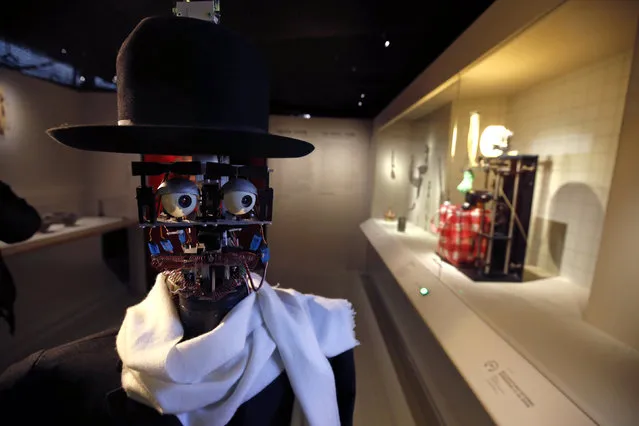
The Berenson robot strolls among visitors during the exhibition “Persona : Oddly Human” at the Quai Branly museum in Paris, France, February 23, 2016. The Berenson robot, developed in France in 2011, is the brainchild of anthropologist Denis Vidal and robotics engineer Philippe Gaussier. Its programming allows it to record reactions of museum visitors to certain pieces of art and then use the data to develop its own unique taste, which allows “Berenson” to judge whether or not it likes a certain work of art within an exhibition. (Photo by Philippe Wojazer/Reuters)

The Berenson robot strolls among visitors during the exhibition “Persona : Oddly Human” at the Quai Branly museum in Paris, France, February 23, 2016. The Berenson robot, developed in France in 2011, is the brainchild of anthropologist Denis Vidal and robotics engineer Philippe Gaussier. Its programming allows it to record reactions of museum visitors to certain pieces of art and then use the data to develop its own unique taste, which allows “Berenson” to judge whether or not it likes a certain work of art within an exhibition. (Photo by Philippe Wojazer/Reuters)
Details
25 Feb 2016 12:26:00