Loading...
Done
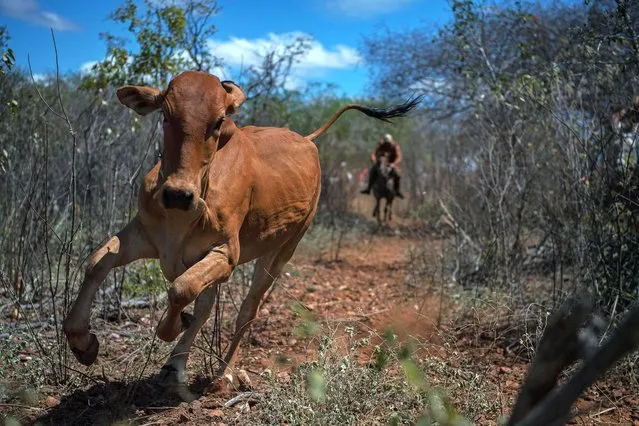
A young bull flees from a Brazilian vaqueiro, or cowboy, competing in the “Pega de Boi” (Ox Catch) tournament in Cabrobo, Pernambuco State, Brazil, on September 4, 2022. The riders compete in pairs to retrieve a cord from a bull which has been released and runs away from them and they are timed on how quickly they can return with the cord. The leather clothing provides them with protection from the dense savannah vegetation which contains a lot of large thorns. Riders have been known to die competing in the tournament (Photo by Carl de Souza/AFP Photo)

A young bull flees from a Brazilian vaqueiro, or cowboy, competing in the “Pega de Boi” (Ox Catch) tournament in Cabrobo, Pernambuco State, Brazil, on September 4, 2022. The riders compete in pairs to retrieve a cord from a bull which has been released and runs away from them and they are timed on how quickly they can return with the cord. The leather clothing provides them with protection from the dense savannah vegetation which contains a lot of large thorns. Riders have been known to die competing in the tournament (Photo by Carl de Souza/AFP Photo)
Details
25 Sep 2022 04:38:00
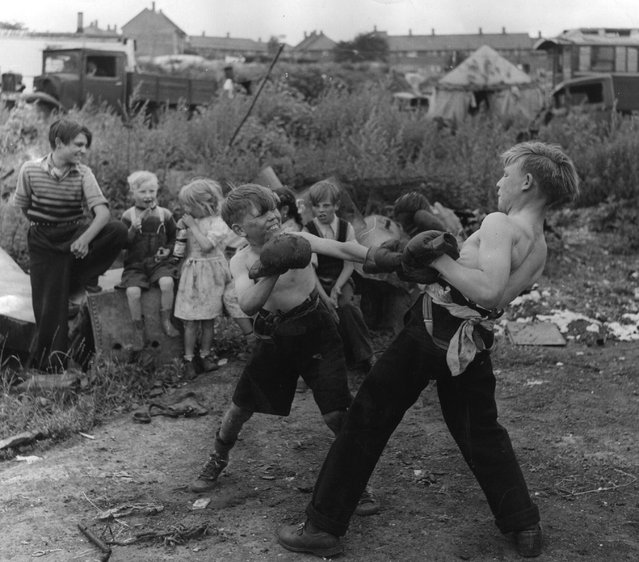
The unromantic gypsies. Children boxing in a gypsy camp in Kent, England on July 1, 1951. Like all boys these gypsy lads like to try their hand at boxing. Encouraged by their friends they fight it out on Corke's Meadow. Few Romanies now live a life of wandering romance. Most are like the three hundred squatters of Corke's Meadow, Kent, which is part of a “gypsy problem” that involves about 100,000 today. Of those about 25,000 can be rightly called gypsies, the rest are Mumpers and Posh-rats and Hobos. Corke's Meadow has both kinds. “Picture Post” cameraman Bert Hardy photographs the Corke's Meadow gypsies in their encampment. (Photo by Hulton-Deutsch Collection/Corbis via Getty Images)

The unromantic gypsies. Children boxing in a gypsy camp in Kent, England on July 1, 1951. Like all boys these gypsy lads like to try their hand at boxing. Encouraged by their friends they fight it out on Corke's Meadow. Few Romanies now live a life of wandering romance. Most are like the three hundred squatters of Corke's Meadow, Kent, which is part of a “gypsy problem” that involves about 100,000 today. Of those about 25,000 can be rightly called gypsies, the rest are Mumpers and Posh-rats and Hobos. Corke's Meadow has both kinds. “Picture Post” cameraman Bert Hardy photographs the Corke's Meadow gypsies in their encampment. (Photo by Hulton-Deutsch Collection/Corbis via Getty Images)
Details
12 Mar 2017 00:01:00
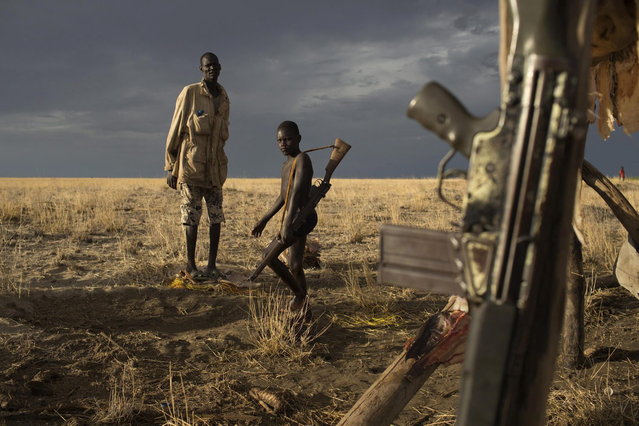
A Turkana man and a boy carrying a gun look on as a G3 battle rifle hangs from a structure used to dry fish at a fishing camp on the shores of Lake Turkana, some kilometres from Todonyang near the Kenya-Ethiopia border in northwestern Kenya October 12, 2013. (Photo by Siegfried Modola/Reuters)

A Turkana man and a boy carrying a gun look on as a G3 battle rifle hangs from a structure used to dry fish at a fishing camp on the shores of Lake Turkana, some kilometres from Todonyang near the Kenya-Ethiopia border in northwestern Kenya October 12, 2013The Turkana are traditionally nomadic pastoralists, but they have seen the pasture that they need to feed their herds suffer from recurring droughts and many have turned to fishing. However, Lake Turkana is overfished, and scarcity of food and pastureland is fuelling long-standing conflict with Ethiopian indigenous Dhaasanac, who have seen grazing grounds squeezed by large-scale government agricultural schemes in southern Ethiopia. The Dhaasanac now venture ever deeper into Kenyan territory in search of fish and grass, clashing with neighbours. Fighting between the communities has a long history, but the conflict has become ever more fatal as automatic weapons from other regional conflicts seep into the area. While the Turkana region is short of basics like grass and ground-water, it contains other resources including oil reserves and massive, newly discovered underground aquifers. (Photo by Siegfried Modola/Reuters)
Details
05 Dec 2013 12:08:00
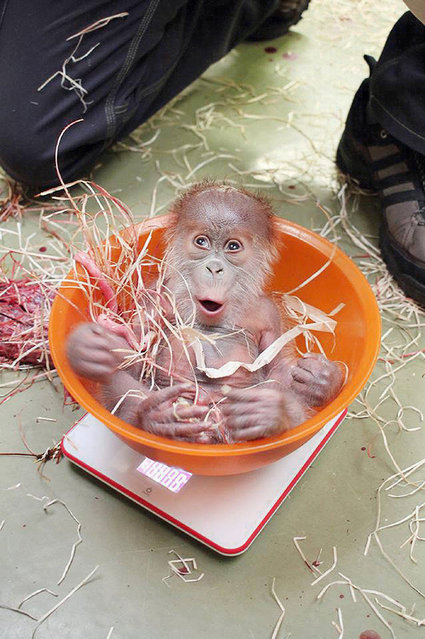
This female orangutan was born at the zoo in the German capital of Berlin.  German online users have fallen in love with Berlin Zoo's most recent addition – this newborn orangutan. (Photo by Europics/Zoo Berlin)

This female orangutan was born at the zoo in the German capital of Berlin. German online users have fallen in love with Berlin Zoo's most recent addition – this newborn orangutan. The female orangutan was born in the early hours of 12th January at the zoo in the German capital of Berlin and weighed a tiny 1.8 kilograms, normally regarded as small for an orangutan baby but nevertheless the infant is healthy and strong. (Photo by Europics/Zoo Berlin)
Details
23 Jan 2015 13:39:00
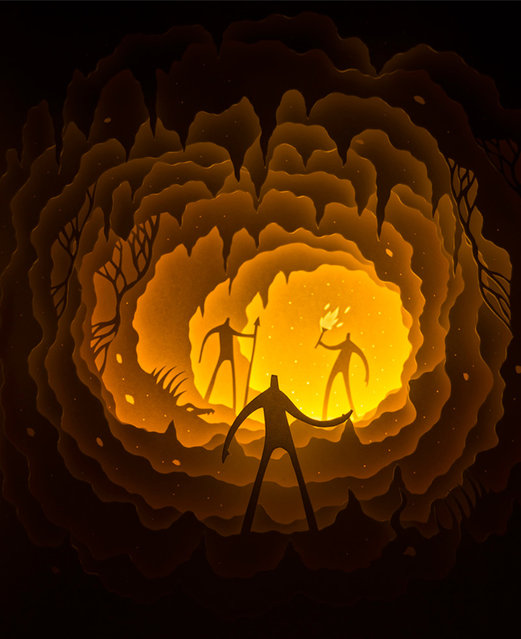
Illuminated Cut Paper Light Boxes By Hari And Deepti

Illuminated Cut Paper Light Boxes by Hari & DeeptiDeepti Nair and Harikrishnan Panicker (known collectively as Hari & Deepti) are an artist couple who create paper cut light boxes. Each diorama is made from layers of cut watercolor paper placed inside a shadow box and is lit from behind with flexible LED light strips. The small visual narratives depicted in each work often play off aspects of light including stars, flames, fireflies, and planets.
Details
17 Jun 2014 12:07:00
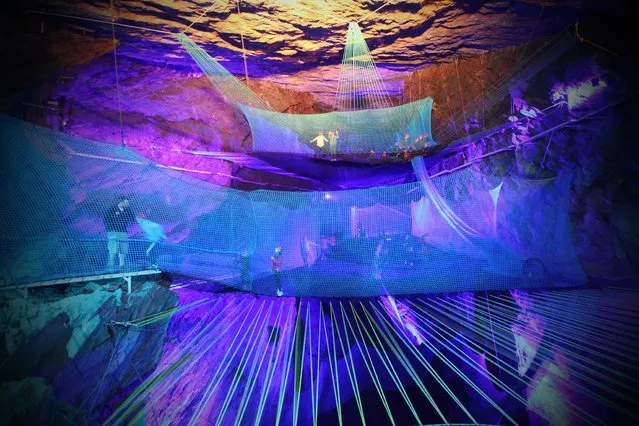
Bounce Below The World’s First Subterranean Playground

If you’re afraid of heights, caves, the dark, suffer from claustrophobia or vertigo, this might not be for you, but if not, a small Welsh town has the perfect subterranean adventure for you: the world’s largest underground trampoline. Just unveiled in Blaenau Ffestiniog, North Wales, Bounce Below is a network of trampolines and slides mounted to the walls of an abandoned slate mine at heights of 20 feet to 180 feet off the ground. Visitors are welcome to climb, bounce, slide, and jump in the netting amidst a technicolor light show.
Details
15 Jul 2014 11:19:00
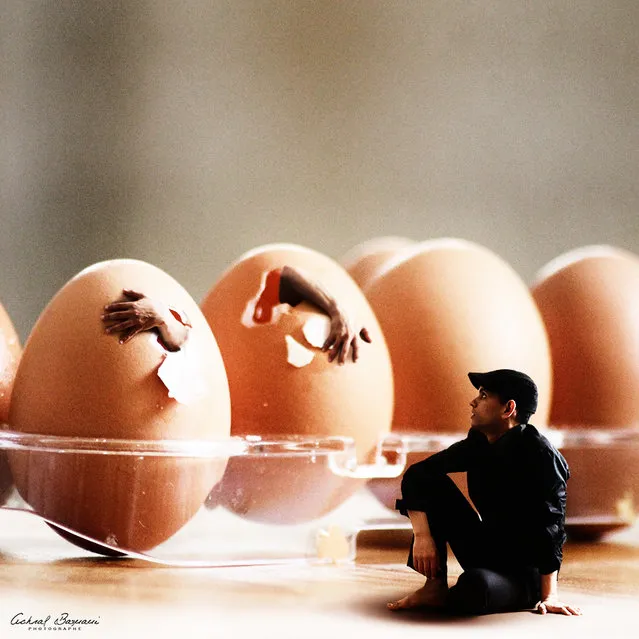
Inside My Dreams By Achraf Baznani

Moroccan photographer and filmmaker Achraf Baznani carries on the traditions of Surrealism with his wild, imaginative, and wholly impractical imagery. Among his inventive scenarios, small human figures—often the artist himself—appear trapped within glass jars or the size of a camera lens; in other works, Baznani more or less dissects his body, as for example, in one, he cleanly removes his brain from his cranium, or in another, twists off his hand, much as if it were a light bulb. Imparted throughout such works are strong senses of humor and wonder, and as such, Baznani’s art offers a Surrealistic take on life experience in the digital age.
Details
03 Aug 2014 12:04:00
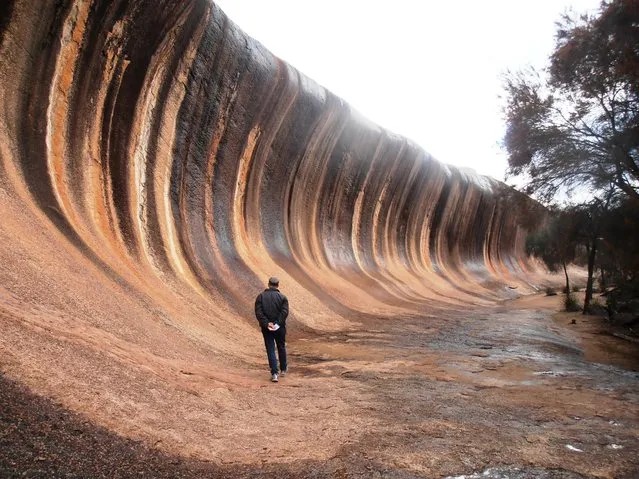
Wave Rock, Arizona

Wave Rock is a natural rock formation that is shaped like a tall breaking ocean wave. The "wave" is about 14 m (46 ft) high and around 110 m (360 ft) long. It forms the north side of a solitary hill, which is known as “Hyden Rock”. This hill, which is a granite inselberg, lies about 3 km (2 mi) east of the small town of Hyden and 296 km (184 mi) east-southeast of Perth, Western Australia. Wave Rock and Hyden Rock are part of a 160 ha (395-acre) nature reserve, Hyden Wildlife Park.
Details
12 Aug 2014 10:21:00