Loading...
Done
Women are covered in dust after making it out of a building that collapsed after an earthquake in the Roma neighborhood of Mexico City, Tuesday, September 19, 2017. (Photo by Rebecca Blackwell/AP Photo)

Women are covered in dust after making it out of a building that collapsed after an earthquake in the Roma neighborhood of Mexico City, Tuesday, September 19, 2017. A powerful earthquake shook Mexico City on Tuesday, causing panic among the megalopolis' 20 million inhabitants on the 32nd anniversary of a devastating 1985 quake. The US Geological Survey put the quake's magnitude at 7.1 while Mexico's Seismological Institute said it measured 6.8 on its scale. The institute said the quake's epicenter was seven kilometers west of Chiautla de Tapia, in the neighboring state of Puebla. (Photo by Rebecca Blackwell/AP Photo)
Details
20 Sep 2017 08:06:00
British artist Lucy Sparrow, 32, adjusts bottles of alcohol on shelves in her art installation supermarket in which everything is made of felt, in Los Angeles, California on July 31, 2018. (Photo by Lucy Nicholson/Reuters)

British artist Lucy Sparrow makes her West Coast debut this week with a nearly 2,800-square-foot supermarket in which everything is made completely of the crafting fabric beloved by kindergarten teachers and camp counselors. The installation, which is staged inside the Standard, Downtown L.A. and runs August 1 to 31, is fully shoppable. Here: Lucy Sparrow, 32, adjusts bottles of alcohol on shelves in her art installation supermarket in which everything is made of felt, in Los Angeles, California on July 31, 2018. (Photo by Lucy Nicholson/Reuters)
Details
02 Aug 2018 00:01:00
Rangoli Folk Art From India

Rangoli, also known as kolam or Muggu, is a folk art from India in which patterns are created on the floor in living rooms or courtyards using materials such as colored rice, dry flour, colored sand or flower petals. It is usually made during Diwali, Onam, Pongal and other Indian festivals. They are meant to be sacred welcoming areas for the Hindu deities. The ancient symbols have been passed down through the ages, from each generation to the next, keeping both the art form and the tradition alive. Similar practices are followed in different Indian states: in Tamil Nadu, there is Kolam in Tamil Nadu; Mandana in Rajasthan; Chaookpurna in Chhattisgarh; Alpana in West Bengal; Aripana in Bihar; Chowk pujan in Uttar Pradesh; Muggu in Andhra Pradesh and others.
Details
16 Jun 2014 10:37:00


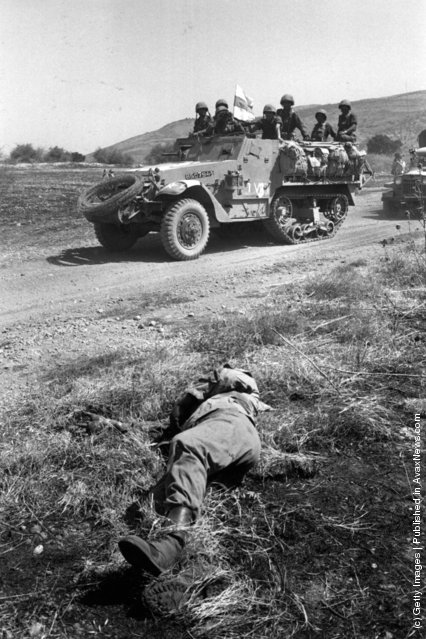
“The Six-Day War or June War, also known as the 1967 Arab-Israeli War or the Third Arab-Israeli War, was fought between June 5 and June 10, 1967, by Israel and the neighboring states of Egypt (known then as the United Arab Republic [UAR]), Jordan, and Syria. The war began with a large-scale surprise air strike by Israel on Egypt. The outcome was a swift and decisive Israeli victory. Israel took effective control of the Gaza Strip and the Sinai Peninsula from Egypt, the West Bank and East Jerusalem from Jordan, and the Golan Heights from Syria. Opinions are divided on whether Israel's attack was an act of aggression or a preemptive strike of a defensive nature”. – Wikipedia

Photo: The corpse of a soldier lying on the line of the Israeli advance into Syria during the Six-Day War. (Photo by Terry Fincher/Getty Images). 1967
Details
21 May 2011 08:29:00
A Togolese policeman, disguised as a terrorist, brandishes his weapon on October 20, 2022 during an anti-terrorism exercise at the Peacekeeping Operations Training Center (CEOMP). (Photo by Yanick Folly/AFP Photo)

A Togolese policeman, disguised as a terrorist, brandishes his weapon on October 20, 2022 during an anti-terrorism exercise at the Peacekeeping Operations Training Center (CEOMP). Togo's military on Thursday carried out a simulated jihadist attack in the capital Lome on Thursday, practising countering an assault and hostage-taking at a restaurant. Togo and neighbouring West African coastal states like Ghana and Benin are preparing for growing spillover from jihadist conflicts across their northern borders in Niger and Burkina Faso. (Photo by Yanick Folly/AFP Photo)
Details
26 Oct 2022 05:26:00


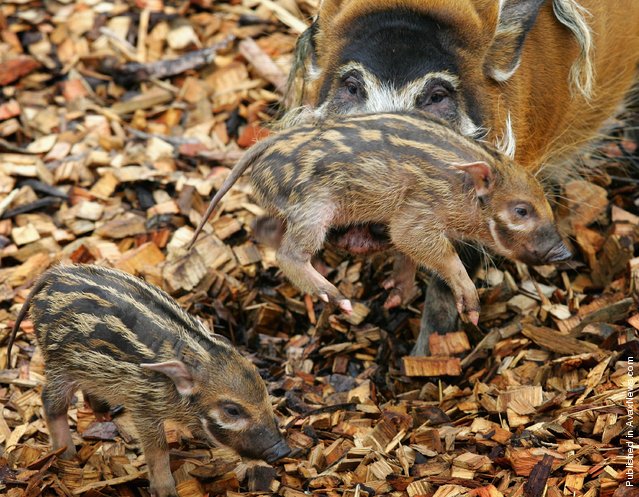
“The Red River Hog (Potamochoerus porcus), also known as the Bush Pig (but not to be confused with P. larvatus, common name “Bushpig”), is a wild member of the pig family living in Africa, with most of its distribution in the Guinean and Congolian forests. It is rarely seen away from rainforests, and generally prefers areas near rivers or swamps.

Red River Hogs eat grass, berries, roots, insects, molluscs, small vertebrates and carrion. They are capable of causing damage to plantations. Red River Hogs typically live in herds of 6-20 members led by a dominant boar. Sows rear 3-6 piglets at a time.”

Photo: Two 17 day old red river hoglet twins forage for food next to their mother Bahiti at London Zoo on August 23, 2007 in London, England. Red River hoglets inhabit the forests and swamps of West and Central Africa. The recent additions to the London Zoo pig pen have been eagerly awaited by zoo keepers. (Photo by Chris Jackson/Getty Images)
Details
18 Mar 2011 15:15:00
Ophiocordyceps Sinensis A.K.A. Caterpillar Fungus

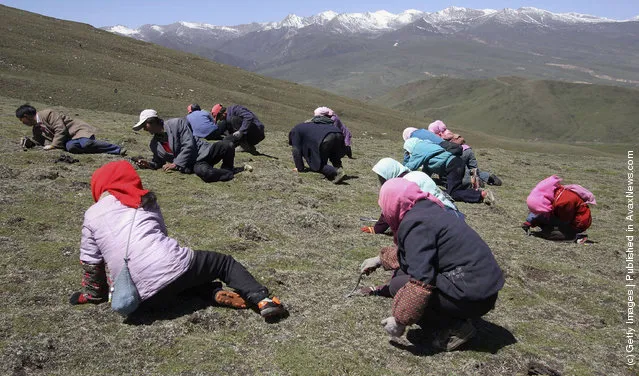
“There are over 680 documented species of the sac fungus genus Ophiocordyceps, and one of the best known of these is Ophiocordyceps sinensis, colloquially known as caterpillar fungus. The fungus is known in Tibetan as yartsa gunbu or yatsa gunbu. O. sinensis is known in the West as a medicinal mushroom and its use has a long history in Traditional Chinese medicine as well as Traditional Tibetan medicine. The highly valuable fungus-caterpillar combination is hand-collected and is used as an aphrodisiac and as a treatment for a variety of ailments from fatigue to cancer”. – Wikipedia

Photo: Nomads dig for Chinese caterpillar fungus from a mountain May 25, 2007 in Guide County, Hainan Prefecture, Qinghai Province, China. Nomads can earn about 2,000 yuan to 5,000 yuan (about U.S. $260 to $653 ) through their work during the fifty-day Chinese caterpillar fungus gathering season. (Photo by China Photos/Getty Images)
Details
26 Sep 2011 10:47:00
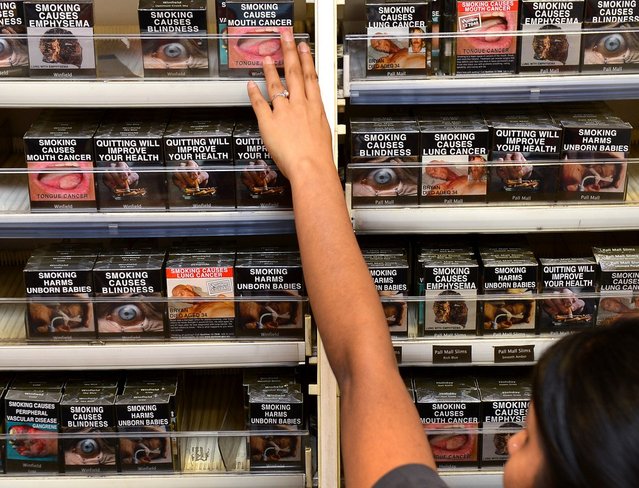
An employee in a bookshop adjusts packaged cigarettes which have to be sold in identical olive-brown packets bearing the same typeface and largely covered with graphic health warnings, with the same style of writing so the only identifier of a brand will be the name on the packet, in Sydney on December 1, 2012.  A new world-first law forcing tobacco companies to sell cigarettes in identical packets came into effect Saturday in Australia in an effort to strip any glamour from smoking and prevent young people from taking up the habit

An employee in a bookshop adjusts packaged cigarettes which have to be sold in identical olive-brown packets bearing the same typeface and largely covered with graphic health warnings, with the same style of writing so the only identifier of a brand will be the name on the packet, in Sydney on December 1, 2012. A new world-first law forcing tobacco companies to sell cigarettes in identical packets came into effect Saturday in Australia in an effort to strip any glamour from smoking and prevent young people from taking up the habit. (Photo by William West/AFP Photo)
Details
02 Dec 2012 09:18:00