Loading...
Done
Milena Pino, 15, puts on makeup prior to taking part in a speed competition with horses at the International Livestock Fair Show in Havana March 21, 2015. (Photo by Alexandre Meneghini/Reuters)

Milena Pino, 15, puts on makeup prior to taking part in a speed competition with horses at the International Livestock Fair Show in Havana March 21, 2015. (Photo by Alexandre Meneghini/Reuters)
Details
26 Aug 2015 10:22:00
A visitor looks at a sculpture by a Chinese artist Chen Wenling at the "Sculpture by the Sea" exhibition which runs along the Bondi to Tamarama coastal walk in Sydney on October 22, 2015. The world's largest annual free-to-the-public outdoor sculpture exhibition runs from October 22 – November 8 this year and features over 107 sculptures by artists around the world. (Photo by Saeed Khan/AFP Photo)

A visitor looks at a sculpture by a Chinese artist Chen Wenling at the "Sculpture by the Sea" exhibition which runs along the Bondi to Tamarama coastal walk in Sydney on October 22, 2015. The world's largest annual free-to-the-public outdoor sculpture exhibition runs from October 22 – November 8 this year and features over 107 sculptures by artists around the world. (Photo by Saeed Khan/AFP Photo)
Details
24 Oct 2015 10:17:00
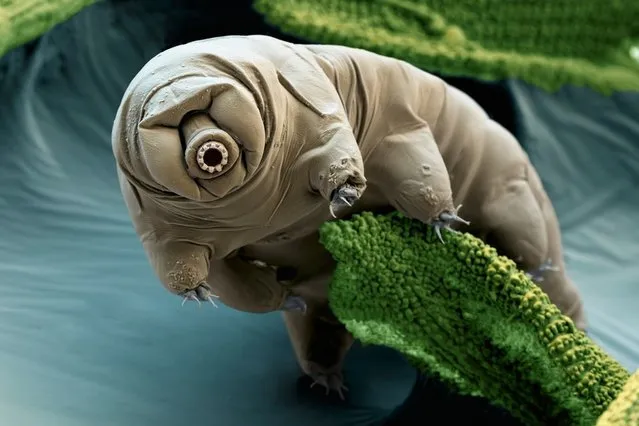
Tardigrades (commonly known as waterbears or moss piglets). (Photo by SPL/East News)

“Tardigrades (commonly known as waterbears or moss piglets) are small, water-dwelling, segmented animals with eight legs. Tardigrades were first discovered in 1773 by Johann August Ephraim Goeze, who called them kleiner Wasserbär, meaning “little water bear” in German. The name Tardigrada means “slow walker” and was given by Lazzaro Spallanzani in 1777. The name water bear comes from the way they walk, reminiscent of a bear's gait. The biggest adults may reach a body length of 1.5 millimetres (0.059 in), the smallest below 0.1 mm. Freshly hatched tardigrades may be smaller than 0.05 mm”. – Wikipedia. Photo: Tardigrades. (Photo by SPL/East News)

Details
26 Sep 2012 09:55:00
A newly born Yangtze finless porpoise (top) swims with his mother at the Hydrobiology Institute of the Chinese Academy of Sciences

“The finless porpoise (Neophocaena phocaenoides) is one of six porpoise species. In the waters around Japan, at the northern end of its range, it is known as the sunameri. A freshwater population found in the Yangtze River in China is known locally as the jiangzhu or «river pig»”. – Wikipedia

Photo: A newly born Yangtze finless porpoise (top) swims with his mother at the Hydrobiology Institute of the Chinese Academy of Sciences on June 3, 2007 in Wuhan of Hubei Province, China. (Photo by China Photos/Getty Images)
Details
20 Feb 2012 12:23:00
Emilio Gonzalez from Venezuela poses during the Cali Tattoo Festival in Cali, Colombia, September 12, 2015. (Photo by Jaime Saldarriaga/Reuters)

Emilio Gonzalez from Venezuela poses during the Cali Tattoo Festival in Cali, Colombia, September 12, 2015. (Photo by Jaime Saldarriaga/Reuters)
Details
15 Sep 2015 13:52:00
An annual fire festival is held in Nachikatsuura, Wakayama Prefecture, western Japan, on July 14, 2019. (Photo by Kyodo News via Getty Images)

An annual fire festival is held in Nachikatsuura, Wakayama Prefecture, western Japan, on July 14, 2019. (Photo by Kyodo News via Getty Images)
Details
02 Aug 2019 00:01:00
Participants take part in a high-wheel bicycle race in the Frederick county, in Maryland, United States on July 15, 2023. (Photo by Celal Gunes/Anadolu Agency via Getty Images)

Participants take part in a high-wheel bicycle race in the Frederick county, in Maryland, United States on July 15, 2023. (Photo by Celal Gunes/Anadolu Agency via Getty Images)
Details
24 Jul 2023 03:06:00
A mannequin with boots is stuffed upside down in the snow in front of a  home in Nisswa, Minnesota, on March 18, 2013. (Photo by Steve Kohls/The Brainerd Daily Dispatch)

A mannequin with boots is stuffed upside down in the snow in front of a home in Nisswa, Minnesota, on March 18, 2013. (Photo by Steve Kohls/The Brainerd Daily Dispatch)

P.S. All pictures are presented in high resolution. To see Hi-Res images – just TWICE click on any picture. In other words, click small picture – opens the BIG picture. Click BIG picture – opens VERY BIG picture (if available; this principle works anywhere on the site AvaxNews).
Details
23 Mar 2013 14:08:00