Loading...
Done
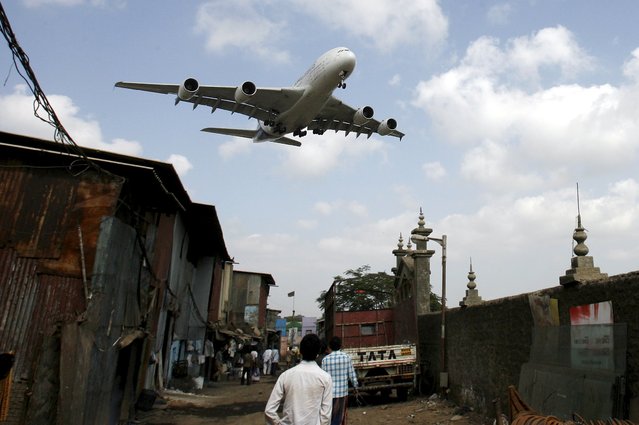
An Airbus A380 aircraft prepares to land at Mumbai airport in this May 8, 2007 file photo. Sentiment at some of Asia's biggest firms deteriorated again in the fourth quarter, falling to a four-year low under the weight of concerns about slowing growth in China, the region's biggest economy, a Thomson Reuters/INSEAD survey showed. (Photo by Arko Datta/Reuters)

An Airbus A380 aircraft prepares to land at Mumbai airport in this May 8, 2007 file photo. Sentiment at some of Asia's biggest firms deteriorated again in the fourth quarter, falling to a four-year low under the weight of concerns about slowing growth in China, the region's biggest economy, a Thomson Reuters/INSEAD survey showed. (Photo by Arko Datta/Reuters)
Details
27 Dec 2015 08:03:00
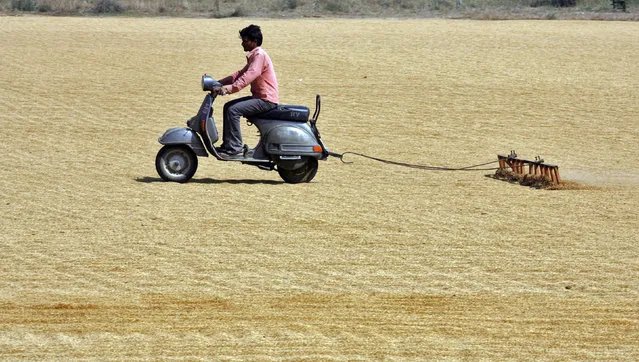
A worker spreads paddy crop for drying in a rice mill complex on the outskirts of Ahmedabad February 3, 2011. (Photo by Amit Dave/Reuters)

A worker spreads paddy crop for drying in a rice mill complex on the outskirts of Ahmedabad February 3, 2011. (Photo by Amit Dave/Reuters)
Details
13 May 2016 12:01:00
The Lun-class Ekranoplane was used by the Soviet Navy starting in 1987, and wasn't retired until the late 1990s, after the Soviet Union's fall. (Igor113)

“The Lun-class ekranoplan (NATO reporting name Duck) was a ground effect vehicle (GEV) designed by Rostislav Evgenievich Alexeev and used by the Soviet and Russian navies from 1987 until sometime in the late 1990s. It “flew” using the lift generated by the ground effect of its large wings when close to the surface of the water – about four metres or less. Although they might look similar and/or have related technical characteristics, ekranoplans like the Lun are not aircraft, seaplanes, hovercraft, or hydrofoils – ground effect is a separate technology altogether. The International Maritime Organization classifies these vehicles as maritime ships. The name Lun comes from the Russian for harrier”. – Wikipedia (Photo by Igor113)
Details
08 Aug 2014 10:51:00
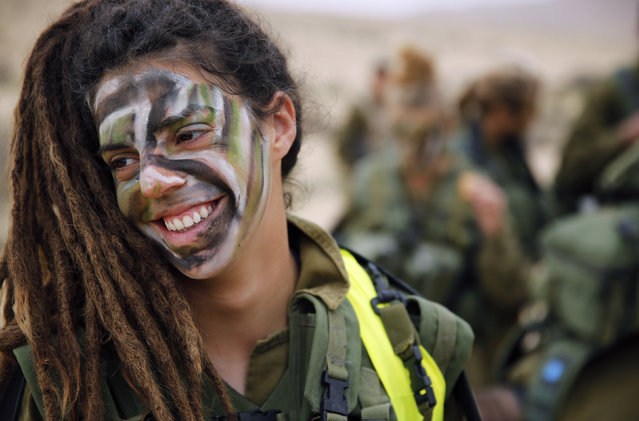
An Israeli soldier of the Caracal battalion smiles during a 23-kilometer march marking the end of their training in Israel's Negev desert, near Kibbutz Sde Boker February 14, 2013. The “Caracal” battalion, two-thirds of whose members are women, was established in 2004 with the purpose of incorporating female soldiers in combat units. The main mission of Caracal is routine patrols on Israel's border with Egypt to intercept infiltrators and smuggling from the Sinai desert. (Photo by Darren Whiteside/Reuters)

An Israeli soldier of the Caracal battalion smiles during a 23-kilometer march marking the end of their training in Israel's Negev desert, near Kibbutz Sde Boker February 14, 2013. The “Caracal” battalion, two-thirds of whose members are women, was established in 2004 with the purpose of incorporating female soldiers in combat units. The main mission of Caracal is routine patrols on Israel's border with Egypt to intercept infiltrators and smuggling from the Sinai desert. (Photo by Darren Whiteside/Reuters)
Details
23 Sep 2014 13:22:00
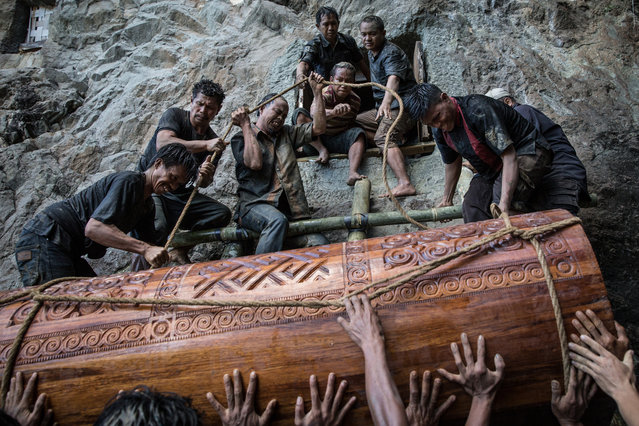
It is said that Torajans are people who “live to die”. For this Indonesian ethnic group, funerals are such extravagant events that they sometimes attract tourists. Families can postpone burials years (and the deceased are considered sick and hosted at home until the funeral) until the family can raise enough money and gather as many relatives as possible. And then it’s a jubilant multiday social event with a parade, dances and animal sacrifices. Agung Parameswara photographed these funerary practices when he traveled to South Sulawesi province, where the Torajans live. But often, their funeral isn’t the last time the dead are seen. In August, crypts are opened, coffins are slid back out and bodies delicately unsheathed. This tender ritual is known as Ma’Nene, which is customarily performed every few years. (Photo by Agung Parameswara/The Washington Post)

It is said that Torajans are people who “live to die”. For this Indonesian ethnic group, funerals are such extravagant events that they sometimes attract tourists. Families can postpone burials years (and the deceased are considered sick and hosted at home until the funeral) until the family can raise enough money and gather as many relatives as possible. And then it’s a jubilant multiday social event with a parade, dances and animal sacrifices. Agung Parameswara photographed these funerary practices when he traveled to South Sulawesi province, where the Torajans live. (Photo by Agung Parameswara/The Washington Post)
Details
06 Oct 2016 09:15:00
Kawakanih Yawalapiti, 9, Upper Xingu region of Mato Grosso, Brazil, 2018: Kawakanih lives with her tribe, the Yawalapiti, in Xingu national park, a preserve in the Amazon basin of Brazil. The Yawalapiti collect seeds to preserve species unique to their ecosystem, which lies between the rain forest and savannah. Kawakanih’s diet is simple, consisting mainly of fish, cassava, porridge, fruit and nuts. “It takes five minutes to catch dinner”, says Kawakanih. “When you’re hungry, you just go to the river with your net”. (Photo by Gregg Segal/The Guardian)

Photographer Gregg Segal travelled the world to document children and the food they eat in a week. Partly inspired by the increasing problems of childhood obesity, he tracked traditional regional diets as yet unaffected by globalisation, and ironically, found that the healthiest diets were often eaten by the least well off. (Photo by Gregg Segal/The Guardian)
Details
03 Jul 2019 00:03:00
Argentinian twin dancers Nicolas Filipeli and German Filipeli perform during the Tango Stage final competition at the Tango Dance World Championship in Buenos Aires on August 21, 2019. (Photo by Ronaldo Schemidt/AFP Photo)

Argentinian twin dancers Nicolas Filipeli and German Filipeli perform during the Tango Stage final competition at the Tango Dance World Championship in Buenos Aires on August 21, 2019. (Photo by Ronaldo Schemidt/AFP Photo)
Details
25 Aug 2019 00:07:00
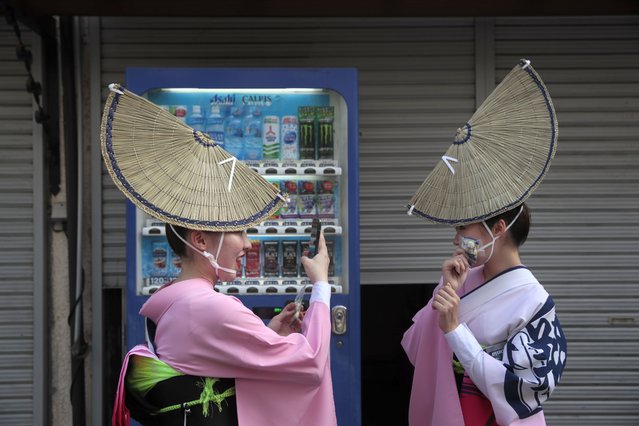
Two young dancers take pictures while waiting for the start of the Koenji Awa-Odori dance festival, in the Koenji neighborhood of Tokyo. Saturday, August 24, 2019, Started in the 1950s, the Koenji Awa-Odori has grown to be one of Tokyo's largest and most popular summer festivals an estimated 10,000 dancers participating in the dance festival. Hundreds of thousands of spectators gather in the neighborhood to watch the two-day summer spectacle. The event is held on the last weekend of August each year. (Photo by Jae C. Hong/AP Photo)

Two young dancers take pictures while waiting for the start of the Koenji Awa-Odori dance festival, in the Koenji neighborhood of Tokyo. Saturday, August 24, 2019, Started in the 1950s, the Koenji Awa-Odori has grown to be one of Tokyo's largest and most popular summer festivals an estimated 10,000 dancers participating in the dance festival. Hundreds of thousands of spectators gather in the neighborhood to watch the two-day summer spectacle. The event is held on the last weekend of August each year. (Photo by Jae C. Hong/AP Photo)
Details
20 Sep 2019 00:03:00