Loading...
Done
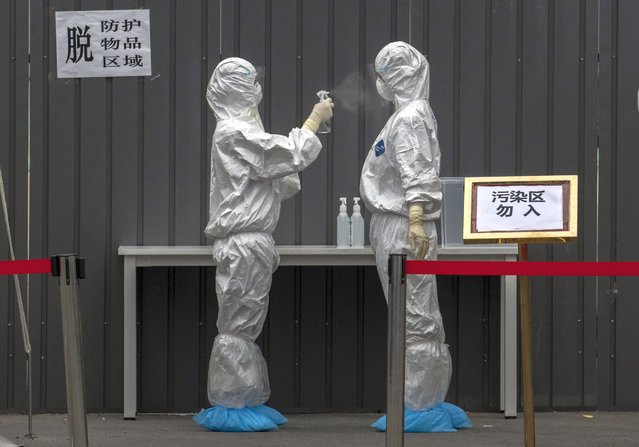
Chinese epidemic control workers wear protective suits as they disinfect each other after performing nucleic acid swab test for COVID-19 on citizens at a government testing site in Xicheng District during an organized tour on June 24, 2020 in Beijing, China. While Chinese government medical officials have said they believe they have controlled the spread, authorities are trying to contain the outbreak linked to the Xinfadi wholesale food market, Beijing's biggest supplier of produce and meat. More than 2.5 million people have undergone nucleic acid tests for COVID-19 at dozens of sites across the city in recent days, with officials using contact tracing to target high and middle risk areas and people who may have had contact with the market or food that came from there. Several neighborhoods have been locked down and a number of other food markets have been closed, The outbreak has triggered fears of a second wave of infection after 56 straight days with no domestically transmitted cases in the capital. (Photo by Kevin Frayer/Getty Images)

Chinese epidemic control workers wear protective suits as they disinfect each other after performing nucleic acid swab test for COVID-19 on citizens at a government testing site in Xicheng District during an organized tour on June 24, 2020 in Beijing, China. While Chinese government medical officials have said they believe they have controlled the spread, authorities are trying to contain the outbreak linked to the Xinfadi wholesale food market, Beijing's biggest supplier of produce and meat. (Photo by Kevin Frayer/Getty Images)
Details
26 Jun 2020 00:01:00
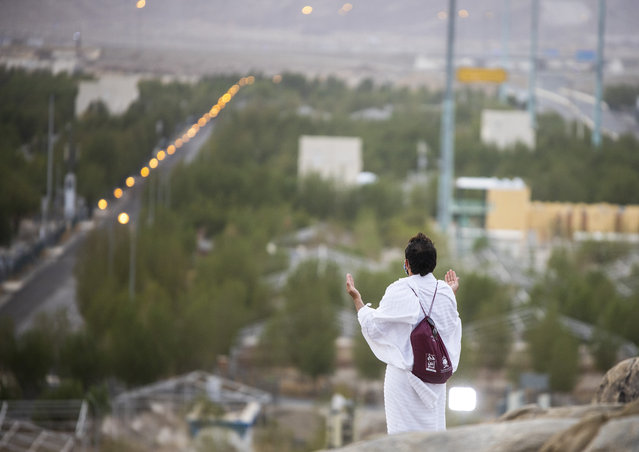
Muslim pilgrims pray on top of the rocky hill known as Mountain of Mercy on the Plain of Arafat during the annual hajj pilgrimage near the holy city of Mecca, Saudi Arabia, Thursday, July 30, 2020. Only about 1,000 pilgrims will be allowed to perform the annual hajj pilgrimage this year due to the virus pandemic. (Photo by Saudi Ministry of Media via AP Photo)

Muslim pilgrims pray on top of the rocky hill known as Mountain of Mercy on the Plain of Arafat during the annual hajj pilgrimage near the holy city of Mecca, Saudi Arabia, Thursday, July 30, 2020. Only about 1,000 pilgrims will be allowed to perform the annual hajj pilgrimage this year due to the virus pandemic. (Photo by Saudi Ministry of Media via AP Photo)
Details
01 Aug 2020 00:03:00
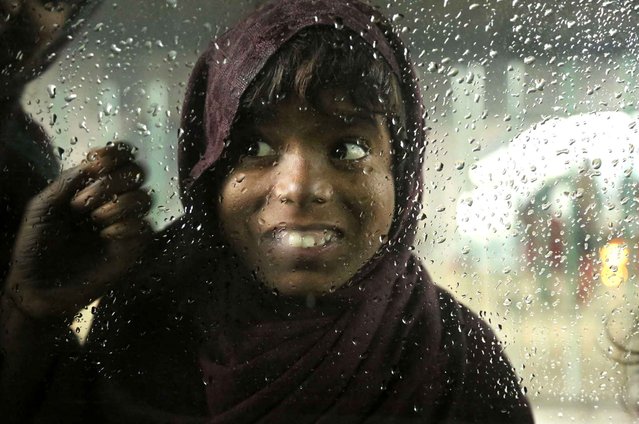
A homeless street child looks in the window of a car in Jammu, India, Friday, January 6, 2017. Some 800 million people in the country live in poverty, many of them migrating to big cities in search of a livelihood and often ending up on the streets. (Photo by Channi Anand/AP Photo)

A homeless street child looks in the window of a car in Jammu, India, Friday, January 6, 2017. Some 800 million people in the country live in poverty, many of them migrating to big cities in search of a livelihood and often ending up on the streets. (Photo by Channi Anand/AP Photo)
Details
02 Feb 2017 04:34:00
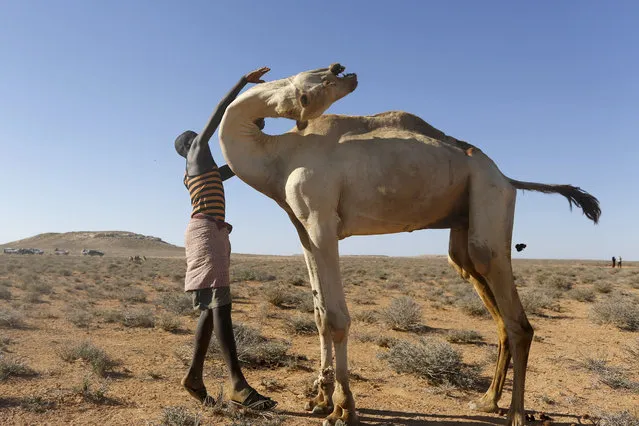
Ali Asair, who has left his family behind and traveled hundreds of kilometers in search for a pasture for his animals, attends to his camel in a pastoralists' settlement in the Bandarbeyla district in Somalia's semi-autonomous region of Puntland, Somalia, 24 March 2017. According to media reports, the United Nations says only 31 percent of 864 million US dollars appeal for a drought-hit Somalia is funded. The UN said the world is facing the largest humanitarian crisis since 1945, adding that more than 20 million people are facing the threat of famine in Somalia, Yemen, South Sudan and Nigeria and 1.4 million children could die from starvation this year. (Photo by Dai Kurokawa/EPA)

Ali Asair, who has left his family behind and traveled hundreds of kilometers in search for a pasture for his animals, attends to his camel in a pastoralists' settlement in the Bandarbeyla district in Somalia's semi-autonomous region of Puntland, Somalia, 24 March 2017. According to media reports, the United Nations says only 31 percent of 864 million US dollars appeal for a drought-hit Somalia is funded. The UN said the world is facing the largest humanitarian crisis since 1945, adding that more than 20 million people are facing the threat of famine in Somalia, Yemen, South Sudan and Nigeria and 1.4 million children could die from starvation this year. (Photo by Dai Kurokawa/EPA)
Details
28 Mar 2017 09:01:00
A goat begs for food as people have a meal and beer at the Beichelstein-Alpe outdoor restaurant near Seeg, southern Germany, on March 27, 2017. (Photo by Karl-Josef Hildenbrand/AFP Photo/DPA)

A goat begs for food as people have a meal and beer at the Beichelstein-Alpe outdoor restaurant near Seeg, southern Germany, on March 27, 2017. (Photo by Karl-Josef Hildenbrand/AFP Photo/DPA)
Details
29 Mar 2017 09:43:00
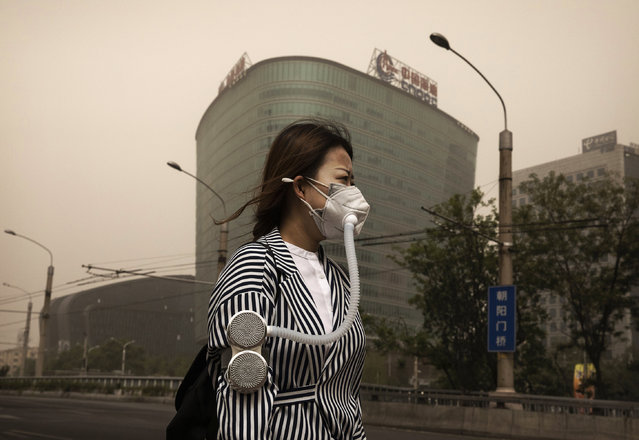
A Chinese woman wears a mask to protect from particles blown in during a sandstorm as she walks in the street on May 4, 2017 in Beijing, China. Sandstorms are common in northern China during the spring season and are caused when heavy winds from Mongolia in the north brings sand and pollutants that can blanket Chinese cities and cause air quality to deteriorate. (Photo by Kevin Frayer/Getty Images)

A Chinese woman wears a mask to protect from particles blown in during a sandstorm as she walks in the street on May 4, 2017 in Beijing, China. Sandstorms are common in northern China during the spring season and are caused when heavy winds from Mongolia in the north brings sand and pollutants that can blanket Chinese cities and cause air quality to deteriorate. (Photo by Kevin Frayer/Getty Images)
Details
12 May 2017 07:06:00
People enjoying the races on a wet day at Chester Racecourse on May 12, 2017 in Chester, England. (Photo by Alan Crowhurst/Getty Images)

People enjoying the races on a wet day at Chester Racecourse on May 12, 2017 in Chester, England. (Photo by Alan Crowhurst/Getty Images)
Details
13 May 2017 09:34:00
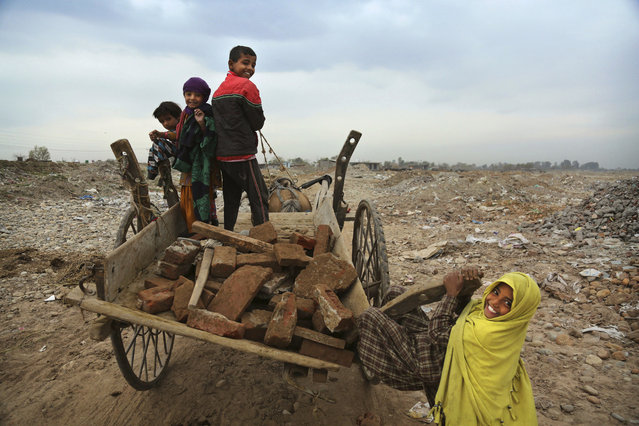
An Indian nomadic Gujjar girl hangs on to a horse cart after collecting bricks from debris on the outskirts of Jammu, India, Tuesday, March 7, 2017. The Gujjar tribal communities are considered by some to be economically and socially backward and the lack of care by the state government has led to resentment amongst the community. The tribe moves to the plains from the hills to escape the cold winters. (Photo by Channi Anand/AP Photo)

An Indian nomadic Gujjar girl hangs on to a horse cart after collecting bricks from debris on the outskirts of Jammu, India, Tuesday, March 7, 2017. The Gujjar tribal communities are considered by some to be economically and socially backward and the lack of care by the state government has led to resentment amongst the community. The tribe moves to the plains from the hills to escape the cold winters. (Photo by Channi Anand/AP Photo)
Details
09 Jun 2017 06:36:00