Loading...
Done
A woman looks at head of bluefin tuna on display in front of a store at Tsukiji fish market in Tokyo, Monday, February 19, 2018.  The large bluefin are particularly valuable in Japan, where they are considered a premium sushi and sashimi fish. A single fish sold for more than $1.75 million at an auction in Japan in 2013. (Photo by Koji Sasahara/AP Photo)

A woman looks at head of bluefin tuna on display in front of a store at Tsukiji fish market in Tokyo, Monday, February 19, 2018. The large bluefin are particularly valuable in Japan, where they are considered a premium sushi and sashimi fish. A single fish sold for more than $1.75 million at an auction in Japan in 2013. (Photo by Koji Sasahara/AP Photo)
Details
06 Mar 2018 00:05:00
View of an American marine as he lies in a foxhole and whistles at a husky, one of the scouting dogs used during the landing on Guam, August 1944. (Photo by W. Eugene Smith/Time & Life Pictures/Getty Images)

View of an American marine as he lies in a foxhole and whistles at a husky, one of the scouting dogs used during the landing on Guam, August 1944. (Photo by W. Eugene Smith/Time & Life Pictures/Getty Images)
Details
25 Feb 2017 00:04:00
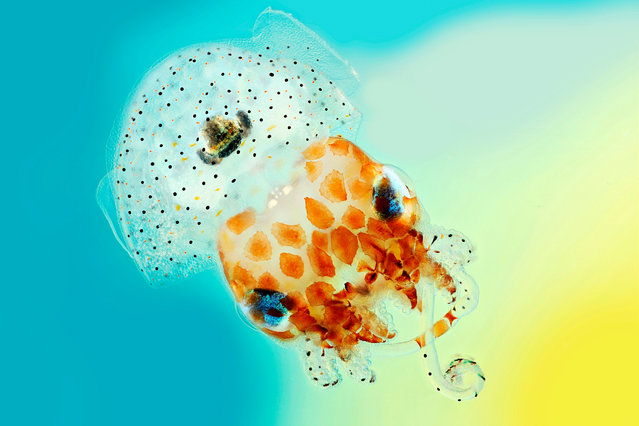
With its huge eyes, comical name and diminutive size, Mark R. Smith’s image of a baby Hawaiian bobtail squid can’t help but raise a smile. A curiously endearing creature, the cephalopod is just 1.5cm across, its mantle cavity bearing more than a passing resemblance to a rather natty shower cap. But it is also a beautiful example of symbiosis – nature’s version of “I’ll scratch your back if you scratch mine” – for on the underside of the squid is a light organ which houses bioluminescent bacteria. The squid offers the bacteria protection and food, while the bacteria emit a glow – a handy trait that the squid uses to offset its silhouette, helping it to evade predators in the depths below. Mark R. Smith’s entry combines several images of a Hawaiian bobtail squid with different focus lengths to create a final picture with greater depth of field than normal. (Photo by Mark R. Smith/Wellcome Images/Macroscopic Solutions)

With its huge eyes, comical name and diminutive size, Mark R. Smith’s image of a baby Hawaiian bobtail squid can’t help but raise a smile. A curiously endearing creature, the cephalopod is just 1.5cm across, its mantle cavity bearing more than a passing resemblance to a rather natty shower cap. But it is also a beautiful example of symbiosis – nature’s version of “I’ll scratch your back if you scratch mine” – for on the underside of the squid is a light organ which houses bioluminescent bacteria. The squid offers the bacteria protection and food, while the bacteria emit a glow – a handy trait that the squid uses to offset its silhouette, helping it to evade predators in the depths below. Mark R. Smith’s entry combines several images of a Hawaiian bobtail squid with different focus lengths to create a final picture with greater depth of field than normal. (Photo by Mark R. Smith/Wellcome Images/Macroscopic Solutions)

Details
08 Mar 2017 00:05:00
People stand by a damaged car at a train station at a makeshift camp for migrants and refugees at the Greek-Macedonian border near the village of Idomeni, Greece, May 10, 2016. (Photo by Marko Djurica/Reuters)

People stand by a damaged car at a train station at a makeshift camp for migrants and refugees at the Greek-Macedonian border near the village of Idomeni, Greece, May 10, 2016. (Photo by Marko Djurica/Reuters)
Details
12 May 2016 14:10:00
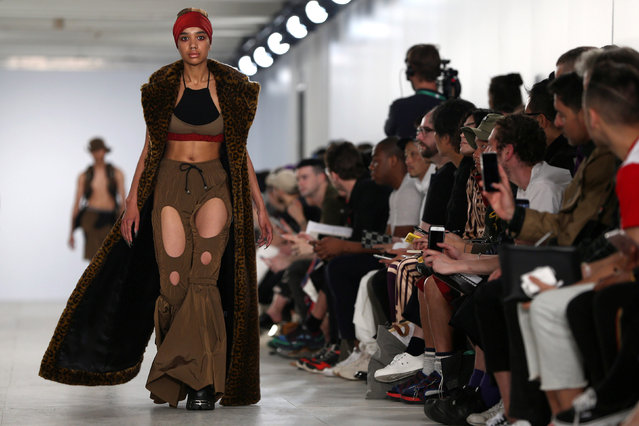
A model presents a creation at the Nasir Mazhar catwalk show at London Collections Men in London, Britain June 11, 2016. (Photo by Neil Hall/Reuters)

A model presents a creation at the Nasir Mazhar catwalk show at London Collections Men in London, Britain June 11, 2016. (Photo by Neil Hall/Reuters)
Details
16 Jun 2016 12:47:00
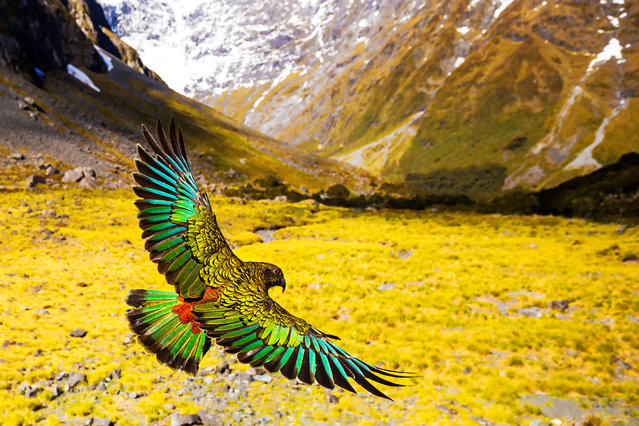
Kea are the only true alpine parrots in the world and thrive as cunning opportunists in the freezing conditions of the Southern Alps. Kea are thought to have developed their wide array of food-finding strategies during the last great ice age, where they learned to adapt using their unusual powers of curiosity. (Photo by Tom Walker/BBC Pictures/The Guardian)

Kea are the only true alpine parrots in the world and thrive as cunning opportunists in the freezing conditions of the Southern Alps. Kea are thought to have developed their wide array of food-finding strategies during the last great ice age, where they learned to adapt using their unusual powers of curiosity. (Photo by Tom Walker/BBC Pictures/The Guardian)
Details
19 Jul 2016 13:03:00
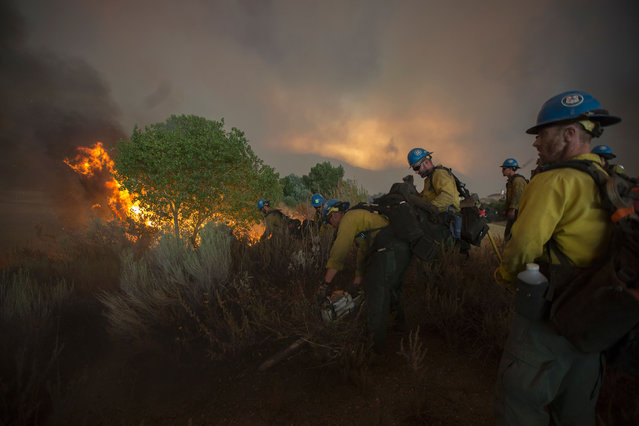
Firefighters of the Texas Canyon Hotshot crew fight the Sand Fire on July 23 2016 near Santa Clarita, California. Fueled by temperatures reaching about 108 degrees fahrenheit, the wildfire began yesterday has grown to 11,000 acres. (Photo by David McNew/AFP Photo)

Firefighters of the Texas Canyon Hotshot crew fight the Sand Fire on July 23 2016 near Santa Clarita, California. Fueled by temperatures reaching about 108 degrees fahrenheit, the wildfire began yesterday has grown to 11,000 acres. (Photo by David McNew/AFP Photo)
Details
25 Jul 2016 11:13:00
Construction workers walk past a mural in Phnom Penh on September 6, 2022. (Photo by Tang Chhin Sothy/AFP Photo)

Construction workers walk past a mural in Phnom Penh on September 6, 2022. (Photo by Tang Chhin Sothy/AFP Photo)
Details
09 Oct 2022 04:05:00