Loading...
Done
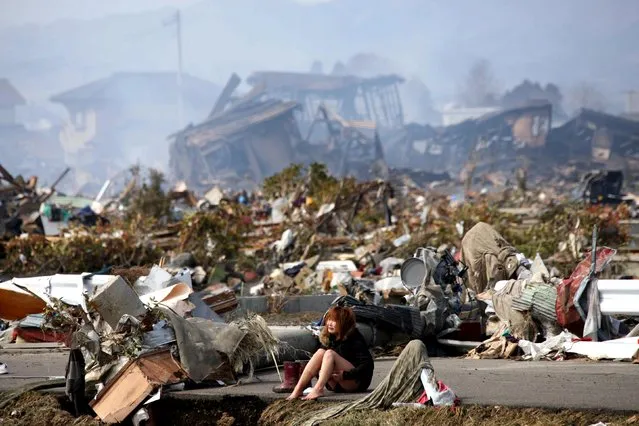
A woman cries while sitting on a road amid the destroyed city of Natori, Miyagi Prefecture in northern Japan March 13, 2011, after a massive earthquake and tsunami that are feared to have killed more than 10,000 people. (Photo by Asahi Shimbun/Reuters)

A woman cries while sitting on a road amid the destroyed city of Natori, Miyagi Prefecture in northern Japan March 13, 2011, after a massive earthquake and tsunami. Five years on from the tsunami that triggered meltdowns at Japan's Fukushima nuclear plant, the page is anything but turned. A magnitude 9 earthquake and towering tsunami on March 11, 2011 killed nearly 16,000 people along Japan's northeastern coast and left more than 2,500 missing. The 10-metre (33-foot) tsunami swept away everything in its path, including houses, ships, cars and farm buildings. (Photo by Asahi Shimbun/Reuters)
Details
09 Mar 2016 12:40:00
Some of the most powerful narratives of the past decade have been produced by a forward-thinking generation of women photojournalists as different as the places and the subjects they have covered. National Geographic's “Women of Vision” exhibit features the work of 11 photographers and is on display at the Fernbank Museum of Natural History in Atlanta until January 3, 2016. (Photo by Stephanie Sinclair/National Geographic)

Some of the most powerful narratives of the past decade have been produced by a forward-thinking generation of women photojournalists as different as the places and the subjects they have covered. National Geographic's “Women of Vision” exhibit features the work of 11 photographers and is on display at the Fernbank Museum of Natural History in Atlanta until January 3, 2016. Here: Nujood Ali stunned the world in 2008 by obtaining a divorce at age 10 in Yemen, striking a blow against forced marriage. (Photo by Stephanie Sinclair/National Geographic)
Details
11 Dec 2015 08:05:00
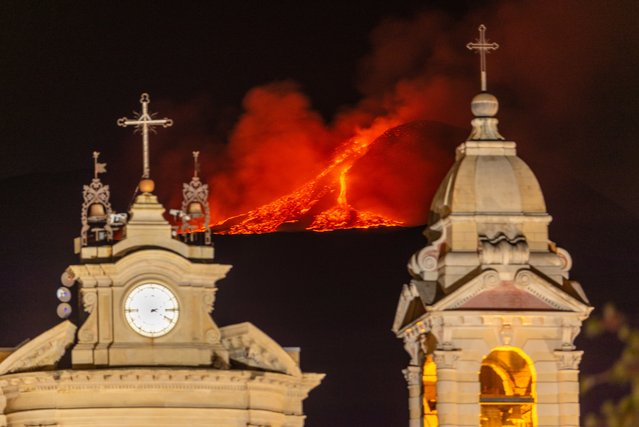
Lava erupts from a crater of Mt. Etna, Europe's largest active volcano, behind Santa Maria della Guardia church in Belpasso, near Catania, in southern Italian island of Sicily, early Friday, June 18, 2021. Since Feb. 16, 2021, Mt. Etna has begun a series of spectacular eruptive episodes. (Photo by Salvatore Allegra/AP Photo)

Lava erupts from a crater of Mt. Etna, Europe's largest active volcano, behind Santa Maria della Guardia church in Belpasso, near Catania, in southern Italian island of Sicily, early Friday, June 18, 2021. Since Feb. 16, 2021, Mt. Etna has begun a series of spectacular eruptive episodes. (Photo by Salvatore Allegra/AP Photo)
Details
07 Jul 2021 09:32:00
A reveler playfully sticks out her tongue during a street pre-carnival party by the “Cordao do Boitata” Block, in Rio de Janeiro, Brazil, Sunday, February 12, 2023. Revelers are taking to the streets for the open-air block parties, leading up to Carnival's official Feb. 17th opening. (Photo by Bruna Prado/AP Photo)

A reveler playfully sticks out her tongue during a street pre-carnival party by the “Cordao do Boitata” Block, in Rio de Janeiro, Brazil, Sunday, February 12, 2023. Revelers are taking to the streets for the open-air block parties, leading up to Carnival's official Feb. 17th opening. (Photo by Bruna Prado/AP Photo)
Details
07 May 2024 04:01:00
A participant takes part in the High-Heels Race as part of the Pride celebrations, in the Chueca neighbourhood in Madrid on July 7, 2022. MADO (Madrid Pride) is a series of street celebrations that take place during the city's LGBTIQ (lesbian, gay, bisexual, transgender, intersеx and queer) Pride week. The Pride parade on July 9 will be the highlight of the week. (Photo by Javier Soriano/AFP Photo)

A participant takes part in the High-Heels Race as part of the Pride celebrations, in the Chueca neighbourhood in Madrid on July 7, 2022. MADO (Madrid Pride) is a series of street celebrations that take place during the city's LGBTIQ (lesbian, gay, bisexual, transgender, intersеx and queer) Pride week. The Pride parade on July 9 will be the highlight of the week. (Photo by Javier Soriano/AFP Photo)
Details
31 Oct 2023 06:39:00
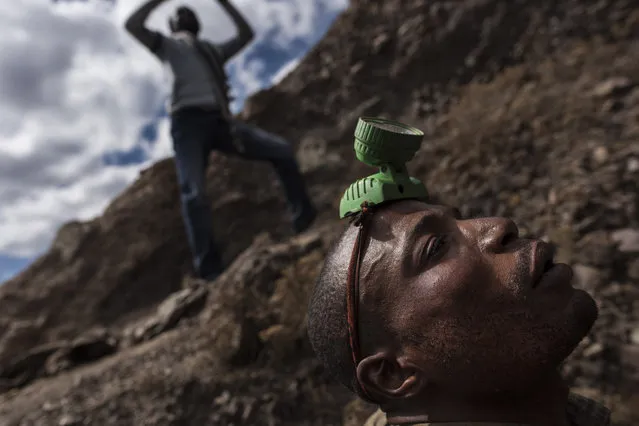
A “creuseur”, or digger, a plastic lantern on his head, readies to enter a copper and cobalt mine in Kawama, Democratic Republic of Congo on June 8, 2016. Cobalt is used in the batteries for electric cars and mobile phones. Working conditions are dangerous, often with no safety equipment or structural support for the tunnels. The diggers say they are paid on average US$2-3/day. (Photo by Michael Robinson Chavez/The Washington Post)

A “creuseur”, or digger, a plastic lantern on his head, readies to enter a copper and cobalt mine in Kawama, Democratic Republic of Congo on June 8, 2016. Cobalt is used in the batteries for electric cars and mobile phones. Working conditions are dangerous, often with no safety equipment or structural support for the tunnels. The diggers say they are paid on average US$2-3/day. (Photo by Michael Robinson Chavez/The Washington Post)
Details
30 Dec 2016 10:29:00
A Buddhist monk uses a traditional needle to tattoo the body of a man at Wat Bang Phra in Nakhon Pathom province on the outskirts of Bangkok, Thailand,  March 18, 2016. (Photo by Chaiwat Subprasom/Reuters)

A Buddhist monk uses a traditional needle to tattoo the body of a man at Wat Bang Phra in Nakhon Pathom province on the outskirts of Bangkok, Thailand, March 18, 2016. Believers from across Thailand travel to the monastery to have their bodies adorned with tattoos and to pay their respects to the temple's master tattooist. They believe the tattoos have mystical powers, ward off bad luck and protect them from harm. (Photo by Chaiwat Subprasom/Reuters)
Details
19 Mar 2016 12:44:00


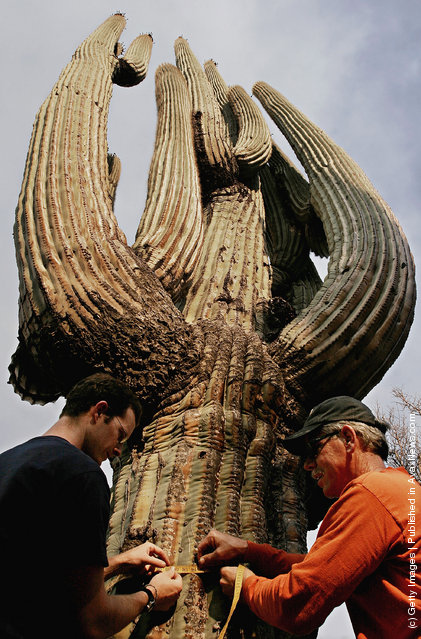
“The saguaro (scientific name Carnegiea gigantea) is a large, tree-sized cactus species in the monotypic genus Carnegiea. It is native to the Sonoran Desert in the U.S. state of Arizona, the Mexican state of Sonora, a small part of Baja California in the San Felipe Desert and an extremely small area of California, U.S. The saguaro blossom is the State Wildflower of Arizona”. – Wikipedia

Photo: Daniel Appel (L), a firefighter with Engine 84 from the Lassen National Forest in California and Mike Hallen, (R), Arizona representative of the National Register of Big Trees, measure the circumference of this Saguaro cactus called the "Grand One," in the Tonto National Forest on July 1, 2005 35 miles north of Phoenix, near Carefree, Arizona. The cactus, estimated to be more than 200 years old, measures a circumference of 7 feet, 10 inches (2.4 meters) and stands 46 feet high (14 meters). The cactus was burned in the Cave Creek Complex fire and may not survive. It was once the largest Saguaro in the world, two others have been found recently that have tied it's measurements. The fire has burned more than 214,000 acres of the Sonoran desert. (Photo by Jeff Topping/Getty Images)
Details
26 Jul 2011 12:27:00