Loading...
Done
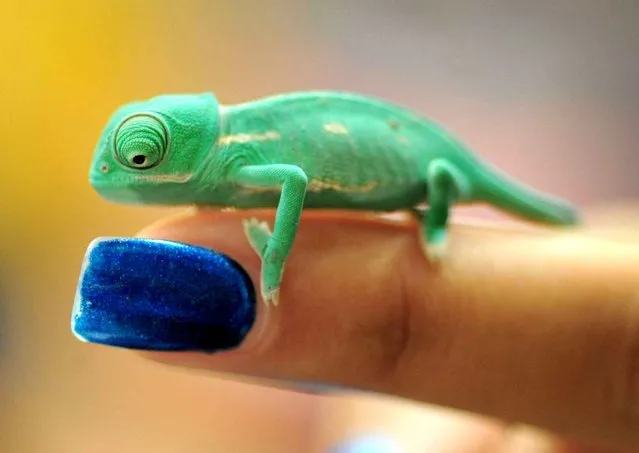
A one month old Turquoise colored Green Veiled Chameleon perches on a finger in the Cardin's Chameleons boothat Repticon 2014 Sunday, August 3, 2014 in Jacksonville, Fla. The vendor specializes in captive bred and born Veiled Chameleons and this particular specimen cost $40.00. (Photo by Bob Self/AP Photo/The Florida Times-Union)

A one month old Turquoise colored Green Veiled Chameleon perches on a finger in the Cardin's Chameleons boothat Repticon 2014 Sunday, August 3, 2014 in Jacksonville, Fla. The vendor specializes in captive bred and born Veiled Chameleons and this particular specimen cost $40.00. The Repticon reptile and Exotic Animal show made its stop in Jacksonville over Saturday and Sunday offering a variety of cold blooded critters and related supplies for sale at the University Center on the University of North Florida campus. The show, which travels nationally stops in Jacksonville several times a year according to event vendor team leader Patty Healey. (Photo by Bob Self/AP Photo/The Florida Times-Union)
Details
09 Aug 2014 11:36:00
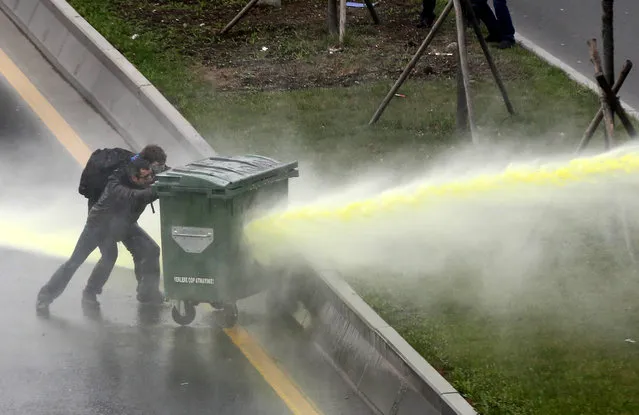
People protect themselves behind a trash can as anti-riot olice fires water cannon to disperse thousands of people demonstrating following the death of Berkin Elvan, a teenage boy wounded in mass anti-government demonstrations last year, on March 11, 2014 near the Middle East Technical University (ODTU) in Ankara. (Photo by Adem Altan/AFP Photo)

People protect themselves behind a trash can as anti-riot olice fires water cannon to disperse thousands of people demonstrating following the death of Berkin Elvan, a teenage boy wounded in mass anti-government demonstrations last year, on March 11, 2014 near the Middle East Technical University (ODTU) in Ankara. Elvan's story – he spent 269 days in a coma – gripped the nation and became a symbol of the heavy-handed tactics used by police to reign in the biggest demonstrations against Prime Minister Recep Tayyip Erdogan since he came to power in 2003. (Photo by Adem Altan/AFP Photo)
Details
13 Mar 2014 09:23:00
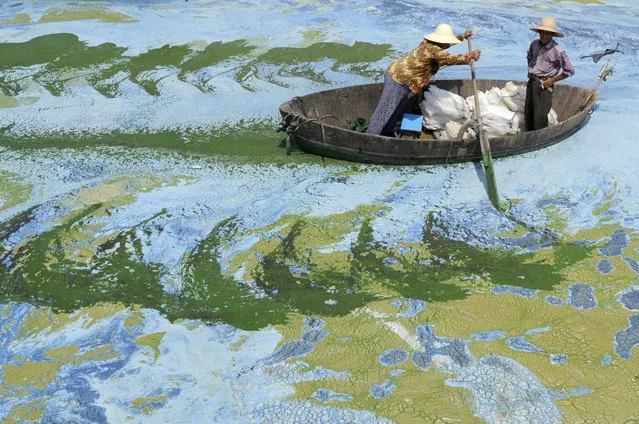
Fishermen row a boat in the algae-filled Chaohu Lake in Hefei, Anhui province, June 19, 2009. The country has invested 51 billion yuan ($7.4 billion) towards the construction of 2,712 projects for the treatment of eight rivers and lakes including Huaihe River, Haihe River, Liaohe River, Chaohu Lake, Dianchi Lake, Songhua River, the Three Gorges region of the Yangtze River and its upstream area, Xinhua News Agency reported. (Photo by Jianan Yu/Reuters)

Growing cities, overuse of fertilizers and factory wastewater have degraded China's water supplies to the extent that half the nation's rivers and lakes are severely polluted. China aims to spend $850 billion to improve filthy water supplies over the next decade, but even such huge outlays may do little to reverse damage caused by decades of pollution and overuse in Beijing's push for rapid economic growth. Photo: Fishermen row a boat in the algae-filled Chaohu Lake in Hefei, Anhui province, June 19, 2009. (Photo by Jianan Yu/Reuters)
Details
03 Aug 2014 08:01:00
Small transportation boats, known as bumboats, leave trails of light as they travel across Marina Bay past the skyline of Singapore in this photo taken in 2004. Singapore holds a Jubilee weekend from 7 to 10 August to celebrate the 50th anniversary of its independence. (Photo by Edgar Su/Reuters)

Small transportation boats, known as bumboats, leave trails of light as they travel across Marina Bay past the skyline of Singapore in this photo taken in 2004. Singapore holds a Jubilee weekend from 7 to 10 August to celebrate the 50th anniversary of its independence. Fifty years ago, hundreds of small boats lined the Singapore river in the city centre. Today, most small boats are gone, except a handful of neon-lit tourist ferries. Maritime trade is still the backbone of the city-state but after decades of rapid growth Singapore, which at less than half the size of London is among the world’s most densely populated nations, is also a popular tourist destination and a thriving global financial hub. (Photo by Edgar Su/Reuters)
Details
01 Aug 2015 12:26:00
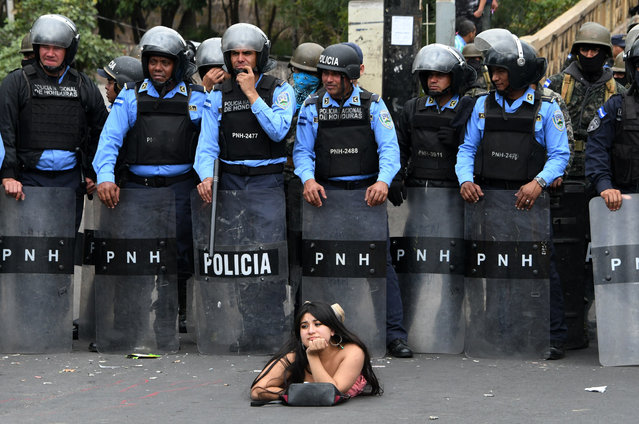
A supporter of the presidential candidate for the Honduran Opposition Alliance Against the Dictatorship for the past election, Salvador Nasralla, lies on the street in front of police officers during a demonstration against the contested re-election of President Juan Orlando Hernandez, in Tegucigalpa, Honduras on January 21, 2018. The opposition called for a “national strike” on Saturday to focus on blocking the country's main roads ahead of the start of the president's new term in office on January 27. Dozens of people have been killed and hundreds jailed since Hernandez was declared the winner of the November 26 run-off election – but only after a three week stretch of often-interrupted ballot counting that stoked tensions and sparked accusations of fraud in the Central American country. (Photo by Orlando Sierra/AFP Photo)

A supporter of the presidential candidate for the Honduran Opposition Alliance Against the Dictatorship for the past election, Salvador Nasralla, lies on the street in front of police officers during a demonstration against the contested re-election of President Juan Orlando Hernandez, in Tegucigalpa, Honduras on January 21, 2018. (Photo by Orlando Sierra/AFP Photo)
Details
23 Jan 2018 08:32:00
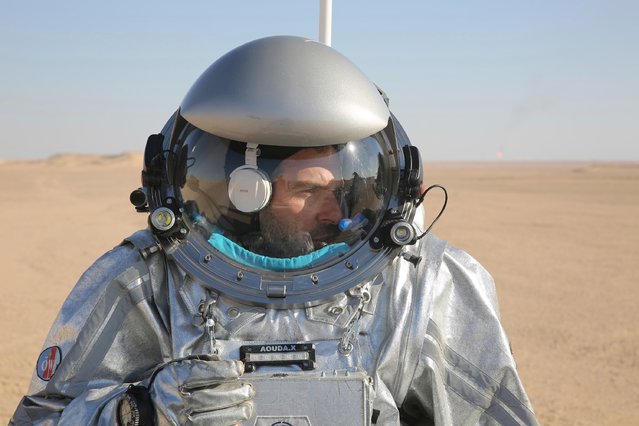
This February 7, 2018, photo shows João Lousada, a flight controller for the International Space Station, wearing an experimental space suit during a simulation of a future Mars mission in the Dhofar desert of southern Oman. (Photo by Sam McNeil/AP Photo)

This February 7, 2018, photo shows João Lousada, a flight controller for the International Space Station, wearing an experimental space suit during a simulation of a future Mars mission in the Dhofar desert of southern Oman. The desolate desert in southern Oman resembles Mars so much that more than 200 scientists from 25 nations organized by the Austrian Space Forum are using it for the next four weeks to field-test technology for a manned mission to Mars. (Photo by Sam McNeil/AP Photo)
Details
10 Feb 2018 07:02:00
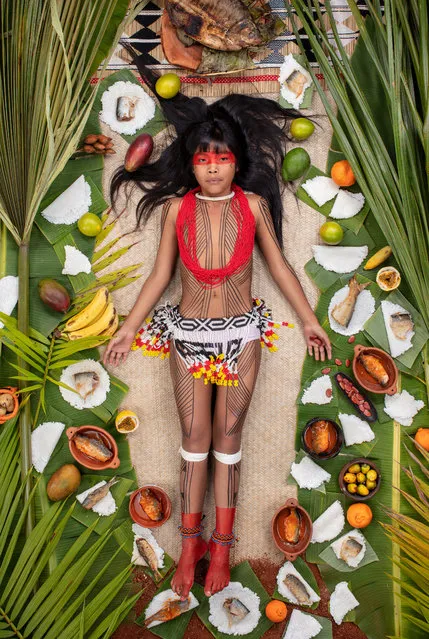
Kawakanih Yawalapiti, 9, Upper Xingu region of Mato Grosso, Brazil, 2018: Kawakanih lives with her tribe, the Yawalapiti, in Xingu national park, a preserve in the Amazon basin of Brazil. The Yawalapiti collect seeds to preserve species unique to their ecosystem, which lies between the rain forest and savannah. Kawakanih’s diet is simple, consisting mainly of fish, cassava, porridge, fruit and nuts. “It takes five minutes to catch dinner”, says Kawakanih. “When you’re hungry, you just go to the river with your net”. (Photo by Gregg Segal/The Guardian)

Photographer Gregg Segal travelled the world to document children and the food they eat in a week. Partly inspired by the increasing problems of childhood obesity, he tracked traditional regional diets as yet unaffected by globalisation, and ironically, found that the healthiest diets were often eaten by the least well off. (Photo by Gregg Segal/The Guardian)
Details
03 Jul 2019 00:03:00
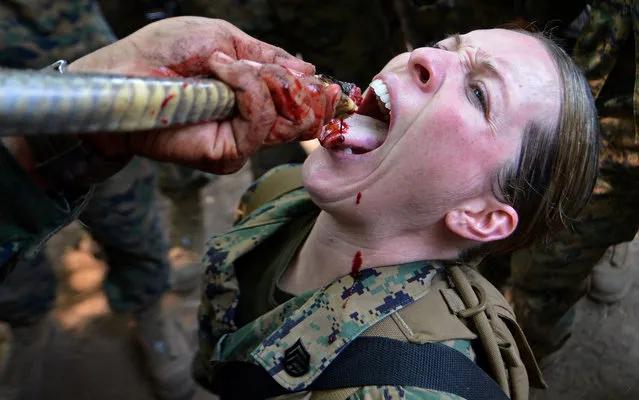
In a military base in the Thai province of Chon Buri February 20 U.S. Marines Navy with Thailand began their studies in jungle survival. The event is held in joint military exercises “Cobra Gold 2013”. During a jungle survival program February 20, 2013 taught by Royal Thai Special Forces in Sannapit, Thailand, U.S. Marines learned to catch cobras and drink their fresh blood, not to mention eat forest insects and pull the heads off of chicken. The training was part of Operation Cobra Gold 13, the 32nd edition of international military exercises hosted by the Thai. According to a U.S. Marines press release, Cobra Gold is the largest exercise of its kind in Asia and incorporates troops from five other nations in addition to the U.S. and Thailand. The Daily Mail reports that the Marines were invited to experience the local custom of drinking cobra blood after being taught to catch and kill cobras in the wild. As CNN notes, Cobra blood is believed to be a panacea and aphrodiasic in parts of Southeast Asia. In Jakarta, vendors can earn over $100 a night selling shots of cobra blood mixed with liquor. (Photo by Pornchai Kittiwongsakul/AFP Photo)

During a jungle survival program February 20, 2013 taught by Royal Thai Special Forces in Sannapit, Thailand, U.S. Marines learned to catch cobras and drink their fresh blood, not to mention eat forest insects and pull the heads off of chicken. The training was part of Operation Cobra Gold 13, the 32nd edition of international military exercises hosted by the Thai. According to a U.S. Marines press release, Cobra Gold is the largest exercise of its kind in Asia and incorporates troops from five other nations in addition to the U.S. and Thailand. The Daily Mail reports that the Marines were invited to experience the local custom of drinking cobra blood after being taught to catch and kill cobras in the wild. As CNN notes, Cobra blood is believed to be a panacea and aphrodiasic in parts of Southeast Asia. In Jakarta, vendors can earn over $100 a night selling shots of cobra blood mixed with liquor. (Photo by Pornchai Kittiwongsakul/AFP Photo)
Details
23 Feb 2013 11:52:00