Loading...
Done
Mayu adjusts Koiku’s kimono, as Koiku wears a protective face mask while posing for a photograph, before they work at a party where they will entertain with other geisha at Japanese luxury restaurant Asada in Tokyo, Japan, June 23, 2020. The coronavirus pandemic has made Tokyo's geisha fear for their centuries-old profession as never before. Though the number of geisha - famed for their witty conversation, beauty and skill at traditional arts - has been falling for years, they were without work for months due to Japan's state of emergency and now operate under awkward social distancing rules. Engagements are down 95 percent, and come with new rules: no pouring drinks for customers or touching them even to shake hands, and sitting 2 meters apart. Masks are hard to wear with their elaborate wigs, so they mostly don't. “I was just full of anxiety”, said Mayu, 47. “I went through my photos, sorted my kimonos ... The thought of a second wave is terrifying”. (Photo by Kim Kyung-Hoon/Reuters)

Mayu adjusts Koiku’s kimono, as Koiku wears a protective face mask while posing for a photograph, before they work at a party where they will entertain with other geisha at Japanese luxury restaurant Asada in Tokyo, Japan, June 23, 2020. (Photo by Kim Kyung-Hoon/Reuters)
Details
23 Jul 2020 00:03:00
Female metro passengers hold flowers presented to them by metro workers, prior to International Women's Day in Kiev, Ukraine, 02 March 2016. (Photo by Sergey Dolzhenko/EPA)

Female metro passengers hold flowers presented to them by metro workers, prior to International Women's Day in Kiev, Ukraine, 02 March 2016. The hustle and bustle of the morning commute is broken up by an unexpected surprise. The first passengers to step on the train receive – a warm welcome and a pot of flowers. One woman says, “It's very nice. All the running around and then you're given a flower, it's not often. It's very nice. I'm going to take care of this flower”. International Women's Day first emerged from the activities of labour movements at the turn of the twentieth century, in North America and across Europe, it is celebrated on March 08 in many countries around the world. (Photo by Sergey Dolzhenko/EPA)
Details
03 Mar 2016 11:34:00
Brtukan. “Being a girl of colour in a society where the majority of the people are white, I have had to get used to all the different ways people approach me. From being asked what kind of rap music you listen to and how you wash your hair, to getting told, “you don’t sound black”, “you’re pretty for a black girl” or “you’re not that black so it’s OK”, as if being black is such a bad thing”. (Photo by Lisa Minogue/The Guardian)

As part of FLAIR Melbourne – a Flinders Lane art festival – Melbourne’s Lisa Minogue presents stylised photographic portraits of Australian women of colour, their faces painted vibrantly to accentuate their individuality and encourage the viewer to study each face more closely. Minogue asked each woman the same question: “What do the words “coloured girl” mean to you?”. (Photo by Lisa Minogue/The Guardian)
Details
17 Aug 2016 11:16:00
In the hours 41-year-old Ralph Savelsberg is not working as a physicist for the Dutch Ministry of Defence, he is recreating classic vehicles in everyones favourite bricks. The Lego mad film buff has lived in the UK for the last few years building every famous car in entertainment you can imagine – And the characters to match! From Del Boys Reliant Regal to Chitty Chitty Bang Bang and the Batmobile, has Ralph handmade the most complete set of popular vehicles ever? Ralph said: Building a LEGO set is fun, but Ive always preferred to build my own models. Here: “Ghostbusters”. (Photo by Ralph Savelsberg/Caters News)

In the hours 41-year-old Ralph Savelsberg is not working as a physicist for the Dutch Ministry of Defence, he is recreating classic vehicles in everyones favourite bricks. Ralph said: Building a LEGO set is fun, but I've always preferred to build my own models. Here: “Ghostbusters”. (Photo by Ralph Savelsberg/Caters News)
Details
29 Nov 2016 13:21:00
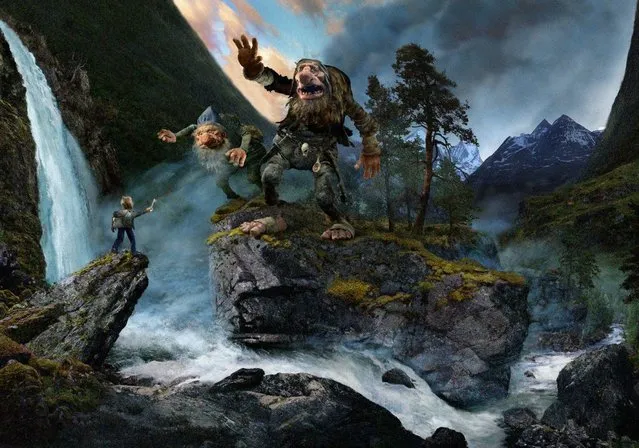
Norwegian Trolls By Ivar Rodningen Part 1

Ivar Rodningem is a professional illustrator, whose imaginative mind transports us into a parallel world where trolls roam the lands. These creatures might seem scary at first sight, but in reality they are very docile and friendly, help each other and humans that they happen to meet. One of their characteristic features is of course their large noses and long tails. They are one with the nature, which is why it is almost impossible to see a troll if he doesn’t want to be found. Just like you and I they love having fun, though it is hard thing to do, considering their size.


See also:Part 2
Details
26 Feb 2015 20:03:00
A file photograph dated 07 January 2006 and released by Greenpeace, showing the Yushin Maru, a factory ship in a Japanese whaling fleet, injuring a whale with it's first harpoon attempt. A UN court in The Hague on 31 March 2014 halted Japan's much-criticized whaling programme, ruling that it contravenes a 1986 moratorium on whale hunting. Japan must end its 'research whaling' programme, the International Court of Justice (ICJ) said. (Photo by Kate Davison/EPA)

A file photograph dated 07 January 2006 and released by Greenpeace, showing the Yushin Maru, a factory ship in a Japanese whaling fleet, injuring a whale with it's first harpoon attempt. A UN court in The Hague on 31 March 2014 halted Japan's much-criticized whaling programme, ruling that it contravenes a 1986 moratorium on whale hunting. Japan must end its 'research whaling' programme, the International Court of Justice (ICJ) said. Japan said the programme was for scientific research and permitted under international conventions. Australia had brought the case to the ICJ in 2010, charging that Japan was breaching international law by killing hundreds of whales every year for commercial purposes. Japan was “deeply disappointed” by the ruling, an unnamed government official was quoted by the Kyodo News agency as saying. But the official said Japan would stand by the ruling. (Photo by Kate Davison/EPA)
Details
01 Apr 2014 08:38:00
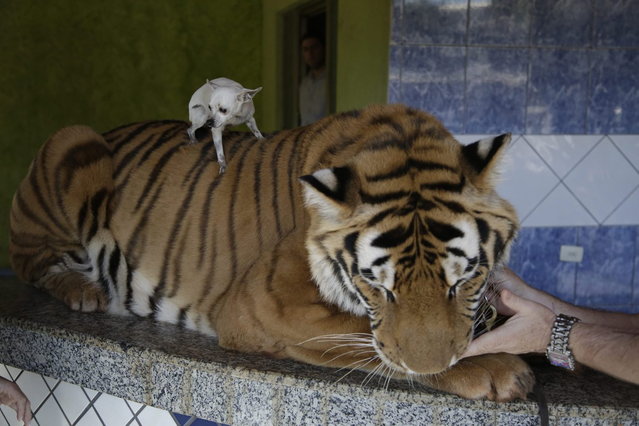
The Borges' family pet dog, Little, is placed on the back of Tom, their tiger, for a photo to be taken, in Maringa, Brazil, Friday, September 27, 2013. The Brazilian family is now locked in a legal dispute for the big cats, they have eight tigers and two lions, with federal wildlife officials working to take them away. While Borges does have a license to raise the animals, Brazilian wildlife officials say he illegally bred the cats, creating a public danger. (Photo by Renata Brito/AP Photo)

“Ary Borges and his family live in southern Brazil like most families the Borges' love animals and have an array of cats living in their home. The only difference between the cats owned by the Borges family and the cat that is cuddled up on your lap as you read this is the Borges' cats weigh over 700 pounds and could kill you just as soon as look at you. The Borges family shares their home with nine tigers, two lionesses, a chimp and a Chihuahua”. – Amanda Schiavo via Latin Times. Photo: The Borges' family pet dog, Little, is placed on the back of Tom, their tiger, for a photo to be taken, in Maringa, Brazil, Friday, September 27, 2013. (Photo by Renata Brito/AP Photo)

Details
04 Oct 2013 11:51:00
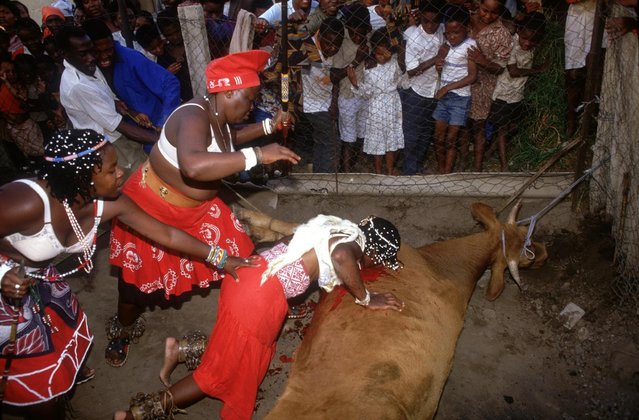
South African Sangomas are wizards and witches who are supposedly chosen by their ancestors to follow a traditional training and go through a rite of passage after which they become Sangomas and can cure and help people. They are so respected and trusted that western medical authorities have actually advised the government of South Africa to develop its cooperation with Sangomas in order to improve hygiene and health among the population. Today is graduation day for Trissa, 25, a Sangoma student in Tembisa, near Pretoria. Thanks to the help of the spirits of her ancestors, she has found a cow that had been hidden. The cow has then been killed by Sangoma Thelma and Trissa is now drinking its blood, thus becoming a Sangoma and changing her name to Nomadlozi. Location: Tembisa, near Pretoria, South Africa. (Photo by Patrick Durand/Sygma via Getty Images)

South African Sangomas are wizards and witches who are supposedly chosen by their ancestors to follow a traditional training and go through a rite of passage after which they become Sangomas and can cure and help people. They are so respected and trusted that western medical authorities have actually advised the government of South Africa to develop its cooperation with Sangomas in order to improve hygiene and health among the population. (Photo by Patrick Durand/Sygma via Getty Images)
Details
24 Feb 2017 00:05:00