Loading...
Done
Double tornadoes, lightning storms and rotating supercells – this is what it's like to chase storms for a year. These dramatic images show apocalyptic weather throughout 2014 from a lightning storm to a pair of rainbows. Roger Hill, 57, has been chasing storms in the United States for thirty years and runs a tour operation with his wife Caryn. (Photo by Roger Hill/Barcroft Media)

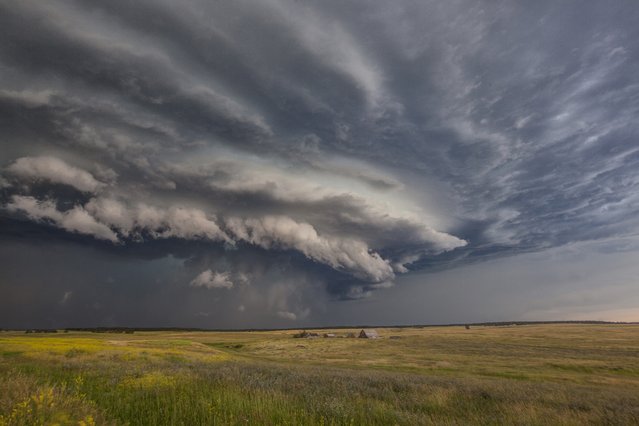
Double tornadoes, lightning storms and rotating supercells – this is what it's like to chase storms for a year. These dramatic images show apocalyptic weather throughout 2014 from a lightning storm to a pair of rainbows. Roger Hill, 57, has been chasing storms in the United States for thirty years and runs a tour operation with his wife Caryn. Here: a hailstorm rolls over fields, on July 22, 2014, in South Dakota. (Photo by Roger Hill/Barcroft Media)
Details
04 Jan 2015 13:08:00
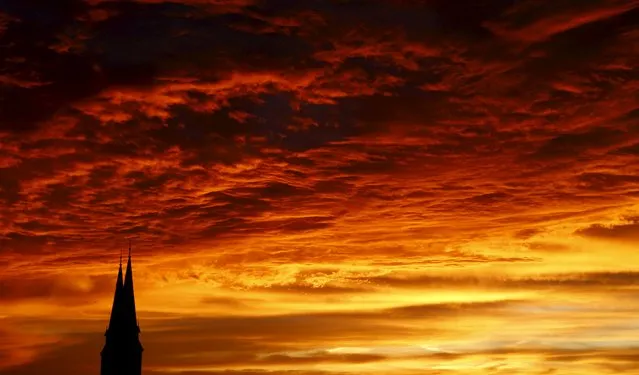
The rising sun illuminates the sky above the spires of a church in Vienna, Austria, November 17, 2015. (Photo by Heinz-Peter Bader/Reuters)

The rising sun illuminates the sky above the spires of a church in Vienna, Austria, November 17, 2015. (Photo by Heinz-Peter Bader/Reuters)
Details
19 Nov 2015 08:05:00
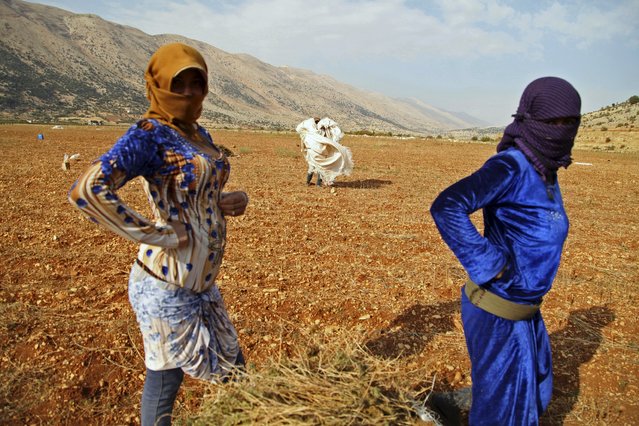
Aisha, 15, (L) (who asked to withhold her last name), a Syrian refugee from Raqqa, waits with a fellow refugee while harvesting cannabis in the Bekaa valley, Lebanon October 19, 2015. Syrian refugees work to harvest and process spiky-leafed cannabis plants in neighbouring Lebanon’s Bekaa Valley. (Photo by Alia Haju/Reuters)

Aisha, 15, (L) (who asked to withhold her last name), a Syrian refugee from Raqqa, waits with a fellow refugee while harvesting cannabis in the Bekaa valley, Lebanon October 19, 2015. Syrian refugees work to harvest and process spiky-leafed cannabis plants in neighbouring Lebanon’s Bekaa Valley. Often farmers of cotton and wheat back home in Raqqa province – now the de facto capital of Islamic State – the conflict in Syria drove them to seek safety in a region where Syrian migrant workers used to spend a few months a year before returning home. (Photo by Alia Haju/Reuters)
Details
24 Dec 2015 08:03:00
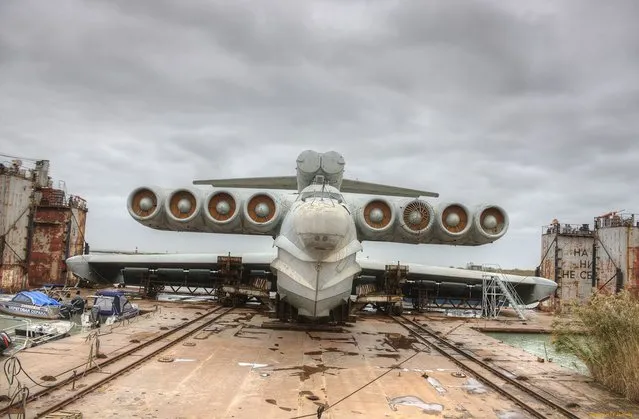
The Lun-class Ekranoplane was used by the Soviet Navy starting in 1987, and wasn't retired until the late 1990s, after the Soviet Union's fall. (Igor113)

“The Lun-class ekranoplan (NATO reporting name Duck) was a ground effect vehicle (GEV) designed by Rostislav Evgenievich Alexeev and used by the Soviet and Russian navies from 1987 until sometime in the late 1990s. It “flew” using the lift generated by the ground effect of its large wings when close to the surface of the water – about four metres or less. Although they might look similar and/or have related technical characteristics, ekranoplans like the Lun are not aircraft, seaplanes, hovercraft, or hydrofoils – ground effect is a separate technology altogether. The International Maritime Organization classifies these vehicles as maritime ships. The name Lun comes from the Russian for harrier”. – Wikipedia (Photo by Igor113)
Details
08 Aug 2014 10:51:00
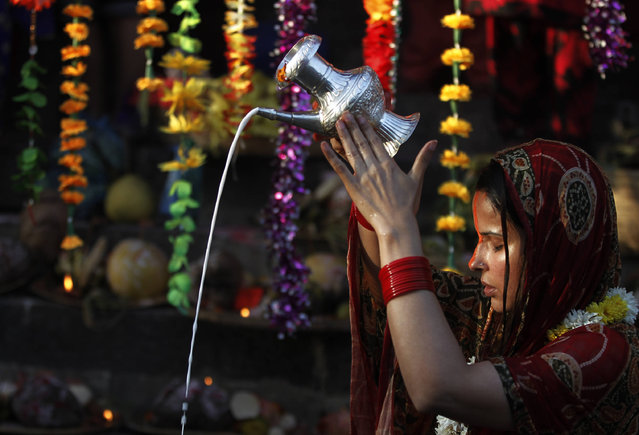
A Nepalese woman pours milk as she offers prayers to the setting Sun on the banks of the Bagmati River during the Chhath Puja festival in Kathmandu, Nepal, Sunday, November 6, 2016. During Chhath, an ancient Hindu festival, rituals are performed to thank the Sun God for sustaining life on earth. (Photo by Niranjan Shrestha/AP Photo)

A Nepalese woman pours milk as she offers prayers to the setting Sun on the banks of the Bagmati River during the Chhath Puja festival in Kathmandu, Nepal, Sunday, November 6, 2016. During Chhath, an ancient Hindu festival, rituals are performed to thank the Sun God for sustaining life on earth. (Photo by Niranjan Shrestha/AP Photo)
Details
08 Nov 2016 11:30:00
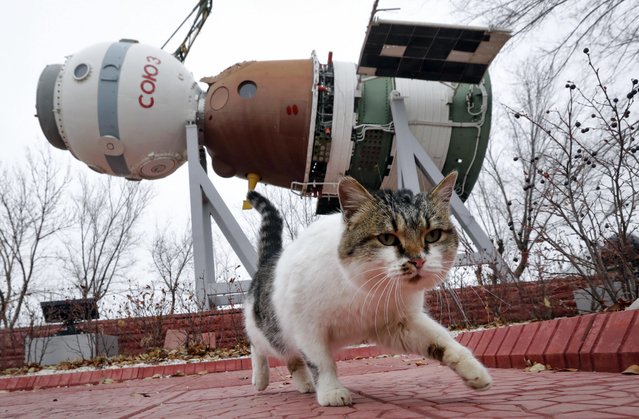
A cat walks past a Soyuz space ship installed at a museum, at the Russian leased Baikonur cosmodrome, Kazakhstan, Tuesday, November 15, 2016. The start of the new Soyuz mission to the International Space Station (ISS) is scheduled on early Friday, Nov. 18 local time. The Russian rocket will carry French astronaut Thomas Pesquet, Russian cosmonaut Oleg Novitsky and U.S. astronaut Peggy Annette Whitson. (Photo by Dmitri Lovetsky/AP Photo)

A cat walks past a Soyuz space ship installed at a museum, at the Russian leased Baikonur cosmodrome, Kazakhstan, Tuesday, November 15, 2016. The start of the new Soyuz mission to the International Space Station (ISS) is scheduled on early Friday, Nov. 18 local time. The Russian rocket will carry French astronaut Thomas Pesquet, Russian cosmonaut Oleg Novitsky and U.S. astronaut Peggy Annette Whitson. (Photo by Dmitri Lovetsky/AP Photo)
Details
16 Nov 2016 11:25:00
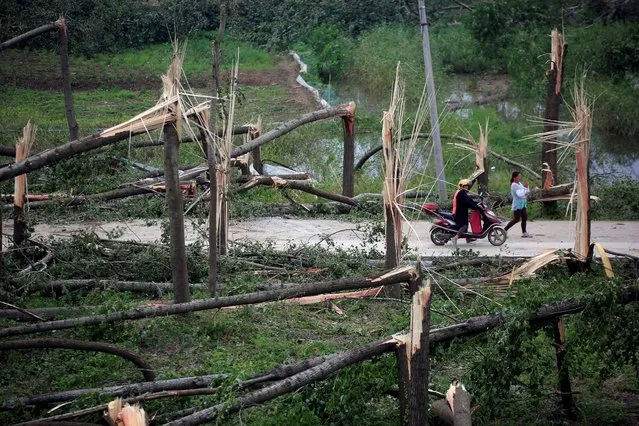
People look at damaged trees after a tornado hit Funing on Thursday, in Yancheng, Jiangsu province, China June 24, 2016. (Photo by Aly Song/Reuters)

People look at damaged trees after a tornado hit Funing on Thursday, in Yancheng, Jiangsu province, China June 24, 2016. (Photo by Aly Song/Reuters)
Details
25 Jun 2016 11:48:00
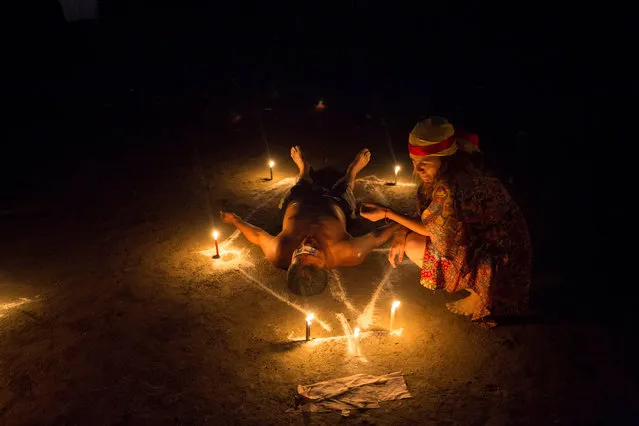
A man lies on the floor during a ritual at the Sorte Mountain on the outskirts of Chivacoa, in the state of Yaracuy, Venezuela October 10, 2015. (Photo by Marco Bello/Reuters)

A man lies on the floor during a ritual at the Sorte Mountain on the outskirts of Chivacoa, in the state of Yaracuy, Venezuela October 10, 2015. One long night every year in a mountainous rainforest in Venezuela, hundreds gather to dance on red-hot embers, enter trance-like states, and worship an ancient goddess known as Maria Lionza. Those who travel to the mountain known as Sorte in central Venezuela are practitioners of a cult that is built on local indigenous traditions. (Photo by Marco Bello/Reuters)
Details
08 Jul 2016 12:19:00