Loading...
Done
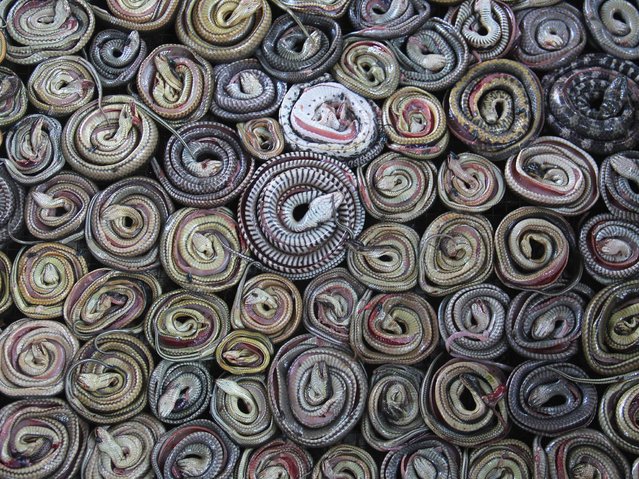
Snakes are collected and rolled before putting into the oven on March 2, 2014 in the village of Kertasura, Cirebon, Indonesia. (Photo by Nurcholis Anhari Lubis/Getty Images)

Snakes are collected and rolled before putting into the oven on March 2, 2014 in the village of Kertasura, Cirebon, Indonesia. At slaughter house snake skins measuring in the hundreds of metres, are sold to bag factories in the West and Central Java provinces on a monthly basis. From snake skin was manufactured into bags, shoes, wallets and belts. The price of a bag made from snake skin costs between 150,000 rupiah ($15 USD) and 300,000 rupiah ($30 USD), depending on its size. When snake skins reach Western fashion houses their price can increase dramatically and sell for up to $4,000 USD. (Photo by Nurcholis Anhari Lubis/Getty Images)
Details
05 Mar 2014 07:31:00
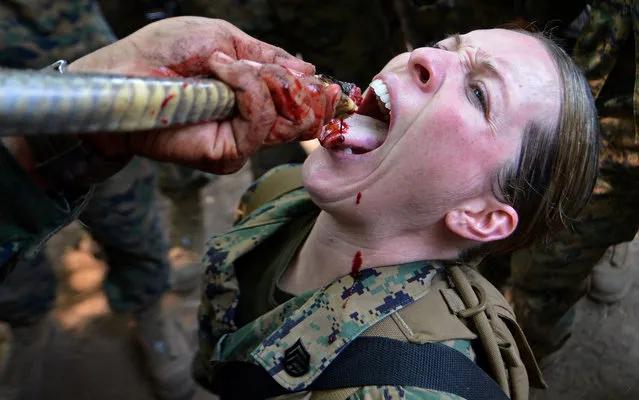
In a military base in the Thai province of Chon Buri February 20 U.S. Marines Navy with Thailand began their studies in jungle survival. The event is held in joint military exercises “Cobra Gold 2013”. During a jungle survival program February 20, 2013 taught by Royal Thai Special Forces in Sannapit, Thailand, U.S. Marines learned to catch cobras and drink their fresh blood, not to mention eat forest insects and pull the heads off of chicken. The training was part of Operation Cobra Gold 13, the 32nd edition of international military exercises hosted by the Thai. According to a U.S. Marines press release, Cobra Gold is the largest exercise of its kind in Asia and incorporates troops from five other nations in addition to the U.S. and Thailand. The Daily Mail reports that the Marines were invited to experience the local custom of drinking cobra blood after being taught to catch and kill cobras in the wild. As CNN notes, Cobra blood is believed to be a panacea and aphrodiasic in parts of Southeast Asia. In Jakarta, vendors can earn over $100 a night selling shots of cobra blood mixed with liquor. (Photo by Pornchai Kittiwongsakul/AFP Photo)

During a jungle survival program February 20, 2013 taught by Royal Thai Special Forces in Sannapit, Thailand, U.S. Marines learned to catch cobras and drink their fresh blood, not to mention eat forest insects and pull the heads off of chicken. The training was part of Operation Cobra Gold 13, the 32nd edition of international military exercises hosted by the Thai. According to a U.S. Marines press release, Cobra Gold is the largest exercise of its kind in Asia and incorporates troops from five other nations in addition to the U.S. and Thailand. The Daily Mail reports that the Marines were invited to experience the local custom of drinking cobra blood after being taught to catch and kill cobras in the wild. As CNN notes, Cobra blood is believed to be a panacea and aphrodiasic in parts of Southeast Asia. In Jakarta, vendors can earn over $100 a night selling shots of cobra blood mixed with liquor. (Photo by Pornchai Kittiwongsakul/AFP Photo)
Details
23 Feb 2013 11:52:00
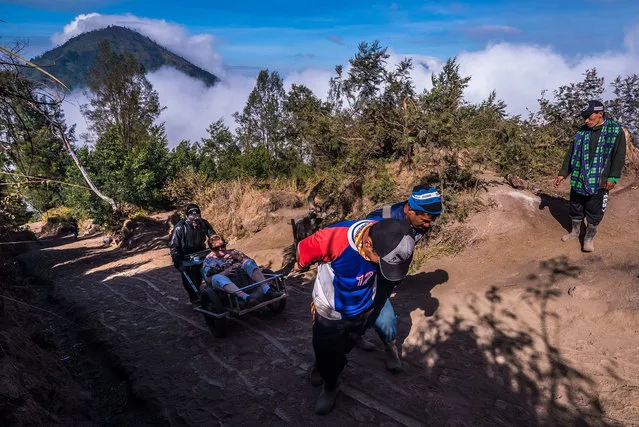
Miners pulling up lazy tourists to the rim of Kawah Ijen (Ijen Volcano), East Java, Indonesia on September 21, 2017. They will earn as much as they would bring down a load of sulfur. Nomadic Explorer, Cultural Lifestyle Photographer Claudio Sieber captured striking images of miners working at Ijen volcanic range in East Java, Indonesia. The sulphur miners risk their lives daily as they climb the active volcano carrying heavy loads, which they sell to sugar refineries. Shortly after midnight curious tourists are flocking in hundreds through the gate of Ijen's foothills to be right on time, driven by the images others took before them. Kawah Ijen is the one of the world's largest acidic volcanic crater lake; famous for its turquoise color as well as the unreal atmosphere it offers during darkness. A dusty path zigzags 3 kilometers up to the crater rim. This doesn't mean anything challenging; in particular, special sights have to be deserved anyway. The irritating smell of sulfur announces the near of the crater's existence. Arriving on the crater's rim the reward for the torture becomes visible. Blue fire darts its tongues through the fumes of sulfur dioxide. Somehow, the spectacle isn't as romantic as expected, since it is also the rough working space of approx. 150 sulfur miners who start their shift at 1 am. Lately, harvesting the abundance of devil's gold received international attention. This did obviously not really improve a miner's lifestyle; neither did it contribute to a better wage. (Photo by Claudio Sieber/Barcroft Images)

Miners pulling up lazy tourists to the rim of Kawah Ijen (Ijen Volcano), East Java, Indonesia on September 21, 2017. They will earn as much as they would bring down a load of sulfur. Nomadic Explorer, Cultural Lifestyle Photographer Claudio Sieber captured striking images of miners working at Ijen volcanic range in East Java, Indonesia. The sulphur miners risk their lives daily as they climb the active volcano carrying heavy loads, which they sell to sugar refineries. (Photo by Claudio Sieber/Barcroft Images)
Details
02 Oct 2017 08:31:00
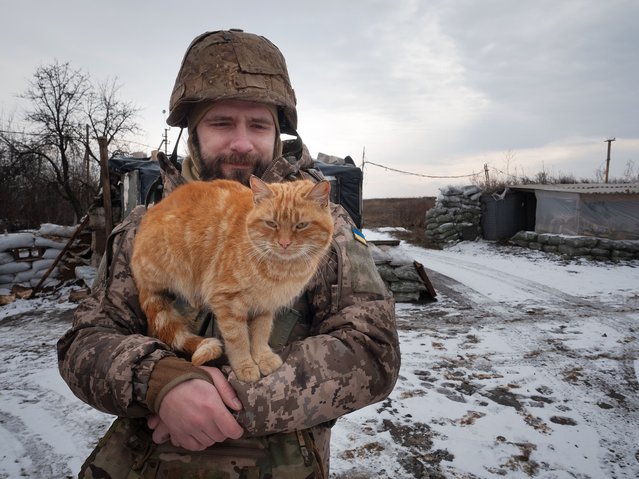
Ukrainian Serviceman Oleksii Hodzenko, aka Godzilla, was a civilian journalist. His father, Sergeant chief Dmytro "Godzilla" Godzenko was killed on March 31, 2016 at 6 a.m. in a mortar attack near the village of Zaitsevo near Horlivka in the Donetsk region. Since then Godzilla "junior" has joined the army, at a frontline position held by Ukraine's 503rd Detached Marine Battalion on February 7, 2022 near Verkhnotoretske, Ukraine. Regional tensions remain high as Russia continues to amass soldiers and military equipment along its border with Ukraine, where large swaths of the Luhansk and Donetsk regions are held by Russian-backed separatists. Russia has also moved roughly 30,000 troops into Belarus, which borders Ukraine to the north. American and European officials say they do not whether Russian President Vladimir Putin has made a decision to invade Ukraine, but have issued a series of warnings about the country's assertive military posture. (Photo by Gaelle Girbes/Getty Images)

Ukrainian Serviceman Oleksii Hodzenko, aka Godzilla, was a civilian journalist. His father, Sergeant chief Dmytro "Godzilla" Godzenko was killed on March 31, 2016 at 6 a.m. in a mortar attack near the village of Zaitsevo near Horlivka in the Donetsk region. Since then Godzilla "junior" has joined the army, at a frontline position held by Ukraine's 503rd Detached Marine Battalion on February 7, 2022 near Verkhnotoretske, Ukraine. Regional tensions remain high as Russia continues to amass soldiers and military equipment along its border with Ukraine, where large swaths of the Luhansk and Donetsk regions are held by Russian-backed separatists. Russia has also moved roughly 30,000 troops into Belarus, which borders Ukraine to the north. American and European officials say they do not whether Russian President Vladimir Putin has made a decision to invade Ukraine, but have issued a series of warnings about the country's assertive military posture. (Photo by Gaelle Girbes/Getty Images)
Details
13 Mar 2022 04:03:00
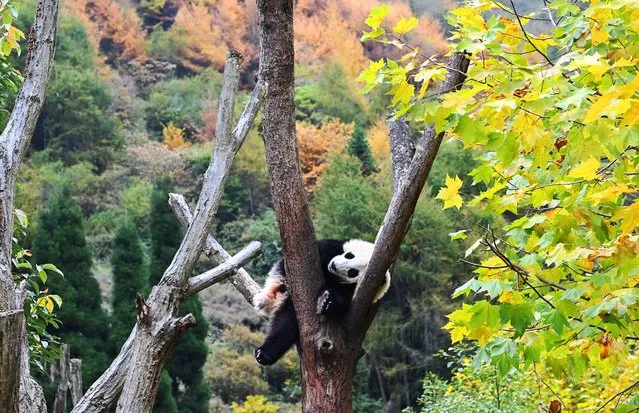
Giant pandas are playing and foraging inside the Shenshuping base of China Conservation and Research Center for the Giant Panda in Wolong National Nature Reserve on November 3, 2021 in Aba Tibetan and Qiang Autonomous Prefecture, Sichuan Province of China. Shenshuping base sits in Aba Tibetan and Qiang Autonomous Prefecture and is committed to the panda's breeding and reproduction. It is the largest conservation and research center for giant pandas along with the bases in Dujiangyan and Ya'an cities in Sichuan. (Photo by An Yuan/China News Service via Getty Images)

Giant pandas are playing and foraging inside the Shenshuping base of China Conservation and Research Center for the Giant Panda in Wolong National Nature Reserve on November 3, 2021 in Aba Tibetan and Qiang Autonomous Prefecture, Sichuan Province of China. (Photo by An Yuan/China News Service via Getty Images)
Details
09 Nov 2021 07:23:00
NASA's rover Opportunity visits Victoria Crater, viewed from orbit by the High Resolution Imaging Science Experiment on NASA's Mars Reconnaissance Orbiter in october of 2006. Opportunity is a small dot on the crater's lip, at top right. Opportunity first reached the crater's rim on September 27, 2006. (Photo by NASA/JPL-Caltech/University of Arizona/The Atlantic)

“NASA's Mars rover Opportunity just celebrated its ninth anniversary on Mars – a mission that was originally meant to last just 90 days...” – The Atlantic. Photo: NASA's rover Opportunity visits Victoria Crater, viewed from orbit by the High Resolution Imaging Science Experiment on NASA's Mars Reconnaissance Orbiter in october of 2006. Opportunity is a small dot on the crater's lip, at top right. Opportunity first reached the crater's rim on September 27, 2006. (Photo by NASA/JPL-Caltech/University of Arizona via The Atlantic)


Details
14 Feb 2013 10:58:00
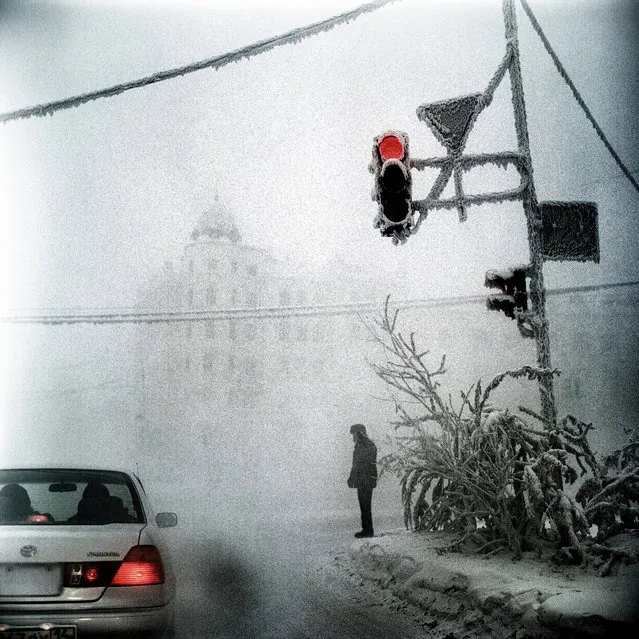
January 2013. A scene in Yakutsk, Siberia, the coldest city in the world. (Photo by Steeve Iuncker/Agence VU)

Yakutsk, a remote city in Eastern Siberia along the Lena River, is the coldest city in the world. Located 1840 km away from Irkoustk and 5000 km away from Moscow, this city founded in 1632 by the Cossacks imposes upon its inhabitants an extreme way of life. And yet, despite particularly harsh conditions, Yakutsk boasts a population of 270,000, or a quarter of the entire population of Siberia. No other place on the planet experiences the temperature extreme found here: in winter, the temperatures regularly fall to minus 40° (the coldest temperature recorded was –64°C) and in summer often reaches temperatures above 30°C. Photo: January 2013. A scene in Yakutsk, Siberia, the coldest city in the world. (Photo by Steeve Iuncker/Agence VU)
Details
29 Apr 2013 10:30:00
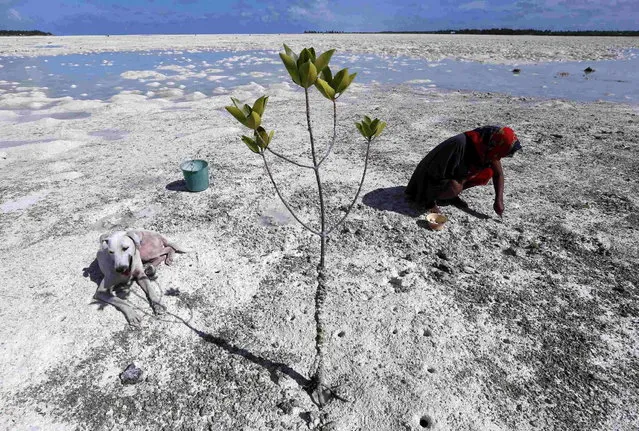
A dog sits in the shade of a mangrove tree as a woman uses a fork to dig for shellfish on the reef-mud flats of a lagoon located at South Tarawa in the central Pacific island nation of Kiribati May 23, 2013. (Photo by David Gray/Reuters)

A dog sits in the shade of a mangrove tree as a woman uses a fork to dig for shellfish on the reef-mud flats of a lagoon located at South Tarawa in the central Pacific island nation of Kiribati May 23, 2013. Kiribati consists of a chain of 33 atolls and islands that stand just metres above sea level, spread over a huge expanse of otherwise empty ocean. With surrounding sea levels rising, Kiribati President Anote Tong has predicted his country will likely become uninhabitable in 30-60 years because of inundation and contamination of its freshwater supplies. (Photo by David Gray/Reuters)
Details
13 Jun 2013 09:23:00