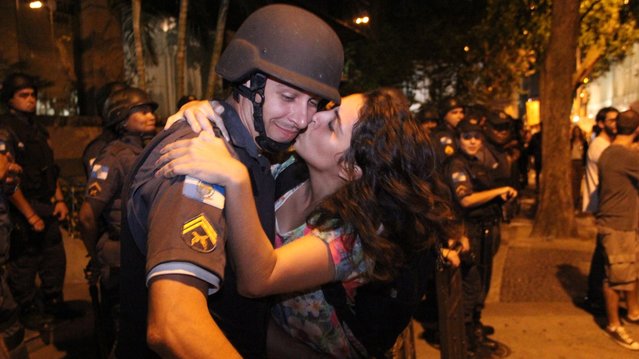
The student Patricia Vasconcellos de Almeida, 22, tried to kiss one of the military police who formed a cordon ostensibly in front of the building Fetranspor (Federation of Transport Companies), in Rio de Janeiro, on June 27, 2013. (Photo by Zulmair Rocha/UOL)
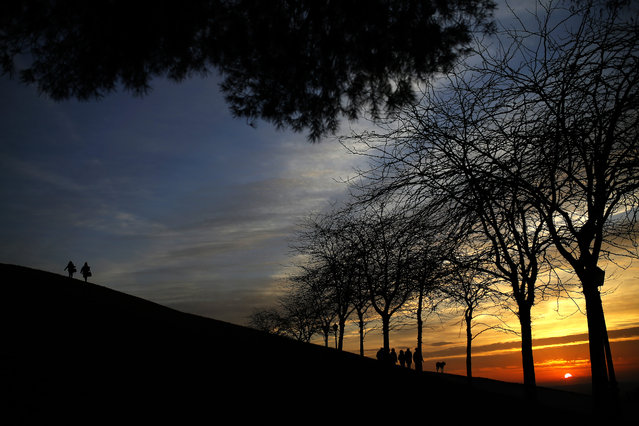
People stroll alongside one of the hills of the Tio Pio park in Madrid, Monday, January 25, 2016. The park is a high viewpoint frequented mostly by locals due to its view of the Spanish capital skyline. (Photo by Francisco Seco/AP Photo)
Models backstage ahead of the St George New Generation show at Mercedes-Benz Fashion Week Australia 2015 at Carriageworks on April 16, 2015 in Sydney, Australia. (Photo by Brendon Thorne/Getty Images)
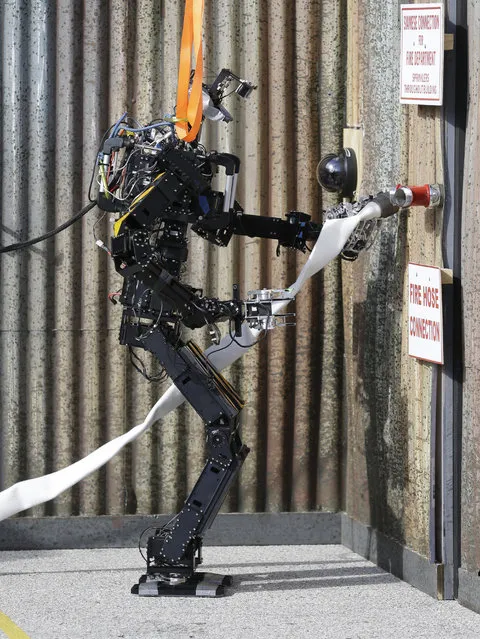
Thor, Virginia Tech College of Engineering, Robotics and Mechanisms Laboratory, tries to connect the hose to a firehose connection during the hose task at the Homestead-Miami Speedway, Friday, December 20, 2013, in Homestead, Fla. (Photo by Alan Diaz/AP Photo)
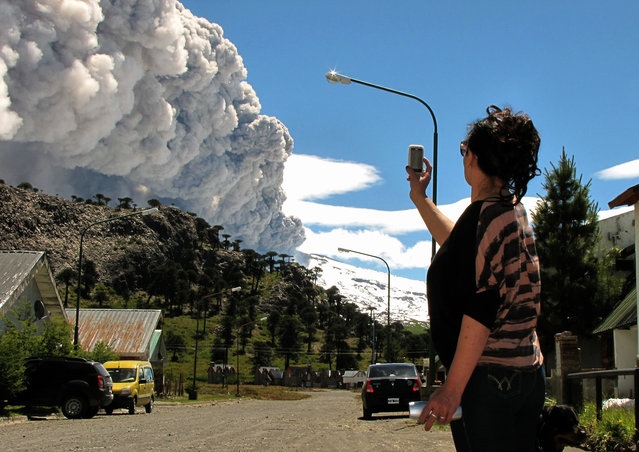
A woman takes a picture with her mobile phone from Caviahue, Neuquen province, Argentina, some 1500 km southwest of Buenos Aires, of the Copahue volcano spewing ashes on December 22, 2012. The authorities of Chile and Argentina issued yellow alerts due to the eruption of the Copahue volcano, placed in the border between both countries. (Photo by Antonio Huglich/AFP Photo)
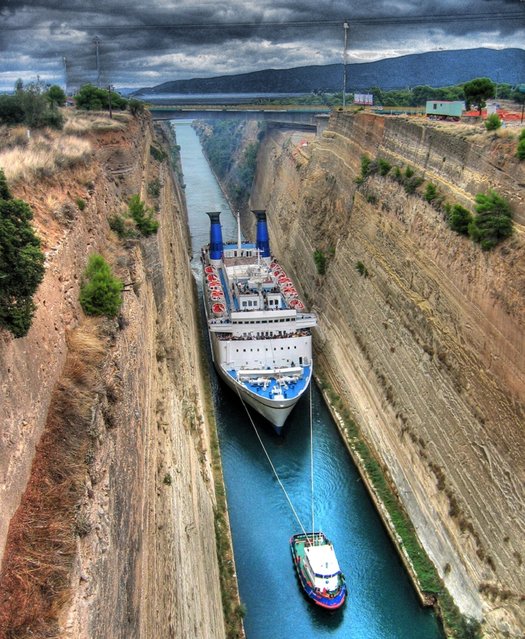
The Corinth Canal is a canal that connects the Gulf of Corinth with the Saronic Gulf in the Aegean Sea. It cuts through the narrow Isthmus of Corinth and separates the Peloponnesian peninsula from the Greek mainland, thus effectively making the former an island. The builders dug the canal through the Isthmus at sea level; no locks are employed. It is 6.4 kilometres (4.0 mi) in length and only 21.3 metres (70 ft) wide at its base, making it unpassable for most modern ships. It now has little economic importance.