Loading...
Done
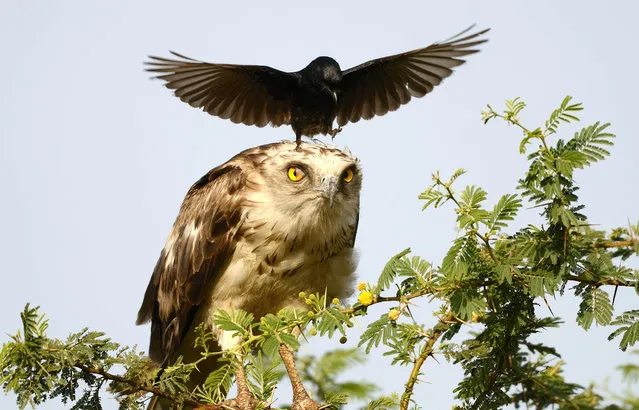
A crow lands on the eagles head much to the eagles displeasure. (Photo by Greaves B. Henriksen/Caters News Agency)

These pictures show a rather annoying crow irritating an eagle. The crow tirelessly circles the bird of prey and repeatedly lands on his head – much to the crows displeasure. The encounter was spotted by Greaves Henriksen in Tamilnadu, India. The 52-year-old amateur photographer believes the eagle was sitting close to a nest, which the crow was trying to defend. Here: A crow lands on the eagles head much to the eagles displeasure. (Photo by Greaves B. Henriksen/Caters News Agency)
Details
09 Feb 2017 00:03:00
A Dogue de Bordeaux. (Photo by Nick Ridley Photography/Caters News Agency)

A British photographer has captured the hilarious expressions pulled by dogs as they go for a run. From popping eyes to lolling tongues, Nick Ridley from Aylesbury in Buckinghamshire has managed to perfectly pause the pooches in time as they pull a host of funny faces in the great outdoors. The 56-year-old uses a fast shutter speed and lies on the ground snapping away as the dogs run towards him in order to get the perfect shot. Here: A Dogue de Bordeaux. (Photo by Nick Ridley Photography/Caters News Agency)
Details
31 Mar 2017 08:07:00
An elephant sprays tourists with water in celebration of the Songkran Water Festival in Ayutthaya province, north of Bangkok, Thailand April 11, 2017. (Photo by Chaiwat Subprasom/Reuters)

An elephant sprays tourists with water in celebration of the Songkran Water Festival in Ayutthaya province, north of Bangkok, Thailand April 11, 2017. Trained elephants sprayed motorists and passers-by with water in Thailand's old capital city of Ayutthaya on Tuesday to welcome in the Buddhist New Year, known as “Songkran”. (Photo by Chaiwat Subprasom/Reuters)
Details
12 Apr 2017 09:59:00
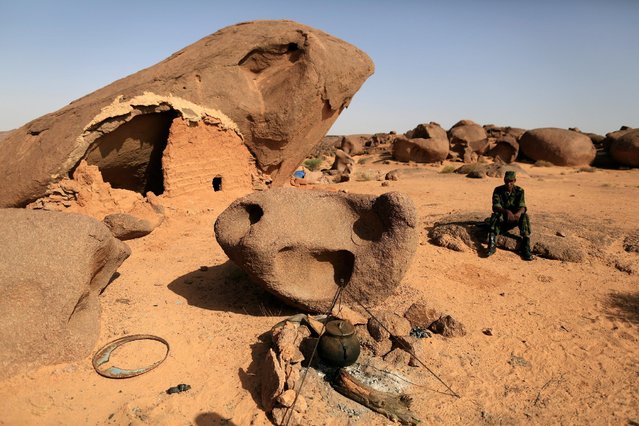
A Polisario fighter sits on a rock at a forward base on the outskirts of Tifariti, Western Sahara, September 9, 2016. At a rocky outpost in Western Sahara, a new generation of soldiers who have never known war are mobilising as tensions resurface in one of Africa's oldest disputes after a quarter century of uneasy peace. Young Sahrawi troops man new desert posts for the Polisario Front, which for more than 40 years has sought independence for the vast desert region - first in a guerrilla war against Morocco and then politically since a ceasefire deal in 1991. Now a standoff with Morocco, which controls the majority of Western Sahara, is renewing pressure for a diplomatic solution to ensure foot soldiers don't return to fighting as the last generation of commanders once did. The standoff since August has brought Moroccan and Polisario forces within 200 metres of each other in a narrow strip of land near the Mauritanian border. Rich in phosphate, Western Sahara has been contested since 1975 when Spanish colonial powers left. Morocco claimed the territory and fought the 16-year war with Polisario. (Photo by Zohra Bensemra/Reuters)

A Polisario fighter sits on a rock at a forward base on the outskirts of Tifariti, Western Sahara, September 9, 2016. At a rocky outpost in Western Sahara, a new generation of soldiers who have never known war are mobilising as tensions resurface in one of Africa's oldest disputes after a quarter century of uneasy peace. (Photo by Zohra Bensemra/Reuters)
Details
04 Nov 2016 12:09:00
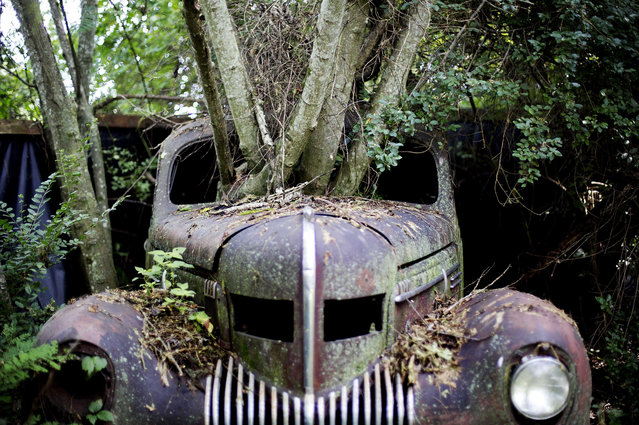
Trees grow through the windshield of a 1937 Chrysler Imperial as it sits at Old Car City, the world's largest known classic car junkyard Thursday, July 16, 2015, in White, Ga. Many of the cars have never moved in over 30 years and in some cases, trees now grow through them, even lifting some off the ground. (Photo by David Goldman/AP Photo)

Trees grow through the windshield of a 1937 Chrysler Imperial as it sits at Old Car City, the world's largest known classic car junkyard Thursday, July 16, 2015, in White, Ga. Over 4,000 classic cars decorate 32 acres of forest which have been turned into a junkyard museum by owner Walter Dean Lewis. The two grew up playing in the cars on the lot which started as a general store selling auto parts in 1931 by Lewis' parents. Lewis stopped selling parts about six years ago when he realized he could sustain the business more as a museum, charging $15 for visitors just looking, and $25 for photographers. Many of the cars have never moved in over 30 years and in some cases, trees now grow through them, even lifting some off the ground. (Photo by David Goldman/AP Photo)
Details
17 Jul 2015 13:14:00
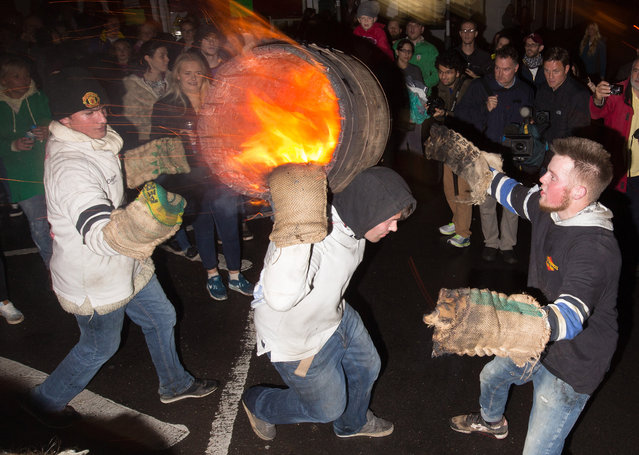
A boy runs with a burning barrel soaked in tar at the annual Ottery St Mary tar barrel festival on November 5, 2015 in Ottery St. Mary, England. The tradition, which is over 400 years old, sees competitors (who must have been born in the town to take part) running with burning barrels on their backs through the village, until the heat becomes too unbearable or the barrel breaks down, starting with junior barrels carried by children and continuing all evening with ever larger and larger barrels. (Photo by Matt Cardy/Getty Images)

A boy runs with a burning barrel soaked in tar at the annual Ottery St Mary tar barrel festival on November 5, 2015 in Ottery St. Mary, England. The tradition, which is over 400 years old, sees competitors (who must have been born in the town to take part) running with burning barrels on their backs through the village, until the heat becomes too unbearable or the barrel breaks down, starting with junior barrels carried by children and continuing all evening with ever larger and larger barrels. The event, which has been threatened with closure on previous years due to increasing public liability insurance costs, raises thousands of pounds for charity and attracts spectators from around the world. (Photo by Matt Cardy/Getty Images)
Details
07 Nov 2015 08:07:00
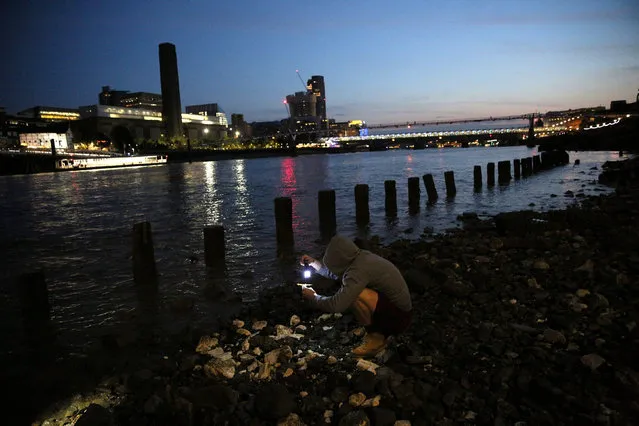
A mudlark uses a torch to look for items on the bank of the River Thames in London, Britain June 06, 2016. Mudlarking is believed to trace its origins to the 18th and 19th century, when scavengers searched the Thames' shores for items to sell. These days, history and archaeology fans are the ones hoping to find old relics such as coins, ceramics, artifacts or everyday items from across centuries. They wait for the low tide and then scour specific areas of exposed shores. "If you're in a field you could be out all day long, with the river you're restricted to about two or three hours," mudlark Nick Stevens said. While many just use the naked eye for their searches, others rely on metal detectors for which a permit from the Port of London Authority is needed. Digging also requires consent. (Photo by Neil Hall/Reuters)

A mudlark uses a torch to look for items on the bank of the River Thames in London, Britain June 06, 2016. Mudlarking is believed to trace its origins to the 18th and 19th century, when scavengers searched the Thames' shores for items to sell. These days, history and archaeology fans are the ones hoping to find old relics such as coins, ceramics, artifacts or everyday items from across centuries. their finds with the Portable Antiquities Scheme. Any item over 300 years old must be recorded. (Photo by Neil Hall/Reuters)
Details
27 Aug 2016 10:43:00
Albertus in the church of St George in Burgrain, Germany. Incredibly, some of the skeletons, which took up to five years to decorate, were even found hidden away in lock-ups and containers. (Photo by Paul Koudounaris/BNPS)

A relic hunter dubbed “Indiana Bones” has lifted the lid on a macabre collection of 400-year-old jewel-encrusted skeletons unearthed in churches across Europe. Art historian Paul Koudounaris has hunted down and photographed dozens of gruesome skeletons in some of the world's most secretive religious establishments. Photo: Albertus in the church of St George in Burgrain, Germany. Incredibly, some of the skeletons, which took up to five years to decorate, were even found hidden away in lock-ups and containers. (Photo by Paul Koudounaris/BNPS)
Details
08 Sep 2013 07:20:00