Loading...
Done
Afghanistan: Dogs of War Part 2

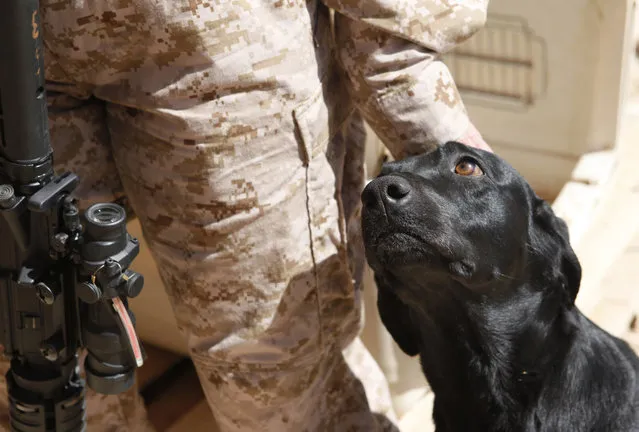
Throughout the course of the long war in Afghanistan, Coalition troops have relied on thousands of military working dogs to help keep them safe, and make their jobs easier. The dogs are trained to detect explosives, to find illegal drugs, to search for missing comrades, or target enemy combatants. Not only are they active on the front lines, but behind the lines they serve as therapy dogs, service dogs, and loyal companions. They also share the same risks as the ground troops, suffering injuries and sometimes death on the battlefields. Gathered here are images of these dogs and their handlers in Afghanistan and back home, from over the past several years, part of the ongoing series here on Afghanistan.
Details
05 Jun 2014 21:10:00
Revellers ride during the 54th annual brass band festival in the Serbian village of Guca August 7, 2014. Every year Guca is swamped by thousands of people taking part in the celebration of brass band music. (Photo by Marko Djurica/Reuters)

Revellers ride during the 54th annual brass band festival in the Serbian village of Guca August 7, 2014. Every year Guca is swamped by thousands of people taking part in the celebration of brass band music. (Photo by Marko Djurica/Reuters)
Details
10 Aug 2014 10:48:00
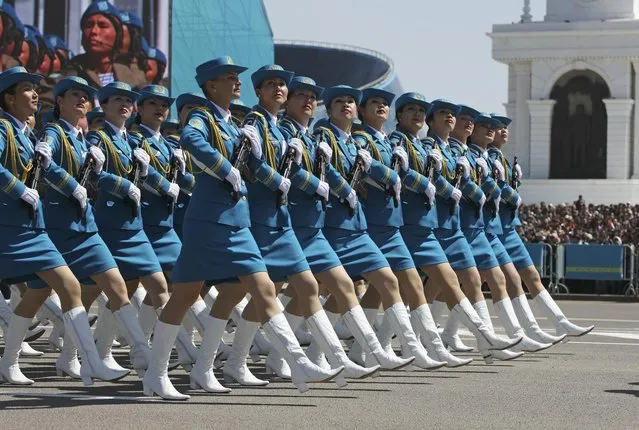
Kazakh troops march during a parade of the armed forces to mark the Defender of the Fatherland Day in Astana, May 7, 2014. (Photo by Mukhtar Kholdorbekov/Reuters)

Kazakh troops march during a parade of the armed forces to mark the Defender of the Fatherland Day in Astana, May 7, 2014. (Photo by Mukhtar Kholdorbekov/Reuters)
Details
24 Sep 2014 12:31:00
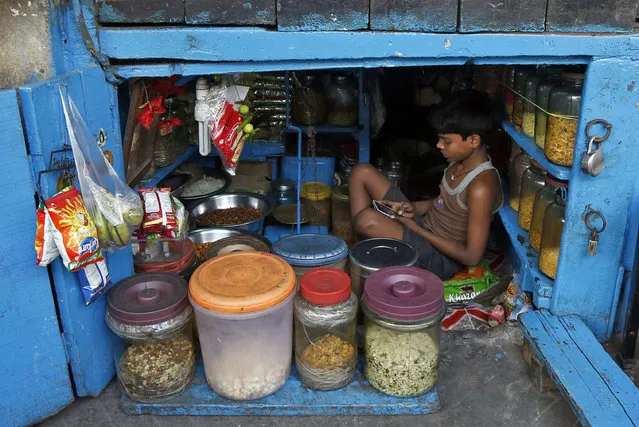
A boy uses a mobile phone as he sits inside his father's snacks shop along a road in Kolkata, India, February 22, 2016. (Photo by Rupak De Chowdhuri/Reuters)

A boy uses a mobile phone as he sits inside his father's snacks shop along a road in Kolkata, India, February 22, 2016. (Photo by Rupak De Chowdhuri/Reuters)
Details
23 Feb 2016 11:38:00
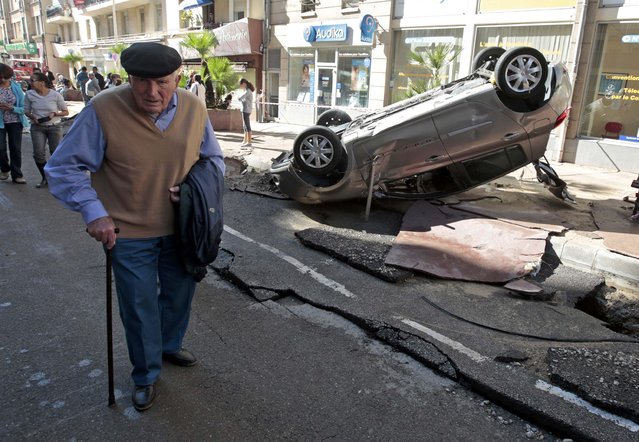
A man walks past an overturned car in the street that was damaged in flooding caused by torrential rain in Cannes, France, October 4, 2015. (Photo by Eric Gaillard/Reuters)

A man walks past an overturned car in the street that was damaged in flooding caused by torrential rain in Cannes, France, October 4, 2015. (Photo by Eric Gaillard/Reuters)
Details
07 Oct 2015 08:00:00
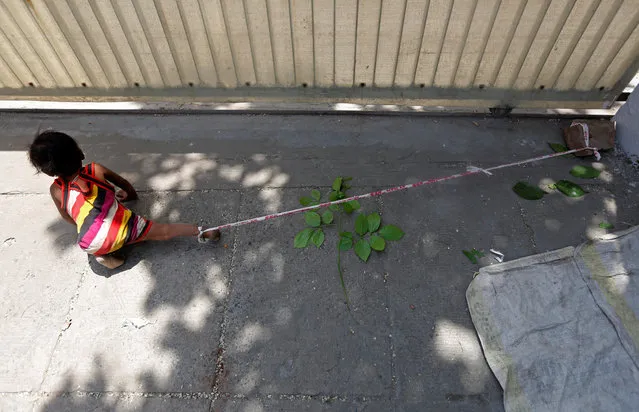
Barrier tape is tied around 15-month-old Shivani's ankle to prevent her from running away, while her mother Sarta Kalara works at a construction site nearby, in Ahmedabad, India, April 19, 2016. Kalara says she has no option but to tether her daughter Shivani to a stone despite her crying, while she and her husband work for 250 rupees ($3.8) each a shift digging holes for electricity cables in the city of Ahmedabad. There are about 40 million construction workers in India, at least one in five of them women, and the majority poor migrants who shift from site to site, building infrastructure for India's booming cities. Across the country it is not uncommon to see young children rolling in the sand and mud as their parents carry bricks or dig for new roads or luxury houses. (Photo by Amit Dave/Reuters)

Barrier tape is tied around 15-month-old Shivani's ankle to prevent her from running away, while her mother Sarta Kalara works at a construction site nearby, in Ahmedabad, India, April 19, 2016. Kalara says she has no option but to tether her daughter Shivani to a stone despite her crying, while she and her husband work for 250 rupees ($3.8) each a shift digging holes for electricity cables in the city of Ahmedabad. There are about 40 million construction workers in India, at least one in five of them women, and the majority poor migrants who shift from site to site, building infrastructure for India's booming cities. Across the country it is not uncommon to see young children rolling in the sand and mud as their parents carry bricks or dig for new roads or luxury houses. (Photo by Amit Dave/Reuters)
Details
14 Dec 2016 07:39:00
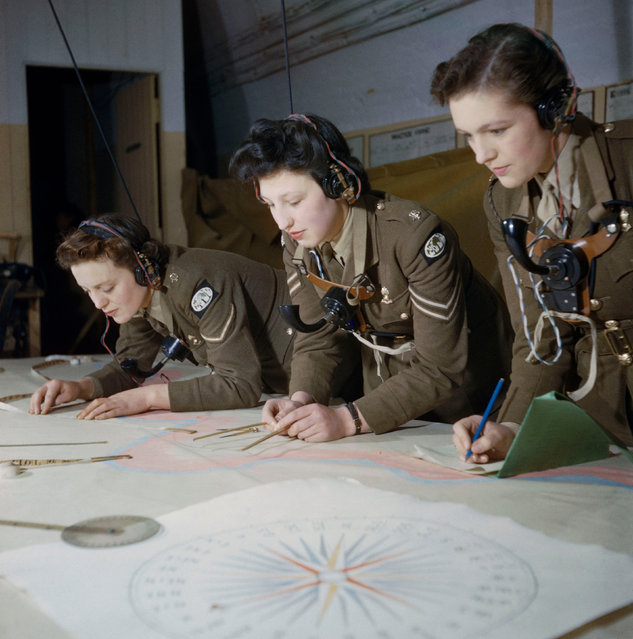
Auxiliary Territorial Service (ATS) plotters at work at Coastal Artillery Headquarters in Dover, December 1942. (Photo by Ted Dearberg/IWM/PA Wire)

Auxiliary Territorial Service (ATS) plotters at work at Coastal Artillery Headquarters in Dover, December 1942. The Auxiliary Territorial Service was the women's branch of the British Army during the Second World War. It was formed on 9 September 1938, initially as a women's voluntary service, and existed until 1 February 1949, when it was merged into the Women's Royal Army Corps. The ATS had its roots in the Women's Auxiliary Army Corps (WAAC), which was formed in 1917 as a voluntary service. During the First World War its members served in a number of jobs including clerks, cooks, telephonists and waitresses. The WAAC was disbanded after four years in 1921. (Photo by Ted Dearberg/IWM/PA Wire)
Details
13 Jul 2017 07:52:00
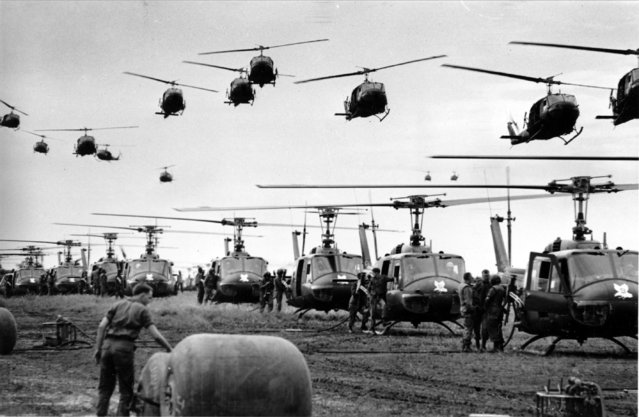
U.S. Army helicopters providing support for U.S. ground troops  fly into a staging area fifty miles northeast of Saigon, Vietnam, August 28, 1966. Helicopter fuel is stored in the large rubber tanks, foreground. (Photo by Henri Huet/AP Photo)

U.S. Army helicopters providing support for U.S. ground troops fly into a staging area fifty miles northeast of Saigon, Vietnam, August 28, 1966. Helicopter fuel is stored in the large rubber tanks, foreground. (Photo by Henri Huet/AP Photo)
Details
29 Aug 2015 11:05:00