Loading...
Done
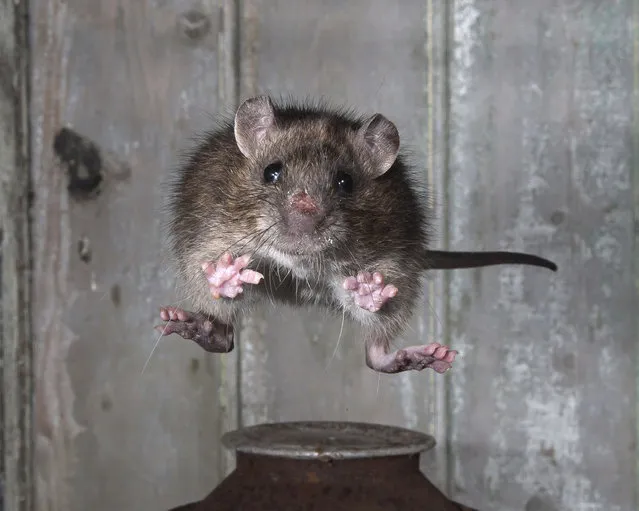
A) 1st place WINNER – Roy Rimmer. This rat was in an outdoor set I made, the set up is two meters long and a meter wide made of Perspex,it has a plywood front with holes cut in for my camera and flash guns, I placed two rusty paint cans in the set up and the rat would leap from one can too the other, I had to use flash to freeze the action.

A) 1st place WINNER – Roy Rimmer. “This rat was in an outdoor set I made, the set up is two meters long and a meter wide made of Perspex,it has a plywood front with holes cut in for my camera and flash guns, I placed two rusty paint cans in the set up and the rat would leap from one can too the other, I had to use flash to freeze the action”.
Details
08 Mar 2013 14:49:00
North Korean soldiers wave along the Yalu River, near the North Korean town of Sinuiju, opposite to the Chinese border city of Dandong October 7, 2014. (Photo by Jacky Chen/Reuters)

North Korean soldiers wave along the Yalu River, near the North Korean town of Sinuiju, opposite to the Chinese border city of Dandong October 7, 2014. (Photo by Jacky Chen/Reuters)
Details
10 Oct 2014 12:34:00
Mount Sinabung spews pyroclastic smoke, seen from Tiga Pancur village on October 13, 2014 in Berastagi, Karo district, North Sumatra, Indonesia. Mount Sinabung, which has lain dormant for over 400 years, has been intermittently erupting since September 15 last year, killing 15 people and forcing hundreds to flee their homes. According to The National Disaster Mitigation Agency, more than 3,000 residents are still displaced. (Photo by Ulet Ifansasti/Getty Images)

Mount Sinabung spews pyroclastic smoke, seen from Tiga Pancur village on October 13, 2014 in Berastagi, Karo district, North Sumatra, Indonesia. Mount Sinabung, which has lain dormant for over 400 years, has been intermittently erupting since September 15 last year, killing 15 people and forcing hundreds to flee their homes. According to The National Disaster Mitigation Agency, more than 3,000 residents are still displaced. (Photo by Ulet Ifansasti/Getty Images)
Details
14 Oct 2014 10:58:00
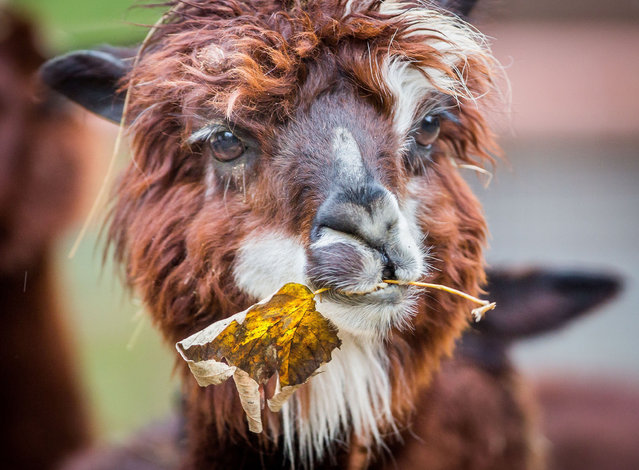
An alpaca chewing a leaf is pictured on November 18,  2014 in the zoo of  Frankfurt am Main, Germany. (Photo by Frank Rumpenhorst/AFP Photo/DPA)

An alpaca chewing a leaf is pictured on November 18, 2014 in the zoo of Frankfurt am Main, Germany. (Photo by Frank Rumpenhorst/AFP Photo/DPA)
Details
22 Nov 2014 14:07:00
Highly commended birds : Crested guan by Tim Hunt (UK). ‘This photo shows a crested guan in the cloud forests of Costa Rica as it pauses while foraging on a lone branch. Due to the clouds that are so typical for this habitat, I could often only photograph the bird’s silhouette against a grey sky. (Photo by Tim Hunt/GDT European Wildlife Photographer of the Year 2015)

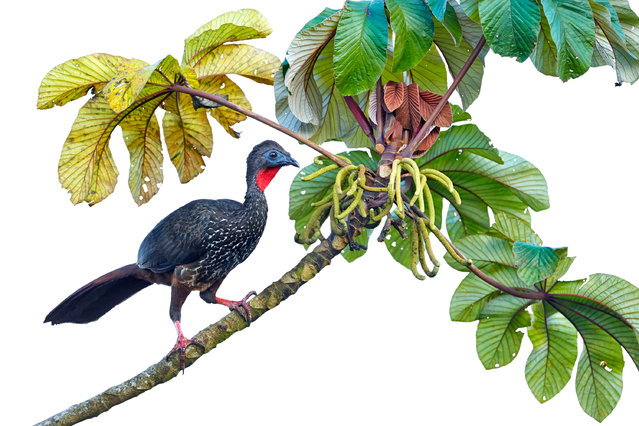
Highly commended birds : Crested guan by Tim Hunt (UK). ‘This photo shows a crested guan in the cloud forests of Costa Rica as it pauses while foraging on a lone branch. Due to the clouds that are so typical for this habitat, I could often only photograph the bird’s silhouette against a grey sky. But then, for a short moment only, the sun broke through the clouds, and I overexposed the image by over two stops in order to blow out the background and allow this beautifully marked bird to stand out’. (Photo by Tim Hunt/GDT European Wildlife Photographer of the Year 2015)
Details
24 Nov 2015 08:01:00
This handout picture taken on December 13, 2016 and released on December 14, 2016 by the Tiergarten Schoenbrunn zoo in Vienna, Austria, shows a baby sloth eating some salad as it hangs on it's mother's belly in their enclosure. The baby was born already on November 18, 2016, but according to the zoo it could be picured for the first time only now as it usually hides in it's mother's soft coat. (Photo by Daniel Zupanc/AFP Photo)

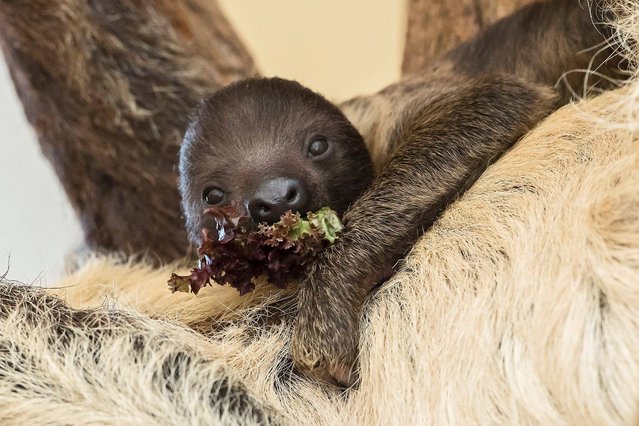
This handout picture taken on December 13, 2016 and released on December 14, 2016 by the Tiergarten Schoenbrunn zoo in Vienna, Austria, shows a baby sloth eating some salad as it hangs on it's mother's belly in their enclosure. The baby was born already on November 18, 2016, but according to the zoo it could be picured for the first time only now as it usually hides in it's mother's soft coat. (Photo by Daniel Zupanc/AFP Photo)
Details
18 Dec 2016 07:52:00
In this February 19, 2017 photo, a couple dances during the “If you don't give me....then you lend me” Carnival street party on Ipanema beach, in Rio de Janeiro, Brazil. The typical view of Carnival in Brazil is anything goes, with no headdress too big, no outfit too small, no song too ribald, but this year some organizers of the world's best known party are drawing the line at lyrics that are sexist, homophobic or racist. (Photo by Silvia Izquierdo/AP Photo)

In this February 19, 2017 photo, a couple dances during the “If you don't give me....then you lend me” Carnival street party on Ipanema beach, in Rio de Janeiro, Brazil. The typical view of Carnival in Brazil is anything goes, with no headdress too big, no outfit too small, no song too ribald, but this year some organizers of the world's best known party are drawing the line at lyrics that are sexist, homophobic or racist. (Photo by Silvia Izquierdo/AP Photo)
Details
24 Feb 2017 00:06:00
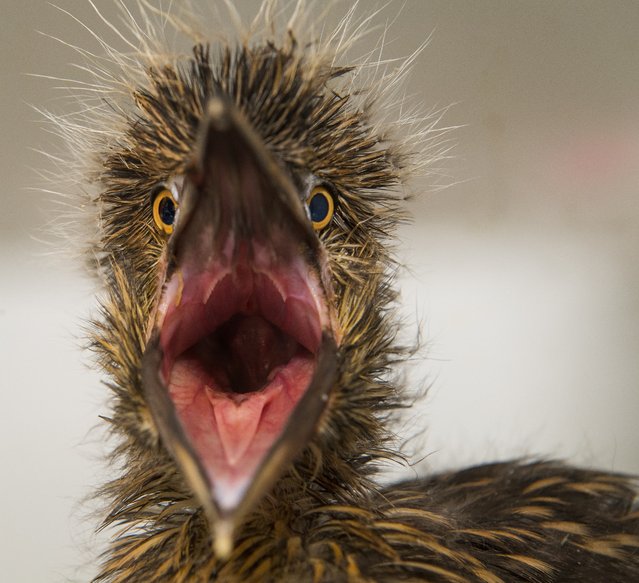
A baby Black-crowned Night Heron squawks in its incubator while being cared for at City Wildlife rescue and rehabilitation center in Washington, DC on May 31, 2017. The heron is one of several that have been brought to CW by the staff at The National Zoo over the past few years. The heron is a native bird and has made an established rookery inside the zoo grounds over a hundred years ago.  Every year at this time, some of the chicks get pushed or fall out of the nest and require human care.  Because the birds are native and not part of the Smithsonian collection, they partnered with CW to rehabilitate the herons for re-release back to the flock inside Zoo. They're reintroduced back to their flock so that they can migrate together in the Fall. The Black-crowned heron usually migrates from the DC area down to southeast North Carolina, some going as far as Jacksonville, FL in winter. The Black-crowned heron is the species of greatest conservation need in the District of Columbia because their numbers are in such rapid decline due to habitat loss. (Photo Linda Davidson/The Washington Post)

A baby Black-crowned Night Heron squawks in its incubator while being cared for at City Wildlife rescue and rehabilitation center in Washington, DC on May 31, 2017. The heron is one of several that have been brought to CW by the staff at The National Zoo over the past few years. (Photo Linda Davidson/The Washington Post)
Details
04 Jun 2017 08:04:00