Loading...
Done
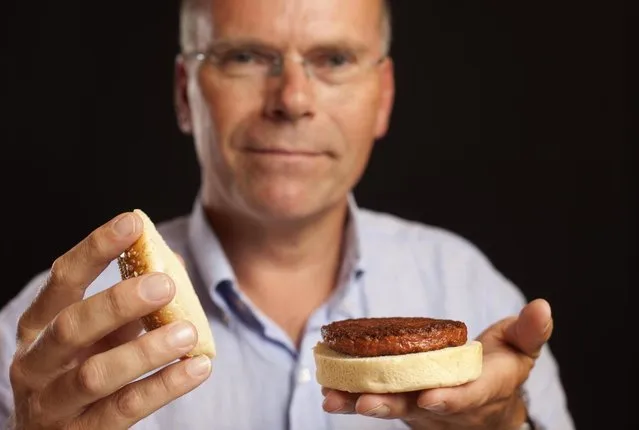
In this handout image provided by Ogilvy, a burger made from cultured beef, which has been developed by Professor Mark Post of Maastricht University in the Netherlands (pictured) is shown to the media during a press conference on August 5, 2013 in London, England. Cultured Beef could help solve the coming food crisis and combat climate change with commercial production of Cultured Beef beginning within ten to twenty years. (Photo by David Parry via Getty Images)

In this handout image provided by Ogilvy, a burger made from cultured beef, which has been developed by Professor Mark Post of Maastricht University in the Netherlands (pictured) is shown to the media during a press conference on August 5, 2013 in London, England. The in-vitro burger, cultured from cattle stem cells, the first example of what its creator says could provide an answer to global food shortages and help combat climate change, was fried in a pan and tasted by two volunteers. The burger is the result of years of research by Dutch scientist Mark Post, a vascular biologist at the University of Maastricht, who is working to show how meat grown in petri dishes might one day be a true alternative to meat from livestock.The meat in the burger has been made by knitting together around 20,000 strands of protein that has been cultured from cattle stem cells in Post's lab. (Photo by David Parry)
Details
06 Aug 2013 08:48:00
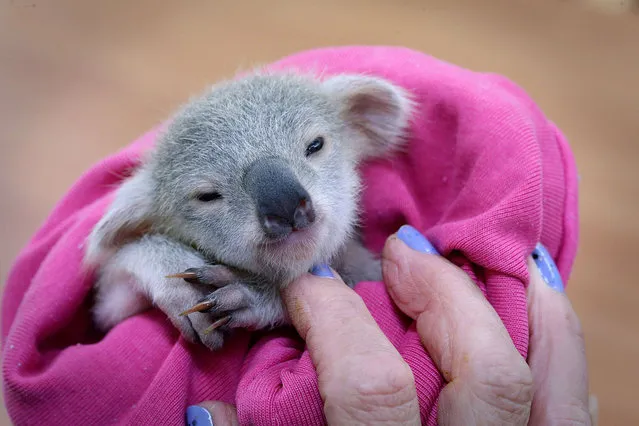
An adorable baby koala is seen enjoying a snooze after a traumatic start to life. The baby koala, nicknamed “Blondie Bumstead”, is being cared for by a volunteer from the Ipswich Koala protection society in Queensland after her mother was killed by a dog. (Photo by Jamie Hanson/Newspix/REX Features)

An adorable baby koala is seen enjoying a snooze after a traumatic start to life. The baby koala, nicknamed “Blondie Bumstead”, is being cared for by a volunteer from the Ipswich Koala protection society in Queensland after her mother was killed by a dog. Blondie, who was named for her light fur, was given just a 50-50 chance of pulling through after the attack. But after a course of antibiotics and some tender loving car from volunteer Marilyn Spletter she has now been given a clean bill of health. According to Marilyn she has hand-reared around 40 baby koalas but says that Blondie, who will be released back into the wild after 15 months, is one of her favourites. She said: “She's got a little character all of her own and she knows what she wants and what she doesn't. When she's stressed I kiss her on the nose or I rub my nose on hers and it relaxes her”. (Photo by Jamie Hanson/Newspix/REX Features)
Details
07 Aug 2014 10:26:00
Cheng Liping, whose husband Ju was onboard Malaysia Airlines Flight MH370 which disappeared on March 8, 2014, shows a picture of she and her husband together and an old card with a message given by her husband, at a park near her house where she and her husband used to visit during an interview with Reuters in Beijing July 24, 2014. (Photo by Kim Kyung-Hoon/Reuters)

Cheng Liping, whose husband Ju was onboard Malaysia Airlines Flight MH370 which disappeared on March 8, 2014, shows a picture of she and her husband together and an old card with a message given by her husband, at a park near her house where she and her husband used to visit during an interview with Reuters in Beijing July 24, 2014. Cheng said her life has been totally changed since the incident. Their two little sons, who don't know about this incident, keep asking her when their dad is coming back. Six months after Malaysia Airlines Flight MH370, with 239 mostly Chinese people on board, disappeared about an hour into a routine journey from Kuala Lumpur to Beijing March 8, loved ones of missing passengers derive what comfort they can from what's left behind after the world's greatest aviation mystery. More than two dozen countries have been involved in the air, sea and underwater search for the Boeing 777 but months of sorties failed to turn up any trace – even after narrowing the search area to the southern Indian Ocean – long after batteries on the black box voice and data recorders had gone flat. (Photo by Kim Kyung-Hoon/Reuters)
Details
05 Sep 2014 11:27:00
Jenna carefully watches two giant boa constrictors that their owner, a street performer she barely knows, entrusted to her. She is careful to keep the one snake wrapped around exercise bars to prevent a wound in the animal’s mouth from touching the sand and getting infected. Jenna is a single mom on disability. She suffers from failed back surgery syndrome, acquired from a violent car accident she had as a teenager. She and her young son Jackson can be found most afternoons on the beach. Originally from South Carolina, Jenna came to Venice in 2010 and describes herself as “an open-minded Christian who loves everyone for who they are”. Nowadays Jenna sometimes has trouble reconciling her inclusive progressive values with her family’s conservative political stance, especially in today’s toxic political climate. (Photo by Dotan Saguy)

Over the past three years, Los Angeles-based photographer Dotan Saguy has spent hundreds of hours documenting the diverse culture, people and pageantry of the iconic Venice Beach boardwalk. He was irresistibly drawn to the free-spirited, anti-materialistic and inclusive nature of the world-famous location, which he found to be a breath of fresh air in contrast to Los Angeles’s sometimes homogenized, celebrity-obsessed culture. (Photo by Dotan Saguy)
Details
01 Aug 2018 00:03:00
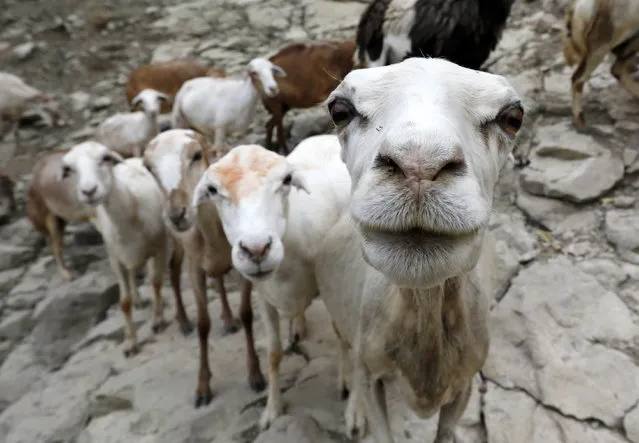
A flock of sheep and goats is led by shepherds to pastures at a mountain village on the outskirts of Sana'a, Yemen, 27 July 2023. At least eight million sheep and goats from about 470,000 pastoralist and agro pastoralist households across Yemen will be treated and vaccinated over the two years 2023 and 2024, in an effort to reduce livestock losses, improve production efficiency, and household income generation amid an acute food insecurity, the UN Food and Agriculture Organization (FAO) has reported. Livestock production in Yemen is a main income-generating activity for many rural and poor households. Yemen remains one of the worst humanitarian crises in the world with over 17 million people out of its 30-million population are food insecure due to a combination of prolonged conflicts and economic crisis. (Photo by Yahya Arhab/EPA)

A flock of sheep and goats is led by shepherds to pastures at a mountain village on the outskirts of Sana'a, Yemen, 27 July 2023. At least eight million sheep and goats from about 470,000 pastoralist and agro pastoralist households across Yemen will be treated and vaccinated over the two years 2023 and 2024, in an effort to reduce livestock losses, improve production efficiency, and household income generation amid an acute food insecurity, the UN Food and Agriculture Organization (FAO) has reported. (Photo by Yahya Arhab/EPA)
Details
01 Aug 2023 03:44:00
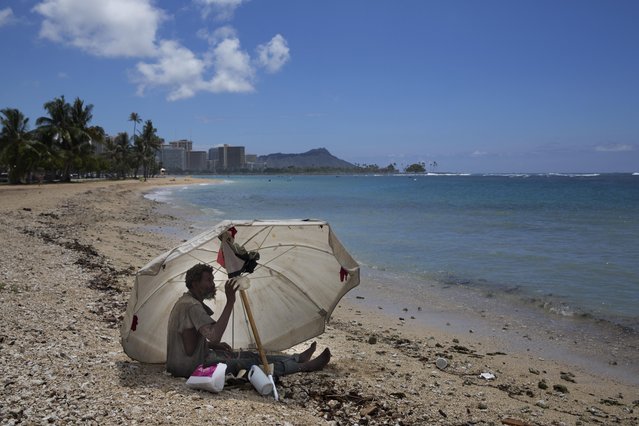
In this Thursday, August 27, 2015 photo, a homeless man drinks water while sitting on the beach at Ala Moana Beach Park located near Waikiki in Honolulu. Homelessness in Hawaii has grown steadily in recent years, leaving the state with the nation's highest rate of homeless people per capita. (Photo by Jae C. Hong/AP Photo)

Hawaii has long been known as a tropical paradise, but in recent years another image has intruded into the state's carefully crafted one of idyllic beaches and relaxing resorts: homelessness. The number of homeless people has grown in recent years, leaving the state with 487 homeless per 100,000 people, the nation's highest rate per capita, above New York and Nevada, according to federal statistics. Many of the homeless, however, defy the stereotype of the mentally ill or drug addicted. They are families, with men and women who work full-time jobs. They are struggling to get a foothold in a place with a high cost of living and low wages. Here: in this Thursday, August 27, 2015 photo, a homeless man drinks water while sitting on the beach at Ala Moana Beach Park located near Waikiki in Honolulu. (Photo by Jae C. Hong/AP Photo)
Details
11 Nov 2015 08:03:00
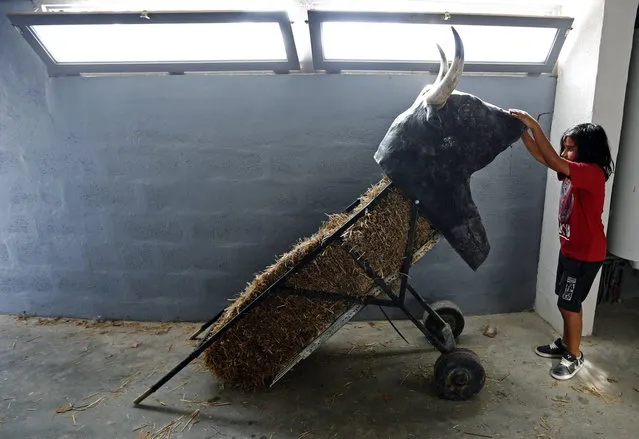
Nino, a ten-year-old toreador apprentice of the French Tauromachy Centre, nicknamed El Nino, touches a practice bull at the bullring of Garons, near Nimes, September 25, 2013. (Photo by Jean-Paul Pelissier/Reuters)

Nino, a ten-year-old toreador apprentice of the French Tauromachy Centre, nicknamed El Nino, touches a practice bull at the bullring of Garons, near Nimes, September 25, 2013. Since 1983, the French Tauromachy Centre in Nimes has trained some 1,000 youths in the art of bullfighting. Twenty of them have gone on to become professional matadors, facing fighting bulls in the arena. Twice a week, students take courses with a matador to learn the movements and gestures of the bullfighter in the ring, but without an animal present. Students train with calves in the surrounding fields during spring, and regularly participate in beginner's bullfights (becerradas) without killing calves. Solal has been taking courses for three years and Nino, for just a year now. Both are normally enrolled in French public schools, but have one thought in mind – bullfighting. They share a passion linked to the city of Nimes, famous for its ferias and bullring. (Photo by Jean-Paul Pelissier/Reuters)
Details
06 Nov 2013 10:12:00
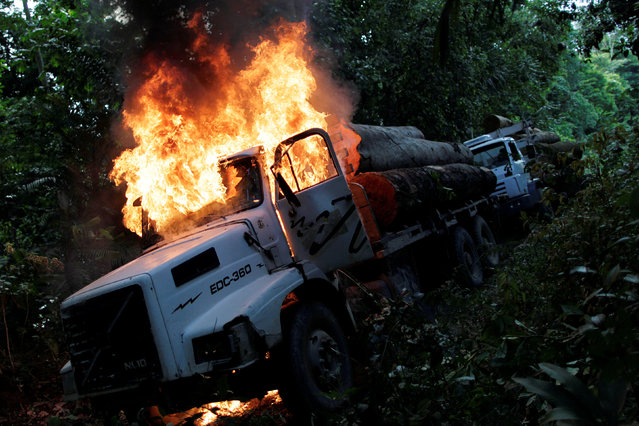
Trucks loaded with tree trunks are burned by agents of the Brazilian Institute for the Environment and Renewable Natural Resources, or Ibama, during an operation to combat illegal mining and logging, in the municipality of Novo Progresso, Para State, northern Brazil, November 11, 2016. When able to do their job, agents of the Brazilian Institute for the Environment and Renewable Natural Resources, or Ibama, are decisive, punishing illegal loggers on the spot. Nearly twice the size of India, the Amazon absorbs an estimated 2 billion tonnes of carbon dioxide per year, making its preservation vital in the fight to halt global warming. Ibama, responsible for preserving Brazil's 65 percent share of the world's largest rainforest, is one of the most important groups in that fight. But after years of surprising success, the rate of deforestation is on the rise again. Over the past four years it has risen 35 percent, as Ibama suffered from a lack of funding amid Brazil's worst recession in a century. (Photo by Ueslei Marcelino/Reuters)

Trucks loaded with tree trunks are burned by agents of the Brazilian Institute for the Environment and Renewable Natural Resources, or Ibama, during an operation to combat illegal mining and logging, in the municipality of Novo Progresso, Para State, northern Brazil, November 11, 2016. When able to do their job, agents of the Brazilian Institute for the Environment and Renewable Natural Resources, or Ibama, are decisive, punishing illegal loggers on the spot. Nearly twice the size of India, the Amazon absorbs an estimated 2 billion tonnes of carbon dioxide per year, making its preservation vital in the fight to halt global warming. (Photo by Ueslei Marcelino/Reuters)
Details
30 Nov 2016 12:36:00