Loading...
Done
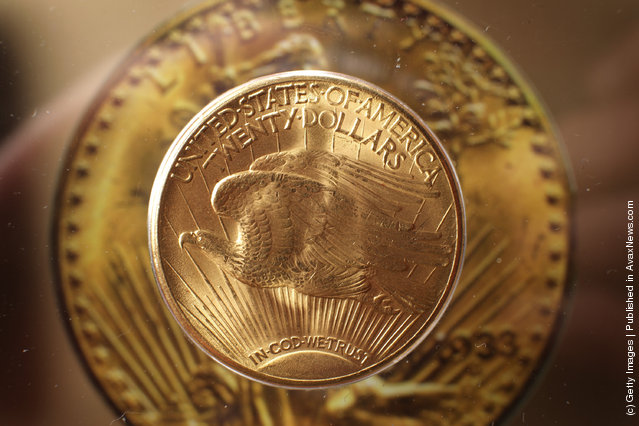
A 'Double Eagle' gold twenty dollar coin

“A Double Eagle is a gold coin of the United States with a denomination of $20. (Its gold content of 0.9675 troy oz was worth $20 at the then official price of $20.67/oz). The coins are made from a 90% gold (0.900 fine = 21.6 kt) and 10% copper alloy”. – Wikipedia

Photo: A “Double Eagle” gold twenty dollar coin is displayed above a catalogue picture showing the reverse side of the coin at Goldsmith's Hall on March 2, 2012 in London, England. Nearly half a million of these coins were originally minted in the midst of the Great Depression in the US. Only 13 are known today after the rest were melted down before they ever left the US Mint, sacrificed as part of a strategy to stabalise the American economy. In 2002 a Double Eagle sold at auction for $7.6 million. (Photo by Peter Macdiarmid/Getty Images)
Details
03 Mar 2012 10:37:00
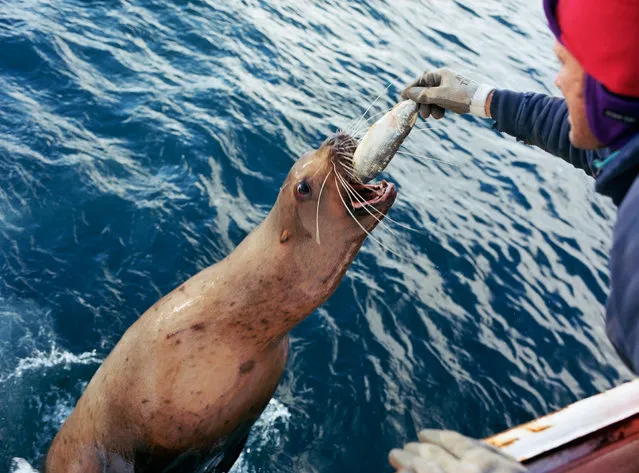
Before heading up to Alaska, the ship loads up with 3 months worth of food. Even so, it's hardly necessary. The ship's cook is constantly steaming fresh crab legs and seafood caught during the day. The hard labour of fishing requires a diet heavy in fat, protein, and omega-3s. Here, a sea lion gets a bite of the grub. (Photo by Corey Arnold)

In 2002 photographer Corey Arnold left behind a poor economy in San Francisco and headed up to Alaska to try his luck at his longtime passion of fishing. Arnold, who had worked summers during college on a salmon boat in Alaska, signed onto the f/v Rollo, a crabbing boat that fishes in the dangerous Bering Sea. While working long, strenuous hours on the Rollo, Arnold often stole away with the captain’s permission to grab his camera and photograph the crew and the ship. Arnold eventually put together “Fish Work: Bering Sea”, a documentation of his seven adventurous and dicey crab seasons aboard the Rollo. (Photo by Corey Arnold)
Details
20 Aug 2014 10:05:00
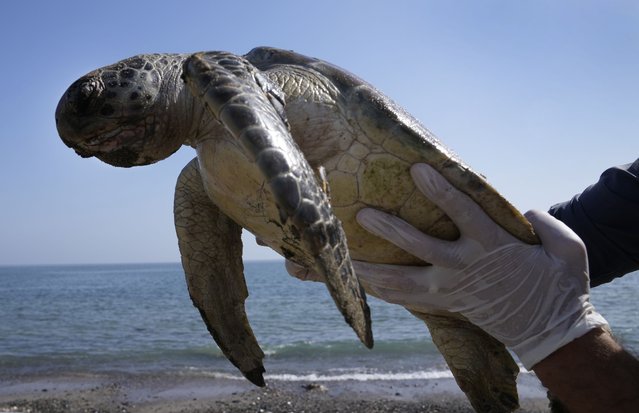
A dead green sea turtle is collected from the beach at the Khor Kalba Conservation Reserve, in the city of Kalba, on the east coast of the United Arab Emirates, Tuesday, February 1, 2022.  A staggering 75% of all dead green turtles and 57% of all loggerhead turtles in Sharjah had eaten marine debris, including plastic bags, bottle caps, rope and fishing nets, a new study published in the Marine Pollution Bulletin. The study seeks to document the damage and danger of the throwaway plastic that has surged in use around the world and in the UAE, along with other marine debris. (Photo by Kamran Jebreili/AP Photo)

A dead green sea turtle is collected from the beach at the Khor Kalba Conservation Reserve, in the city of Kalba, on the east coast of the United Arab Emirates, Tuesday, February 1, 2022. A staggering 75% of all dead green turtles and 57% of all loggerhead turtles in Sharjah had eaten marine debris, including plastic bags, bottle caps, rope and fishing nets, a new study published in the Marine Pollution Bulletin. The study seeks to document the damage and danger of the throwaway plastic that has surged in use around the world and in the UAE, along with other marine debris. (Photo by Kamran Jebreili/AP Photo)
Details
26 Feb 2022 04:58:00
Funny Cartoons By Lucas Levitan Part 2

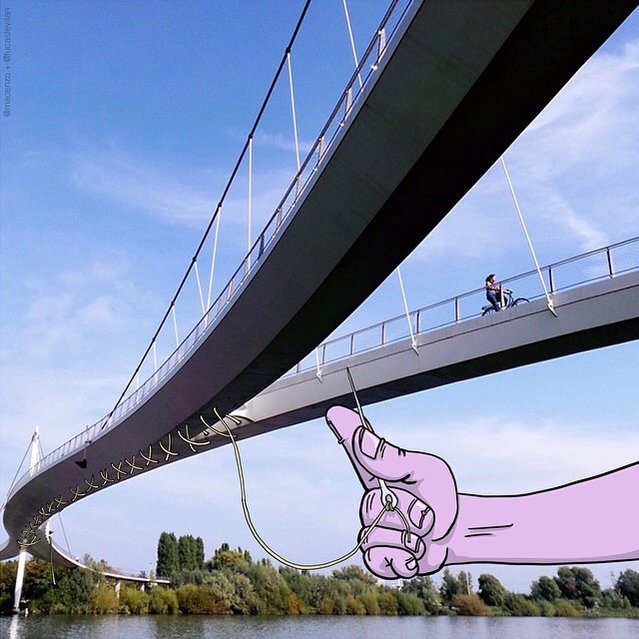
Being able to look at this world in a different light is the main thing that distinguishes a true artist from a common person. We can clearly see that Lucas Levitan is a true artist despite the crude drawings that he makes. By hunting through thousands of photos that people post on Instagram, he finds the ones that might have a completely different, surprising, and comical theme. For example, a sensual photo of lady’s eyelashes is transformed into a scene in which a farmer is harvesting his crops. This is imagination at its finest, which is why the art works of Lucas Levitan are so interesting to look at. (Photo by Lucas Levitan)
Details
04 Jan 2015 12:39:00
“No More Stars”: Abandoned Stars Wars Sets in the Desert by Rä di Martino

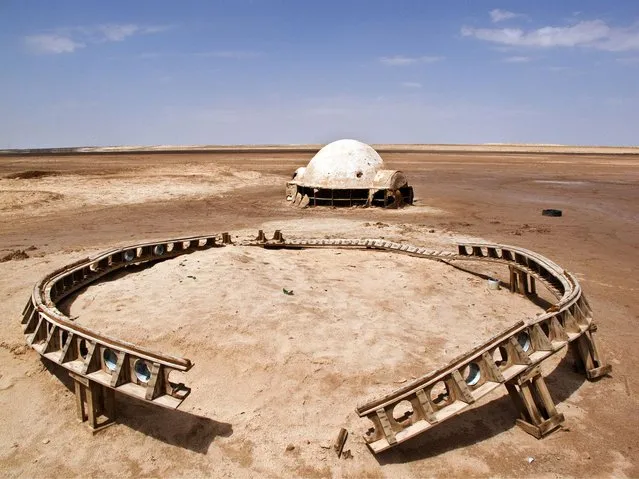
New York-based visual artist and filmmaker Rä di Martino has taken a series of eerie and beautiful photos that capture scenes of abandoned Hollywood film sets. Martino spent over a year traveling throughout the desert towns of Morocco and Tunisia hunting down the old Star Wars sets, exploring these massive structures that stand almost like ancient ruins. “No More Stars” showcases the backdrop of Luke Skywalker's home on the fictional desert planet Tatooine. (Photo by Rä di Martino)
Details
12 Mar 2015 13:38:00
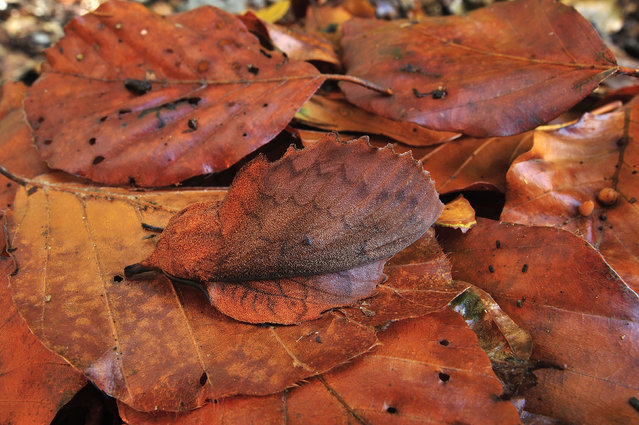
The camouflage mappet moth looks like a fall lead in Switzerland. (Photo by Thomas Marent/Caters News/Ardea)

Whether they are the hunter or the hunted, these camouflage animals show natures incredible ability to blend in with its surroundings. Pictured perfectly concealed against their natural environment, the stunning pictures show the amazing lengths some animals will go to to stay out of sight. Here: The camouflage mappet moth looks like a fall lead in Switzerland. (Photo by Thomas Marent/Caters News/Ardea)
Details
09 Oct 2014 12:58:00
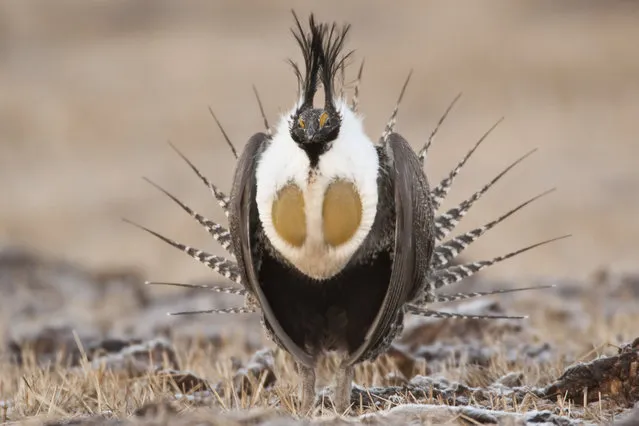
Greater Sage-Grouse

The Greater Sage-Grouse is certainly a formidable-looking bird. Being the largest grouse in North America and having tail feathers, which look like giant spikes, make for a ferocious sight. These birds are well known for their complicated courtship rituals, in which the males perform a special “strutting display” to attract the females. Another distinct feature of the Greater Sage-Grouse is two large yellow throat sacs (gular sacs), which are inflated by the males during the courtship display. Unlike pelicans, whose gular sacs are used to store fish while hunting, the throat sacks of the Greater Sage-Grouse are merely for display.
Details
21 Nov 2014 12:25:00
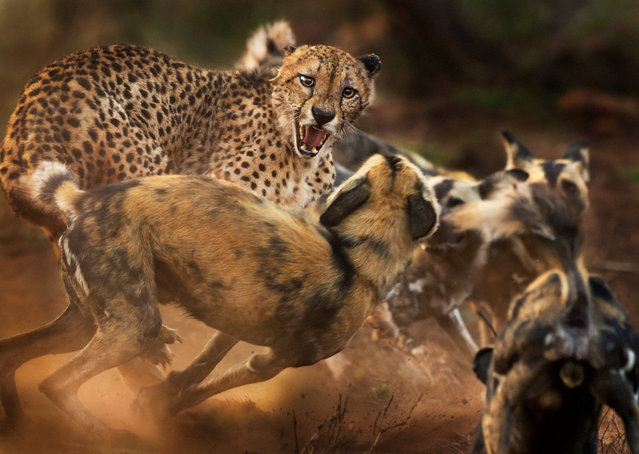
A lone male cheetah is set upon by a pack of African wild dogs. Peter Haygarth had been following the dogs as they hunted in Zimanga Private Game Reserve in KwaZulu-Natal, South Africa. On first encountering the cheetah, the dogs were wary, but as the rest of the pack arrived, their confidence grew and they began to encircle the cat. Peter kept his focus on the cat’s face. In a few minutes the spat was over as the cheetah fled. (Behaviour: mammals category). (Photo by Peter Haygarth)

A lone male cheetah is set upon by a pack of African wild dogs. Peter Haygarth had been following the dogs as they hunted in Zimanga Private Game Reserve in KwaZulu-Natal, South Africa. On first encountering the cheetah, the dogs were wary, but as the rest of the pack arrived, their confidence grew and they began to encircle the cat. Peter kept his focus on the cat’s face. In a few minutes the spat was over as the cheetah fled. (Behaviour: mammals category). (Photo by Peter Haygarth)
Details
10 Sep 2019 00:03:00