Loading...
Done
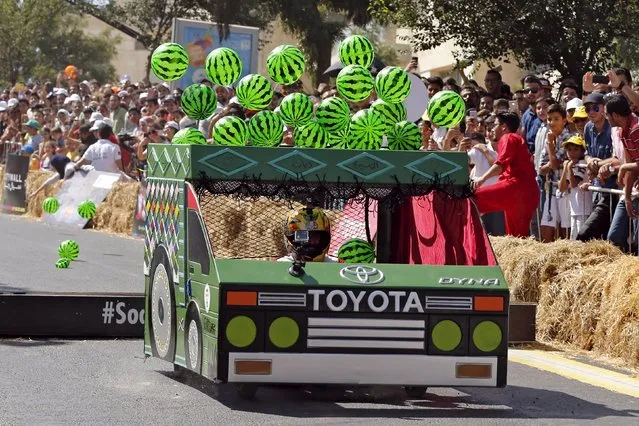
People watch a competitor riding a homemade vehicle without an engine on a 300-metre-track during the Red Bull Soapbox Race in Amman, Jordan September 4, 2015. (Photo by Muhammad Hamed/Reuters)

People watch a competitor riding a homemade vehicle without an engine on a 300-metre-track during the Red Bull Soapbox Race in Amman, Jordan September 4, 2015. (Photo by Muhammad Hamed/Reuters)
Details
05 Sep 2015 12:47:00
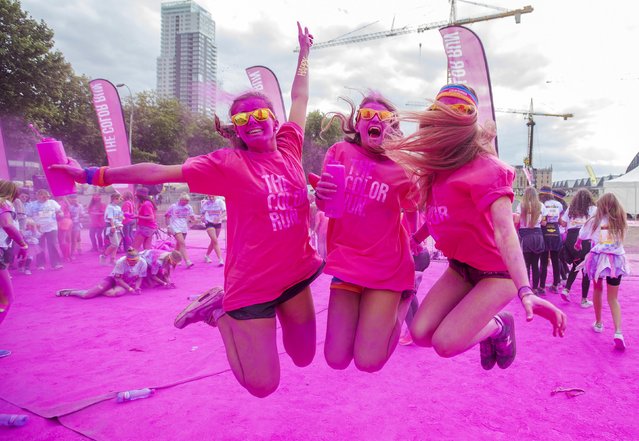
People take part in The Color Run in Brussels, Belgium September 6, 2015. (Photo by Yves Herman/Reuters)

People take part in The Color Run in Brussels, Belgium September 6, 2015. The Color Run is a five-kilometre, untimed race, held in cities worldwide, with the aim of promoting healthy living. Participants are doused from head to toe in different colors at each kilometre. (Photo by Yves Herman/Reuters)
Details
07 Sep 2015 14:16:00
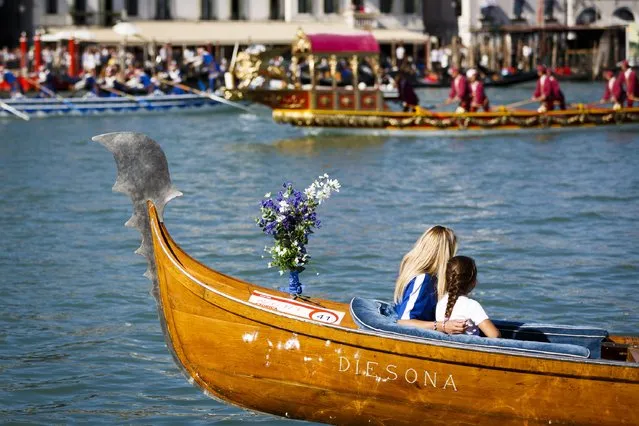
General views of atmosphere during the Regatta Storica during the 72nd Venice Film Festival on September 7, 2015 in Venice, Italy. (Photo by Tristan Fewings/Getty Images)

General views of atmosphere during the Regatta Storica during the 72nd Venice Film Festival on September 7, 2015 in Venice, Italy. (Photo by Tristan Fewings/Getty Images)
Details
08 Sep 2015 11:31:00
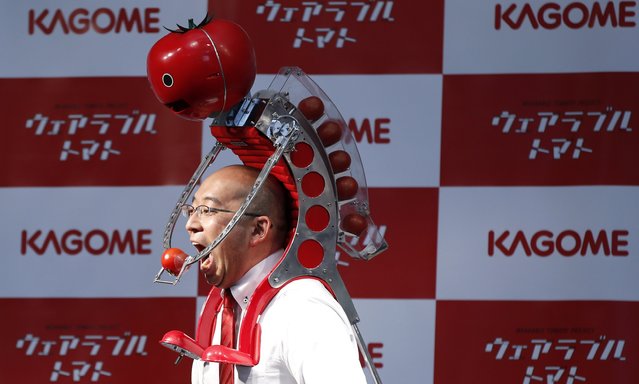
Kagome Co's employee Shigenori Suzuki tries to eat a tomato which is fed to him by the newly-developed “Wearable Tomato” device for runners, during its unveiling event ahead of the weekend's Tokyo Marathon in Tokyo February 19, 2015. (Photo by Toru Hanai/Reuters)

Kagome Co's employee Shigenori Suzuki tries to eat a tomato which is fed to him by the newly-developed “Wearable Tomato” device for runners, during its unveiling event ahead of the weekend's Tokyo Marathon in Tokyo February 19, 2015. The eight-kilo (17.6-pound) contraption fits on a runner like a rucksack. It can distribute a total of seven medium-sized tomatoes, one by one, at the click of a button and supplies the runner with much needed nutrients during a long jog or race. (Photo by Toru Hanai/Reuters)
Details
20 Feb 2015 13:23:00
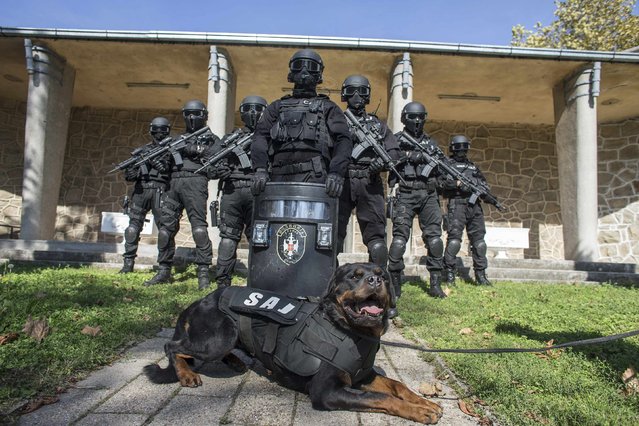
Serbian police officers of the Special Anti-Terrorist Unit pose for a picture in their base outside Belgrade October 8, 2014. (Photo by Marko Djurica/Reuters)

Serbian police officers of the Special Anti-Terrorist Unit pose for a picture in their base outside Belgrade October 8, 2014. When the killing of an unarmed black teenager by a white policeman in Ferguson, Missouri, in August sparked sometimes violent protests, the response of police in camouflage gear and armoured vehicles wielding stun grenades and assault rifles seemed more like a combat operation than a public order measure. Some U.S. police departments have recently acquired U.S. military-surplus hardware from wars abroad, but there are many law enforcers around the world whose rules of engagement also allow the use of lethal force with relatively few restrictions. But for every regulation that gives police wide scope to use firearms, there is another code that sharply limits their use. In Serbia, police may use measures ranging from batons to special vehicles, water cannon and tear gas on groups of people who have gathered illegally and are behaving in a way that is violent or could cause violence, but they may use firearms only when life is endangered. (Photo by Marko Djurica/Reuters)
Details
27 Nov 2014 14:53:00
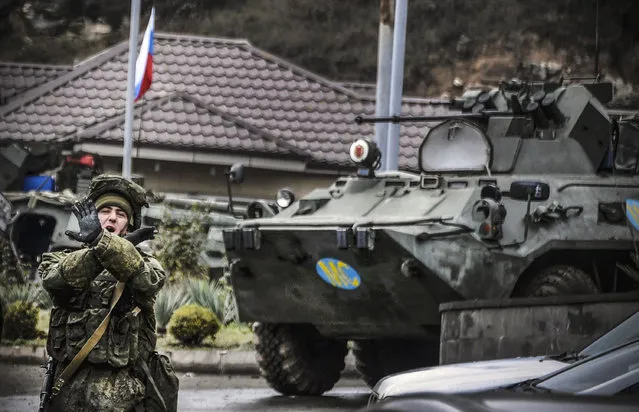
A Russian peacekeeper shouts “No pictures!” at a checkpoint outside the city of Stepanakert on November 13, 2020, during a ceasefire in the military conflict between Armenia and Azerbaijan over the breakaway region of Nagorno-Karabakh. Russian began deploying 2,000 peacekeepers to Nagorno-Karabakh on November 10 after Armenia and Azerbaijan agreed a peace deal to end weeks of fierce fighting over the disputed region. The Moscow-brokered agreement came after a string of Azerbaijani victories in its fight to retake the ethnic Armenian enclave. It sparked celebrations in Azerbaijan but fury in Armenia, where protesters took to the streets to denounce their leaders for losses in the territory, which broke from Azerbaijan's control during a war in the early 1990s. (Photo by Alexander Nemenov/AFP Photo)

A Russian peacekeeper shouts “No pictures!” at a checkpoint outside the city of Stepanakert on November 13, 2020, during a ceasefire in the military conflict between Armenia and Azerbaijan over the breakaway region of Nagorno-Karabakh. Russian began deploying 2,000 peacekeepers to Nagorno-Karabakh on November 10 after Armenia and Azerbaijan agreed a peace deal to end weeks of fierce fighting over the disputed region. (Photo by Alexander Nemenov/AFP Photo)
Details
15 Nov 2020 00:07:00
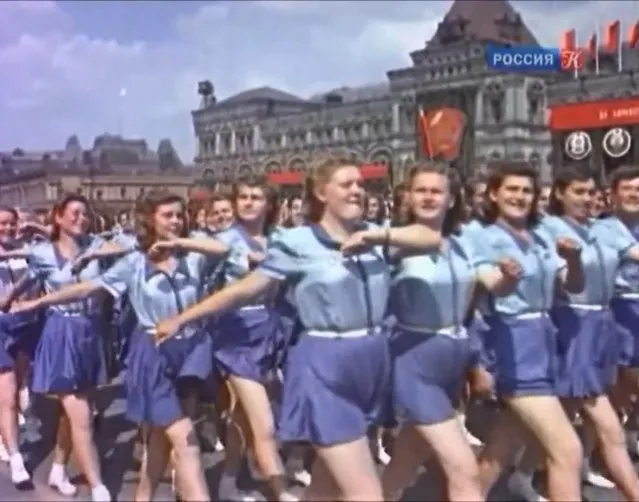
Russia – Back in the USSR

Russia – Back in the USSR. No comment.


Details
03 Sep 2014 15:40:00
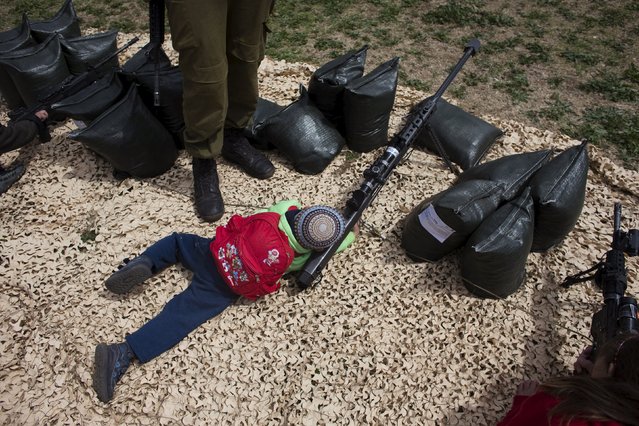
An Israeli boy looks through the sight of a weapon during a display of Israeli Defense Forces (IDF) equipment and abilities at the West Bank settlement of Kiryat Arba, April 23, 2015, during celebrations for Israel's Independence Day, marking the 67th anniversary of the creation of the state. (Photo by Ronen Zvulun/Reuters)

An Israeli boy looks through the sight of a weapon during a display of Israeli Defense Forces (IDF) equipment and abilities at the West Bank settlement of Kiryat Arba, April 23, 2015, during celebrations for Israel's Independence Day, marking the 67th anniversary of the creation of the state. (Photo by Ronen Zvulun/Reuters)
Details
24 Apr 2015 11:14:00