Loading...
Done
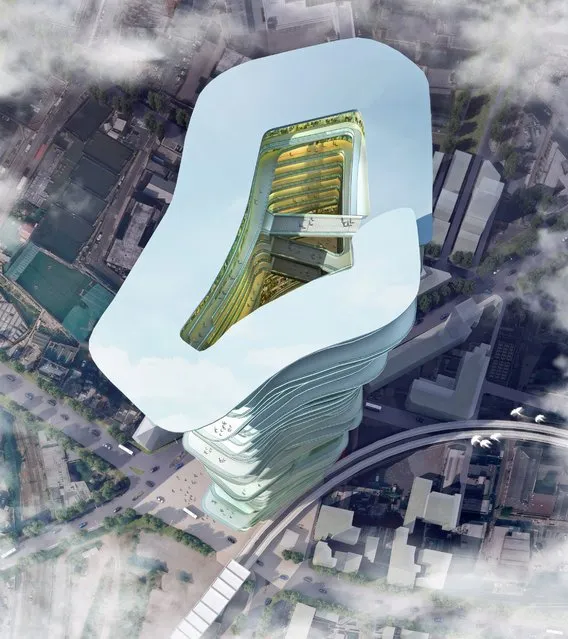
These are the ambitious plans which suggest skyscrapers of the future may house an entire city. The Endless City project is an award-winning proposal by sure Architecture, who propose turning skyscrapers into complete ecosystems. London is the proposed city for the mixed-use tower – which would feature huge ramps linking different sections of the structure. The company, whose design won the SkyScrapers and SuperSkyScrapers Competition, insist the structure would be a great space-saver in dense cities which have previously spread outwards rather than upwards. (Photo by Caters News)

These are the ambitious plans which suggest skyscrapers of the future may house an entire city. The Endless City project is an award-winning proposal by sure Architecture, who propose turning skyscrapers into complete ecosystems. London is the proposed city for the mixed-use tower – which would feature huge ramps linking different sections of the structure. The company, whose design won the SkyScrapers and SuperSkyScrapers Competition, insist the structure would be a great space-saver in dense cities which have previously spread outwards rather than upwards. (Photo by Caters News)
Details
08 Sep 2014 10:38:00
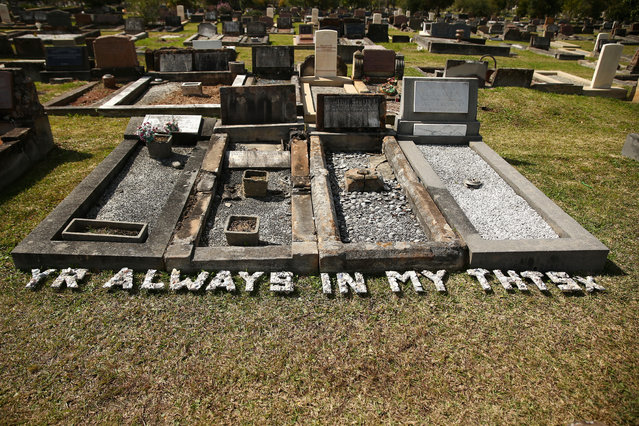
One part of “Celestrial Texts – Heavenly Tweets” by Laine Hogarty is seen as part of the “Hidden” annual sculpture exhibition at Rookwood Cemetery on September 15, 2014 in Sydney, Australia. Located in the suburb or Rookwood in Western Sydney Rookwood cemetery is the largest necropolis in the southern hemisphere. The Annual “Hidden” exhibition features works by local artists. (Photo by Mark Kolbe/Getty Images)

One part of “Celestrial Texts – Heavenly Tweets” by Laine Hogarty is seen as part of the “Hidden” annual sculpture exhibition at Rookwood Cemetery on September 15, 2014 in Sydney, Australia. Located in the suburb or Rookwood in Western Sydney Rookwood cemetery is the largest necropolis in the southern hemisphere. The Annual “Hidden” exhibition features works by local artists. (Photo by Mark Kolbe/Getty Images)
Details
16 Sep 2014 12:46:00
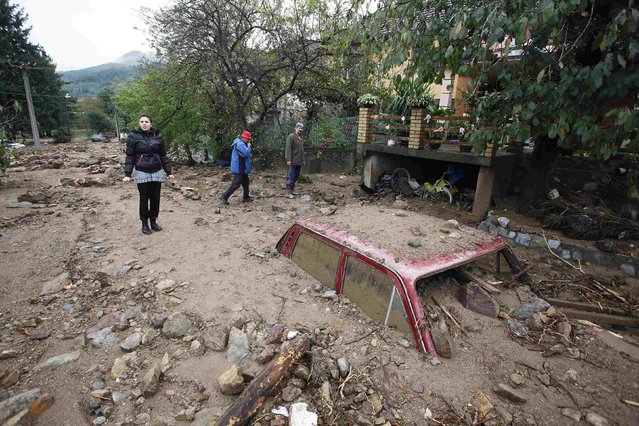
People pass by a vehicle almost completely submerged on a street covered with mud due to heavy floods in Tekija village September 17, 2014. One person died in Serbia and authorities scrambled to evacuate hundreds of people from villages threatened by rising rivers, officials said on Tuesday, in scenes recalling the devastating May flooding that killed dozens. (Photo by Djordje Kojadinovic/Reuters)

People pass by a vehicle almost completely submerged on a street covered with mud due to heavy floods in Tekija village September 17, 2014. One person died in Serbia and authorities scrambled to evacuate hundreds of people from villages threatened by rising rivers, officials said on Tuesday, in scenes recalling the devastating May flooding that killed dozens. (Photo by Djordje Kojadinovic/Reuters)
Details
18 Sep 2014 11:21:00


“Henri Marie Raymond de Toulouse-Lautrec-Monfa or simply Henri de Toulouse-Lautrec (24 November 1864 – 9 September 1901) was a French painter, printmaker, draughtsman, and illustrator, whose immersion in the colourful and theatrical life of fin de siècle Paris yielded an œuvre of exciting, elegant and provocative images of the modern and sometimes decadent life of those times. Toulouse-Lautrec is known along with Cézanne, Van Gogh, and Gauguin as one of the greatest painters of the Post-Impressionist period. In a 2005 auction at Christie's auction house a new record was set when “La blanchisseuse”, an early painting of a young laundress, sold for $22.4 million U.S” – Wikipedia.

Photo: Full-length portrait of French artist Henri Toulouse-Lautrec wearing an overcoat, a bowler hat, and pince-nez eyeglasses while holding a cane. (Photo by Hulton Archive/Getty Images). Circa 1895
Details
20 Mar 2011 09:28:00


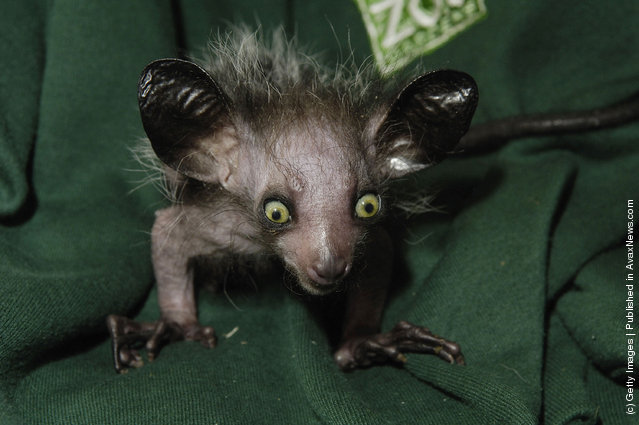
“The aye-aye (Daubentonia madagascariensis) is a lemur, a strepsirrhine primate native to Madagascar that combines rodent-like teeth and a special thin middle finger to fill the same ecological niche as a woodpecker. It is the world's largest nocturnal primate, and is characterized by its unusual method of finding food; it taps on trees to find grubs, then gnaws holes in the wood and inserts its narrow middle finger to pull the grubs out. The only other animal species known to find food in this way is the striped possum. From an ecological point of view the aye-aye fills the niche of a woodpecker as it is capable of penetrating wood to extract the invertebrates within”. – Wikipedia

Photo: In this handout image from Bristol Zoo is seen the first captive bred aye-aye in the UK named “Kintana” (meaning star in Malagasy) April 15, 2005 at Bristol Zoo Gardens, England. The zoo announced today only the second baby aye-aye to be hand-reared in the world (the first was in Jersey Zoo) and has now made his first public appearance since his birth on 11 February 2005. (Photo by Rob Cousins/Bristol Zoo via Getty Images)
Details
13 Apr 2011 13:33:00


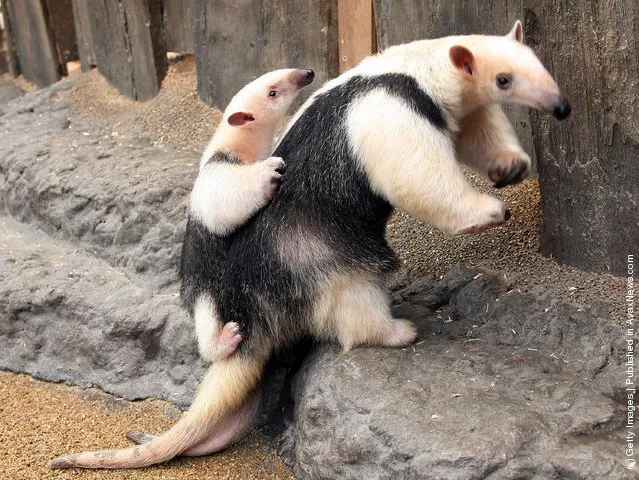
“The Southern Tamandua, Collared Anteater or Lesser Anteater (Tamandua tetradactyla) is a species of anteater from South America. It is a solitary animal, found in many habitats from mature to highly disturbed secondary forests and arid savannas. It feeds on ants, termites and bees. It has very strong foreclaws that can be used to break insect nests or to defend itself”. – Wikipedia

Photo: A three-month-old baby Southern Tamandua “Konbu” lies on its mother Tae's back at Sunshine International Aquarium on July 7, 2009 in Tokyo, Japan. Baby Southern Tamandua feels safe and comfortable holding onto something and normally stays on the mother's back until around 3 months old. (Photo by Junko Kimura/Getty Images)
Details
19 May 2011 10:31:00


“The Berlin Wall (German: Berliner Mauer) was a barrier constructed by the German Democratic Republic (GDR, East Germany) starting on 13 August 1961, that completely cut off West Berlin from surrounding East Germany and from East Berlin. The barrier included guard towers placed along large concrete walls, which circumscribed a wide area (later known as the “death strip”) that contained anti-vehicle trenches, “fakir beds” and other defenses. The Soviet-dominated Eastern Bloc officially claimed that the wall was erected to protect its population from fascist elements conspiring to prevent the “will of the people” in building a socialist state in East Germany. However, in practice, the Wall served to prevent the massive emigration and defection that marked Germany and the communist Eastern Bloc during the post-World War II period”. – Wikipedia

Photo: West Berlin policemen and East German Volkspolizei face each other across the border in Berlin, circa 1955. (Photo by Three Lions/Hulton Archive/Getty Images)
Details
22 May 2011 10:49:00


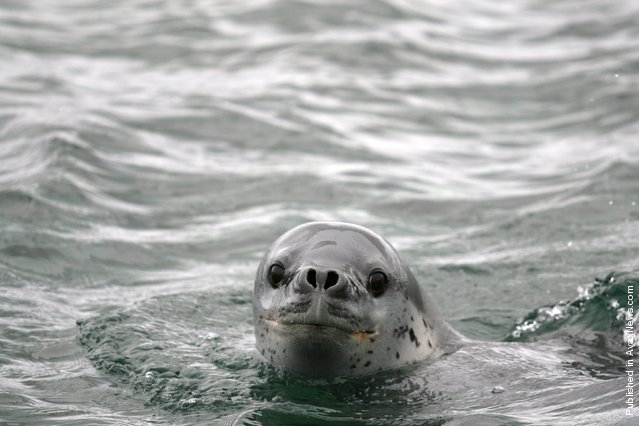
“The leopard seal (Hydrurga leptonyx), also referred to as the sea leopard, is the second largest species of seal in the Antarctic (after the southern elephant seal). It is most common in the southern hemisphere along the coast of Antarctica and on most sub-Antarctic islands, but can also be found on the coasts of southern Australia, Tasmania, South Africa, New Zealand, Lord Howe Island, Tierra del Fuego, the Cook Islands, and the Atlantic coast of South America. It can live twenty-six years, possibly more. Orcas and large sharks are the only natural predators of leopard seals”. – Wikipedia

Photo by: Gilad Rom; Source: Flickr
Details
13 Nov 2011 11:24:00