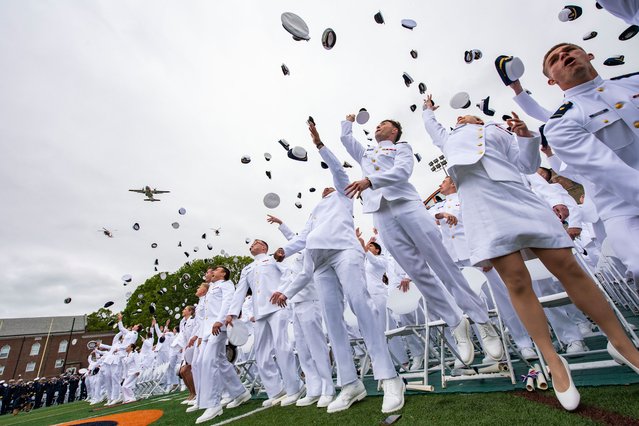
Newly commissioned officers toss their hats during the US Coast Guard Academy's 144th Commencement in New London, Connecticut, on May 21, 2025. (Photo by Joseph Prezioso/AFP Photo)
This hazel dormouse is being given a once-over by a disease risk team at ZSL London Zoo, UK in May 2025, as part of reintroduction programme. (Photo by David Levene/The Guardian)
“Ring Girls” attend the undercard bouts before Oleksandr Usyk of Ukraine faces Daniel Dubois of Great Britain in their undisputed heavyweight title bout at the Wembley Stadium in London, Great Britain, 19 July 2025. It is the second meeting between the WBA (Super), WBO and WBC champion Usyk and IBF title-holder Dubois following their fight in 2023 which Usyk won. (Photo by Daniel Hambury/EPA)
A Fulton Hotshot lights a controlled burn on the so-called “Rough Fire” in the Sequoia National Forest, California, August 21, 2015. In California, suffering its worst drought on record, about 2,500 people were forced to flee Christian camps east of Fresno at Hume Lake as the so-called Rough Fire crossed Highway 180, officials said. (Photo by Max Whittaker/Reuters)
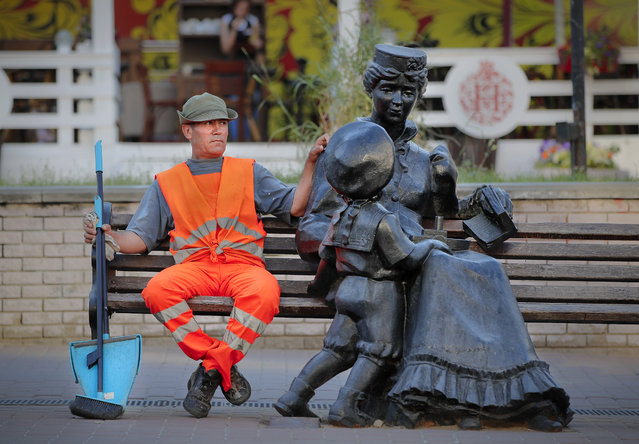
A municipal worker sits on a bench, next to a statue, in Nizhny Novgorod, Russia, during the 2018 soccer World Cup, Thursday, June 28, 2018. Nizhny Novgorod was a “closed city” during the Soviet era. It was known as Gorky until 1990 and it was here that dissident scientist Andrei Sakharov was held under house arrest. Now the city hosts six World Cup matches and is teeming with tourists. That was unthinkable in the Soviet era and even rare now in a city that is seldom visited by outsiders. (Photo by Vadim Ghirda/AP Photo)
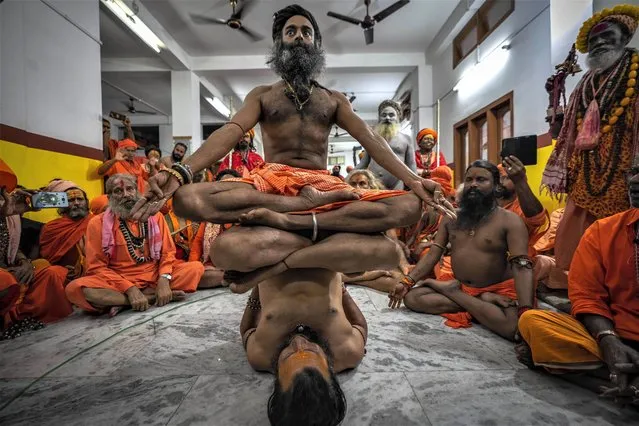
Hindu holy men display their yoga skills before media on International Day of Yoga at the Kamakhya temple in Guwahati, Assam, India, Wednesday, June 21, 2023. The holy men from different parts of this northeastern state arrived at the temple to attend the Ambubachi festival that starts on Thursday. (Photo by Anupam Nath/AP Photo)
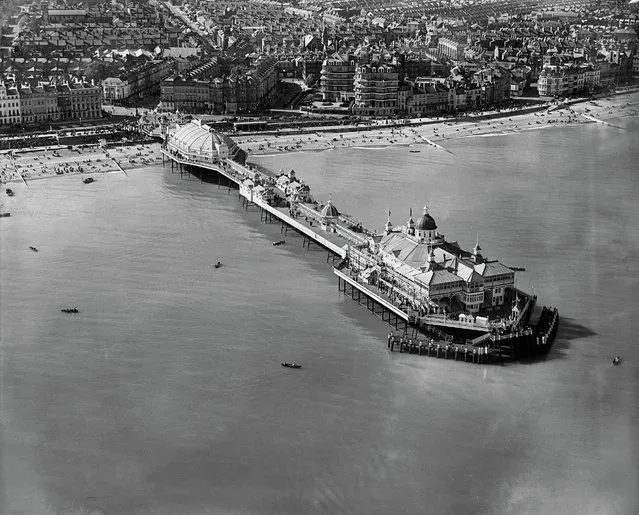
While the lido was described as bringing “modernism to the masses” on the British coast it was just the latest example of a trend that had been developing since Victorian times – transforming seaside towns into resorts for leisure and entertainment. In the latter half of the nineteenth century, the fashion was for local authorities to build great piers stretching from the promenade out into the sea. The Eastbourne Pier, pictured here in May 1931, was erected between 1866 and 1870 to an ingenious design by Eugenius Birch, which saw the structure sitting on special cups allowing the supporting struts to “move” in bad weather. Arranged on the pier's 1,000-foot length were kiosks, a theatre, a ballroom and a camera obscura. 1931. (Photo by Aerofilms Collection via “A History of Britain From Above”)