Loading...
Done
A woman and a girl dressed in historical Red Army uniform, wait before watching the Victory Day parade, marking the 71st anniversary of the victory over Nazi Germany in World War Two, at Red Square in Moscow, Russia, May 9, 2016. (Photo by Grigory Dukor/Reuters)

A woman and a girl dressed in historical Red Army uniform, wait before watching the Victory Day parade, marking the 71st anniversary of the victory over Nazi Germany in World War Two, at Red Square in Moscow, Russia, May 9, 2016. (Photo by Grigory Dukor/Reuters)
Details
10 May 2016 13:19:00
A woman shoots her rifle at a forest shooting range near the village of Visnova, Czech Republic, June 9, 2016. (Photo by David W. Cerny/Reuters)

A woman shoots her rifle at a forest shooting range near the village of Visnova, Czech Republic, June 9, 2016. (Photo by David W. Cerny/Reuters)
Details
11 Jun 2016 12:17:00
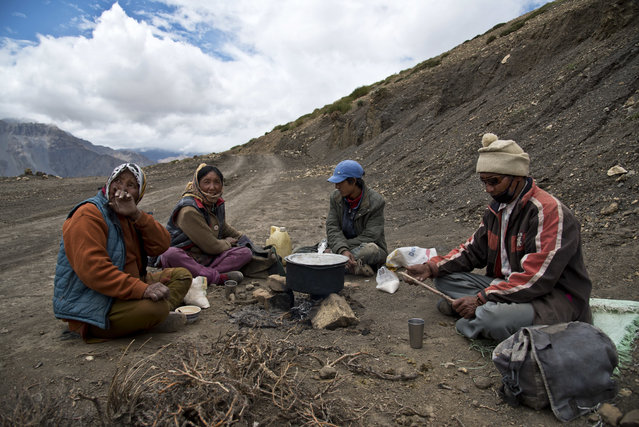
In this August 17, 2016, photo, from left to right, Chhering Chodom, 60, Tashi Yangzom, 50, Lobsang Chhering, 27, and Dorje Tandup, 58, drink milk tea on the side of the road. For centuries, the sleepy valley nestled in the Indian Himalayas remained a hidden Buddhist enclave forbidden to outsiders. Enduring the harsh year-round conditions of the high mountain desert, the people of Spiti Valley lived by a simple communal code – share the Earth's bounty, be hospitable to neighbors, and eschew greed and temptation at all turns. That's all starting to change, for better or worse. Since India began allowing its own citizens as well as outsiders to visit the valley in the early 1990s, tourism and trade have boomed. And the marks of modernization, such as solar panels, asphalt roads and concrete buildings, have begun to appear around some of the villages that dot the remote landscape at altitudes above 4,000 meters (13,000 feet). (Photo by Thomas Cytrynowicz/AP Photo)

In this August 17, 2016, photo, from left to right, Chhering Chodom, 60, Tashi Yangzom, 50, Lobsang Chhering, 27, and Dorje Tandup, 58, drink milk tea on the side of the road. For centuries, the sleepy valley nestled in the Indian Himalayas remained a hidden Buddhist enclave forbidden to outsiders. Enduring the harsh year-round conditions of the high mountain desert, the people of Spiti Valley lived by a simple communal code – share the Earth's bounty, be hospitable to neighbors, and eschew greed and temptation at all turns. That's all starting to change, for better or worse. (Photo by Thomas Cytrynowicz/AP Photo)

Details
15 Sep 2016 09:22:00
Female “pilot” Anna (C) climbs out the cockpit of Japanese electronics company Suidobashi Heavy Industry's newly unveiled robot “Kuratas” at the Wonder Festival in Chiba, suburban Tokyo on July 29, 2012. The Kuratas robot, which will go on sale with a price tag of one million USD, measures four meters in height, weighs four tons and has four wheeled legs that can either be controlled remotely through the 3G network or by a human seated within the cockpit.

Female pilot Anna climbs out the cockpit of Japanese electronics company Suidobashi Heavy Industry's newly unveiled robot “Kuratas” at the Wonder Festival in Chiba, suburban Tokyo on July 29, 2012. The “Kuratas” robot, which will go on sale with a price tag of one million USD, measures four meters in height, weighs four tons and has four wheeled legs that can either be controlled remotely through the 3G network or by a human seated within the cockpit. (Photo by Yoshikazu Tsuno/AFP Photo)
Details
30 Jul 2012 09:26:00


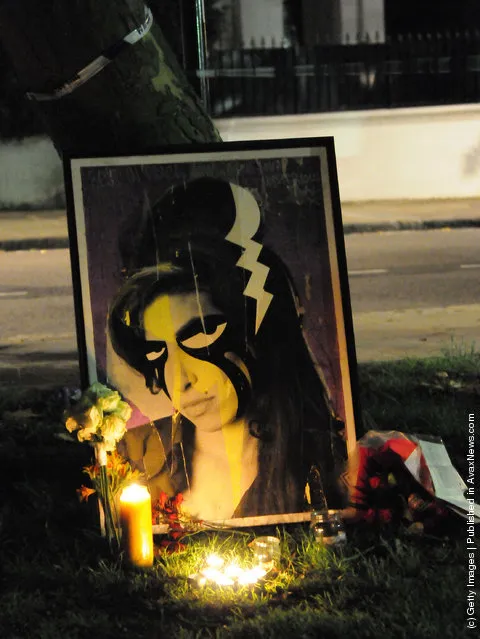
“Amy Jade Winehouse (14 September 1983 – 23 July 2011) was a British singer-songwriter known for her powerful contralto vocals and her eclectic mix of musical genres including R&B, soul and jazz. ... Winehouse died at the age of 27 on 23 July 2011 at her home in London; police have said that the cause of her death was «as yet unexplained»”. – Wikipedia

Photo: Amy Winehouse vigil outside Amy Winehouse's North London home on July 23, 2011 in London, England. Singer Winehouse, 27, was found dead today. (Photo by Sylvia Linares/Getty Images)
Details
24 Jul 2011 09:52:00
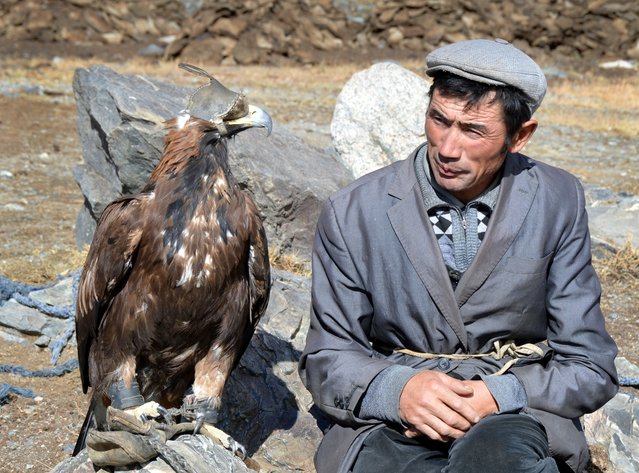
Hunter Berek and his eagle outside his home. (Photo by Brad Ruoho/The Star Tribune)

“I’d come to the Altai Mountains on an Adventure Sherpas tour. Our group of 12 was made up mostly of Minnesotans who’d left warm weather and falling leaves for frosty Mongolia. We’d come to sleep in cozy ger tents, the traditional yurt abode of the Mongolian steppe; sip mare’s milk tea; climb mountain glaciers; ride horses to an ancient battle site, and attend the annual Eagle Hunting Festival in Ölgiy...”. – Kathryn Kysar via The Star Tribune. Here: hunter Berek and his eagle outside his home. (Photo by Brad Ruoho/The Star Tribune)
Details
11 Jan 2015 12:57:00
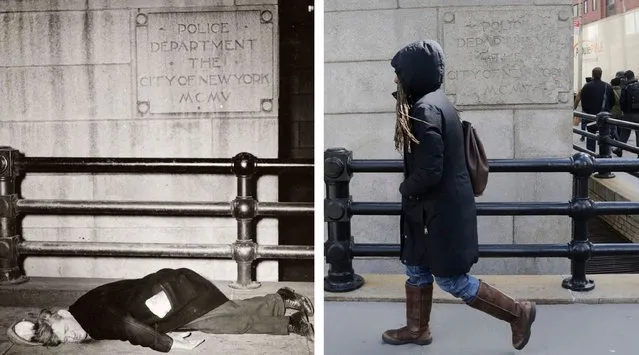
A new book of photos by legendary photographer Weegee shows what industrialized, pre-gentrified New York looked like in the mid-20th century, before the city was crammed with towers and billboards. (Photo by AP Photo/Copyright Weegee/The International Center of Photography, Mark Lennihan)

A new book of photos by legendary photographer Weegee shows what industrialized, pre-gentrified New York looked like in the mid-20th century, before the city was crammed with towers and billboards. Here: this combination shows the 1945 photo “Derelict sleeping on the sidewalk outside police headquarters” by Weegee, provided by the International Center of Photography in New York, and a woman walking on the same spot on Wednesday, March 18, 2015. (Photo by AP Photo/Copyright Weegee/The International Center of Photography, Mark Lennihan)


Details
27 Mar 2015 13:16:00
A picture made available on 13 May 2016 shows A Tiwa girl performing her traditional dance as they celebrated the Wanchuwa festival in Karbi Anglong District of Assam state, India, 11 May 2016. Wanchuwa is one of the most important festivals of the Tiwa tribal community living in the hills as it is related with agriculture which is the mainstay of their economy. Tiwas pray for a bountiful harvest during this festival and to protect their crops from pest and other natural calamities. (Photo by EPA/Stringer)

A picture made available on 13 May 2016 shows A Tiwa girl performing her traditional dance as they celebrated the Wanchuwa festival in Karbi Anglong District of Assam state, India, 11 May 2016. Wanchuwa is one of the most important festivals of the Tiwa tribal community living in the hills as it is related with agriculture which is the mainstay of their economy. Tiwas pray for a bountiful harvest during this festival and to protect their crops from pest and other natural calamities. Tiwa is a major tribe of Assam state who practice Jhum or shifting cultivation for their living in the hills. (Photo by EPA/Stringer)
Details
14 May 2016 11:45:00