Loading...
Done
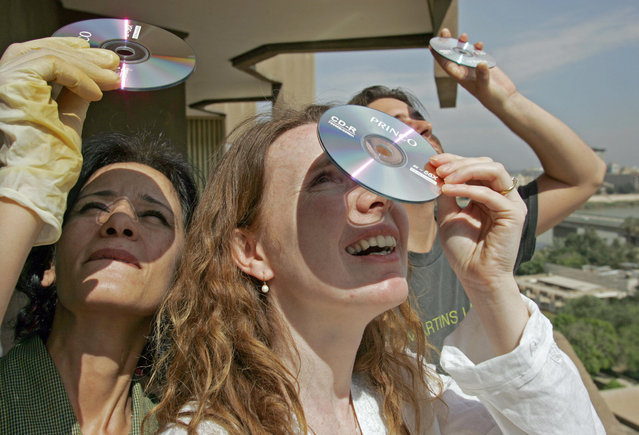
An Iraqi woman and foreigners use  pair of compact discs as a filter to watch the partial solar eclipse in war-torn Baghdad, 29 March 2006. Without access to proper equipment to protect their eyes from the sun's rays, eclipse watchers in Iraq used makeshift filters.  The moon blotted out the sun over northwest Africa early Wednesday, turning day into night in a total solar eclipse as it swept a shadowy path from the outer tip of Brazil to the steppes of Mongolia. (Photo by Hassan Ammar/AFP Photo)

An Iraqi woman and foreigners use pair of compact discs as a filter to watch the partial solar eclipse in war-torn Baghdad, 29 March 2006. Without access to proper equipment to protect their eyes from the sun's rays, eclipse watchers in Iraq used makeshift filters. The moon blotted out the sun over northwest Africa early Wednesday, turning day into night in a total solar eclipse as it swept a shadowy path from the outer tip of Brazil to the steppes of Mongolia. (Photo by Hassan Ammar/AFP Photo)
Details
25 Jul 2017 09:31:00
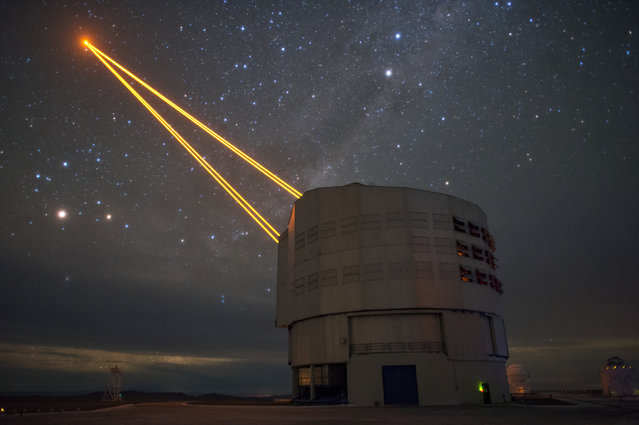
Four pillars of light from the 4 Laser Guide Star Facility on ESO's Very Large Telescope (VLT) are shown reaching into the Chilean night sky in this image from ESO Photo Ambassador Fred Kamphues, on September 2, 2016. The lasers are a key part of the adaptive optics system on the VLT. Adaptive optics allows astronomers to drastically reduce the atmospheric distortion present at even the best sites in the world for astronomy, including Paranal in Chile, the home of the VLT. (Photo by F. Kamphues/ESO)

Four pillars of light from the 4 Laser Guide Star Facility on ESO's Very Large Telescope (VLT) are shown reaching into the Chilean night sky in this image from ESO Photo Ambassador Fred Kamphues, on September 2, 2016. The lasers are a key part of the adaptive optics system on the VLT. Adaptive optics allows astronomers to drastically reduce the atmospheric distortion present at even the best sites in the world for astronomy, including Paranal in Chile, the home of the VLT. (Photo by F. Kamphues/ESO)
Details
23 Feb 2017 00:06:00
New York City Deputy Police Commissioner John A. Leach, right, watching agents pour liquor into sewer following a raid during the height of prohibition, circa 1921. (Photo by Tom Marshall/Mediadrumworld)

New York City Deputy Police Commissioner John A. Leach, right, watching agents pour liquor into sewer following a raid during the height of prohibition, circa 1921. (Photo by Tom Marshall/Mediadrumworld)
Details
15 Mar 2017 00:00:00
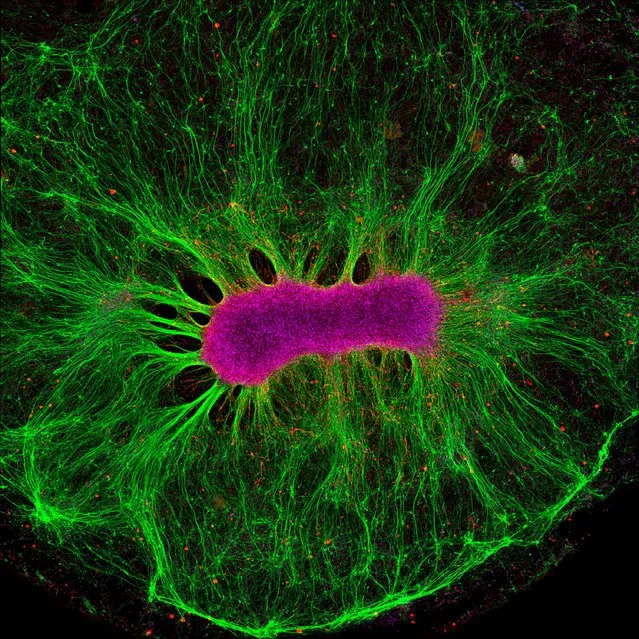
Brain-on-a-chip. Dazzling in green and magenta this image shows the nerve fibres (in green) produced by neural stem cells (in magenta) as they grow on a synthetic gel. Captured by a technique known as confocal microscopy, the image is part of research shedding light on how tinkering with the environment can affect the way in which nerve fibres grow. (Photo by Collin Edington and Iris Lee/Massachusetts Institute of Technology/Wellcome Images)

Brain-on-a-chip. Dazzling in green and magenta this image shows the nerve fibres (in green) produced by neural stem cells (in magenta) as they grow on a synthetic gel. Captured by a technique known as confocal microscopy, the image is part of research shedding light on how tinkering with the environment can affect the way in which nerve fibres grow. (Photo by Collin Edington and Iris Lee/Massachusetts Institute of Technology/Wellcome Images)
Details
17 Mar 2017 00:01:00
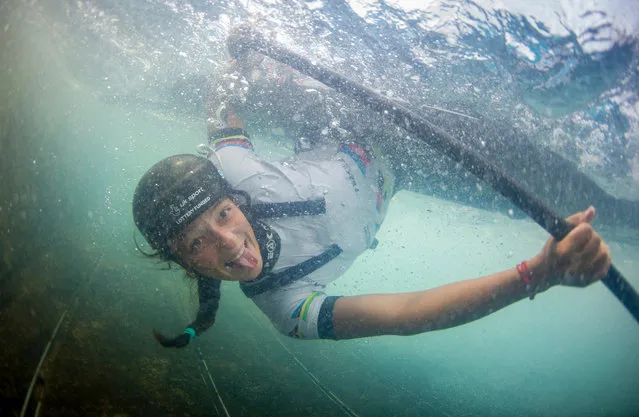
Special Merit Award. Mallory Franklin (2019). The British slalom canoeist has competed internationally since 2009 and won nine medals in total at the ICF Canoe Slalom World Championships with four golds, four silvers and a bronze. She has also won eleven medals at the European Championships. (Photo by Richard Pelham/World Sports Photography Awards 2021)

Special Merit Award. Mallory Franklin (2019). The British slalom canoeist has competed internationally since 2009 and won nine medals in total at the ICF Canoe Slalom World Championships with four golds, four silvers and a bronze. She has also won eleven medals at the European Championships. (Photo by Richard Pelham/World Sports Photography Awards 2021)
Details
05 Jun 2021 09:12:00
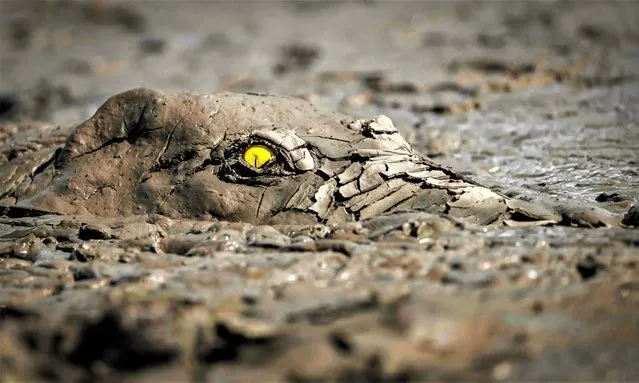
“Danger in the mud” – a crocodile at Mana Pools National Park, Zimbabwe. The grand prize winner. (Photo by Jens Cullmann/World Nature Photography Awards 2022)

“Danger in the mud” – a crocodile at Mana Pools National Park, Zimbabwe. The grand prize winner. (Photo by Jens Cullmann/World Nature Photography Awards 2022)
Details
08 Mar 2023 04:28:00
Joy Corrigan attending the “BlacKkKlansman” premiere during the 71 st Cannes Film Festival at the Palais des Festivals on May 14, 2018 in Cannes, France. (Photo by Stephane Mahe/Reuters)

Joy Corrigan attending the “BlacKkKlansman” premiere during the 71 st Cannes Film Festival at the Palais des Festivals on May 14, 2018 in Cannes, France. (Photo by Stephane Mahe/Reuters)
Details
21 May 2018 06:22:00
A woman cries while sitting on a road amid the destroyed city of Natori, Miyagi Prefecture in northern Japan March 13, 2011, after a massive earthquake and tsunami that are feared to have killed more than 10,000 people. (Photo by Asahi Shimbun/Reuters)

A woman cries while sitting on a road amid the destroyed city of Natori, Miyagi Prefecture in northern Japan March 13, 2011, after a massive earthquake and tsunami. Five years on from the tsunami that triggered meltdowns at Japan's Fukushima nuclear plant, the page is anything but turned. A magnitude 9 earthquake and towering tsunami on March 11, 2011 killed nearly 16,000 people along Japan's northeastern coast and left more than 2,500 missing. The 10-metre (33-foot) tsunami swept away everything in its path, including houses, ships, cars and farm buildings. (Photo by Asahi Shimbun/Reuters)
Details
09 Mar 2016 12:40:00