Loading...
Done
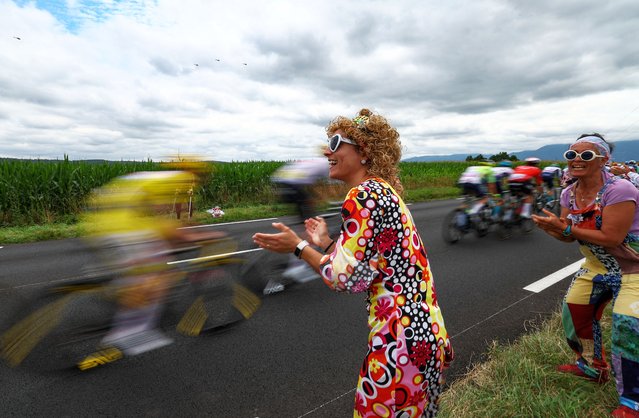
Spectators in colourful attire cheer as the pack of riders (peloton) cycles by during the 14th stage of the 111th edition of the Tour de France cycling race, 151,9 km between Pau and Saint-Lary-Soulan Pla d'Adet, in the Pyrenees mountains in southwestern France, on July 13, 2024. (Photo by Anne-Christine Poujoulat/AFP Photo)

Spectators in colourful attire cheer as the pack of riders (peloton) cycles by during the 14th stage of the 111th edition of the Tour de France cycling race, 151,9 km between Pau and Saint-Lary-Soulan Pla d'Adet, in the Pyrenees mountains in southwestern France, on July 13, 2024. (Photo by Anne-Christine Poujoulat/AFP Photo)
Details
24 Nov 2025 04:41:00
Revellers get into the spirit of the 40th annual Zomercarnaval – summer carnival –  in Rotterdam on July 28, 2024. The two-day event is such in integral part of Netherlands tradition it was added to Unesco’s Intangible Cultural Heritage list last year. (Phoot by James Petermeier/ZUMA Press Wire)

Revellers get into the spirit of the 40th annual Zomercarnaval – summer carnival – in Rotterdam on July 28, 2024. The two-day event is such in integral part of Netherlands tradition it was added to Unesco’s Intangible Cultural Heritage list last year. (Phoot by James Petermeier/ZUMA Press Wire)
Details
29 Nov 2025 06:11:00
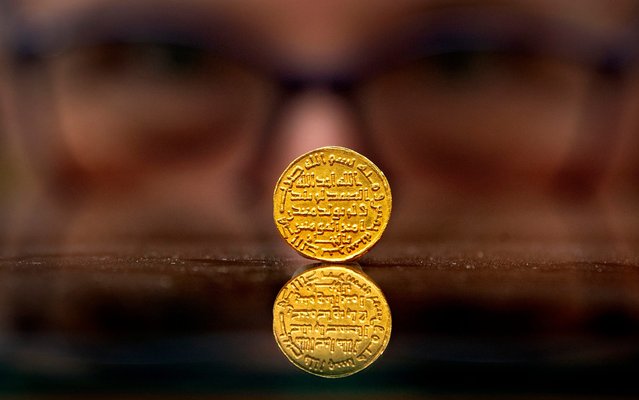
A member of staff at Morton & Eden holds an extremely rare early Islamic gold coin on Thursday September 12, 2019, which is expected to fetch £1.4m at auction in London. Measuring a 20mm across, about the size of a modern £1 piece, it is one of the world's rarest and most treasured Islamic gold coins from the first dynasty of Islam, the Umayyad gold dinar dated 105h (723AD). (Photo by Victoria Jones/PA Images via Getty Images)

A member of staff at Morton & Eden holds an extremely rare early Islamic gold coin on Thursday September 12, 2019, which is expected to fetch £1.4m at auction in London. Measuring a 20mm across, about the size of a modern £1 piece, it is one of the world's rarest and most treasured Islamic gold coins from the first dynasty of Islam, the Umayyad gold dinar dated 105h (723AD). (Photo by Victoria Jones/PA Images via Getty Images)
Details
14 Sep 2019 00:01:00
A reveler jumps over a bonfire during the night of San Juan in Alcobendas near Madrid, Spain, Wednesday, June 24, 2015. The San Juan night coincides with the Summer solstice and it's the welcome to Summer. This celebration takes place during the shortest night of the year in almost all cities and towns of Spain. (Photo by Andres Kudacki/AP Photo)

A reveler jumps over a bonfire during the night of San Juan in Alcobendas near Madrid, Spain, Wednesday, June 24, 2015. The San Juan night coincides with the Summer solstice and it's the welcome to Summer. This celebration takes place during the shortest night of the year in almost all cities and towns of Spain. (Photo by Andres Kudacki/AP Photo)
Details
30 Jul 2015 12:35:00
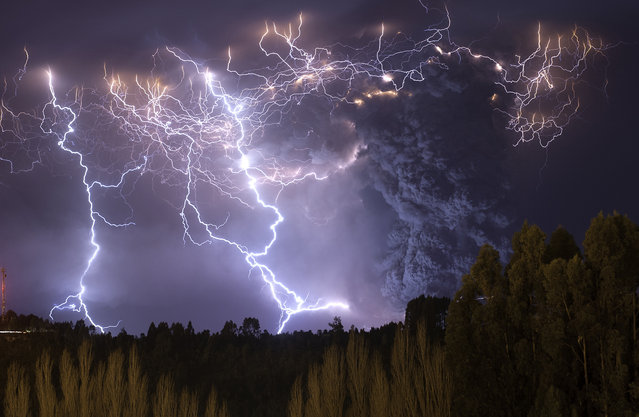
The eruption of Cordon Caulle began on June 4, 2011, located in the Region of Los Rios in Chile. For about 12 months, people and animals became accustomed to living with the daily fall of ash, which also caused problems in the air traffic in South America. The explosions and lightning during first days of the eruption could be seen from hundreds of miles around. This photograph was taken on the second night of eruption from the town of Lago Ranco. (Photo and caption by Francisco Negroni/National Geographic Traveler Photo Contest)

The eruption of Cordon Caulle began on June 4, 2011, located in the Region of Los Rios in Chile. For about 12 months, people and animals became accustomed to living with the daily fall of ash, which also caused problems in the air traffic in South America. The explosions and lightning during first days of the eruption could be seen from hundreds of miles around. This photograph was taken on the second night of eruption from the town of Lago Ranco. (Photo and caption by Francisco Negroni/National Geographic Traveler Photo Contest)

ATTENTION! All pictures are presented in high resolution. To see Hi-Res images – just TWICE click on any picture. In other words, click small picture – opens the BIG picture. Click BIG picture – opens VERY BIG picture.
Details
23 Jun 2013 11:24:00
An artist's impression of a growing supermassive black hole located in the early Universe is seen in this NASA handout illustration released on June 15, 2011. Using the deepest X-ray image ever taken, astronomers found the first direct evidence that massive black holes were common in the early universe. This discovery from NASA's Chandra X-Ray Observatory shows that very young black holes grew more aggressively than previously thought, in tandem with the growth of their host galaxies. (Photo by Reuters/NASA/Chandra X-Ray Observatory/A.Hobart)

An artist's impression of a growing supermassive black hole located in the early Universe is seen in this NASA handout illustration released on June 15, 2011. Using the deepest X-ray image ever taken, astronomers found the first direct evidence that massive black holes were common in the early universe. This discovery from NASA's Chandra X-Ray Observatory shows that very young black holes grew more aggressively than previously thought, in tandem with the growth of their host galaxies. (Photo by Reuters/NASA/Chandra X-Ray Observatory/A.Hobart)
Details
11 Feb 2016 12:57:00
Lance Cpl. Blas Trevino of the 1st Battalion, 5th Marines, shouts out as he is rescued on a medevac helicopter from the U.S. Army's Task Force Lift “Dust Off”, Charlie Company 1-214 Aviation Regiment after he got shot in the stomach outside Sangin, in the Helmand Province of southern Afghanistan on June 11, 2011. The Army's 'Dust Off' crew needed two attempts to get him out, as they were fired upon and took five rounds of bullets into the tail of their aircraft. (Photo by Anja Niedringhaus/AP Photo/File)

Lance Cpl. Blas Trevino of the 1st Battalion, 5th Marines, shouts out as he is rescued on a medevac helicopter from the U.S. Army's Task Force Lift “Dust Off”, Charlie Company 1-214 Aviation Regiment after he got shot in the stomach outside Sangin, in the Helmand Province of southern Afghanistan on June 11, 2011. The Army's 'Dust Off' crew needed two attempts to get him out, as they were fired upon and took five rounds of bullets into the tail of their aircraft. (Photo by Anja Niedringhaus/AP Photo/File)
Details
17 May 2021 07:36:00


“The Trabant is a car that was produced by former East German auto maker VEB Sachsenring Automobilwerke Zwickau in Zwickau, Sachsen. It was the most common vehicle in East Germany, and was also exported to countries both inside and outside the communist bloc. The main selling points was that it had room for four adults and luggage in a compact, light and durable shell and that it was fast (when introduced) and durable. With its mediocre performance, smoky two-stroke engine, and production shortages, the Trabant is often cited as an example of the disadvantages of centralized planning; on the other hand, it is regarded with derisive affection as a symbol of the failed former East Germany and of the fall of communism (in former West Germany, as many East Germans streamed into West Berlin and West Germany in their Trabants after the opening of the Berlin Wall in 1989). It was in production without any significant changes for nearly 30 years with 3,096,099 Trabants produced in total”. – Wikipedia

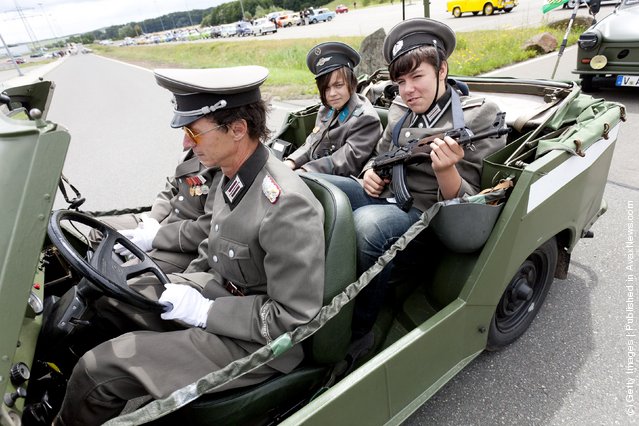
Photo: Enthusiasts weared in uniforms of the former eastern german army trive in a military Trabant car as fans and owners of East German-era Trabant cars gather at the 2011 International Trabantfahrer Treffen (International Trabant Drivers Meeting) on June 26, 2011 in Zwickau, Germany. The Trabant, also known as the Trabi, was among the main cars produced in communist East Germany and built by VEB Sachsenring Automobilwerke in Zwickau for 30 years until 1989. Today the car has cult status for many followers and one company, IndiKar, is even seeking to revive the brand in a modern, electric version. (Photo by Carsten Koall/Getty Images)

Details
27 Jun 2011 12:21:00