Loading...
Done
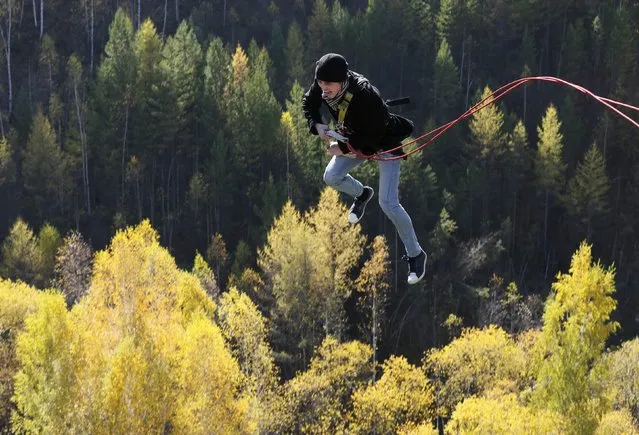
A member of the “Exit Point” amateur rope-jumping group jumps from a 44-metre high (144-feet high) waterpipe bridge in the Siberian Taiga area outside Krasnoyarsk, September 28, 2014. (Photo by Ilya Naymushin/Reuters)

A member of the “Exit Point” amateur rope-jumping group jumps from a 44-metre high (144-feet high) waterpipe bridge in the Siberian Taiga area outside Krasnoyarsk, September 28, 2014. Fans of rope-jumping, a kind of extreme sport involving a jump from a high point using an advanced system of amortization including mountaineering and rope safety equipment, attended the Golden Autumn group's jumping season. (Photo by Ilya Naymushin/Reuters)
Details
04 Oct 2014 11:12:00
A topless protester from the Ukrainian feminist group Femen is blocked by a security guard and a priest as she tries to throw herself at the leader of the Russian Orthodox Church

“A bare-breasted feminist activist bearing a threatening message on her body tried to attack the Russian Orthodox Church's leader Thursday, July 26, 2012, to protest alleged anti-Ukrainian policies by the church and the Kremlin”. – HeraldNet.com

Photo: A topless protester from the Ukrainian feminist group FEMEN is blocked by a security guard and a priest as she tries to throw herself at the leader of the Russian Orthodox Church. (Photo by Associated Press)
Details
27 Jul 2012 10:27:00
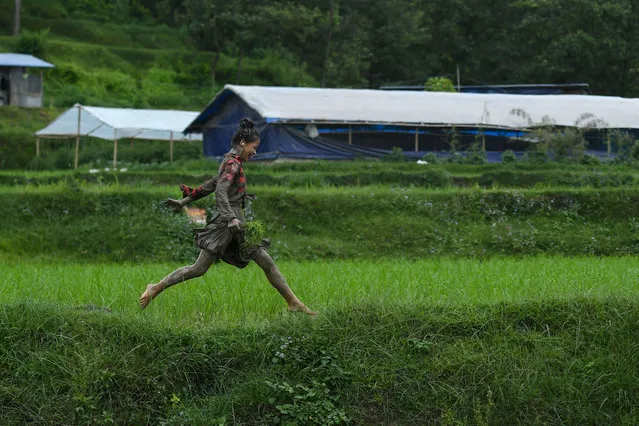
A girl walks along rice paddy fields during “National Paddy Day”, which marks the start of the annual rice planting season, in Tokha village on the outskirts of Kathmandu on June 29, 2020. Splashing mud and drinking local rice beer, Nepali farmers this week celebrated National Paddy Day to mark the beginning of the rice-planting season, despite some coronavirus lockdown measures still in place. Traditional farming songs and laughter echoed in the air as farmers waded into waterlogged fields to sow green paddy. (Photo by Prakash Mathema/AFP Photo)

A girl walks along rice paddy fields during “National Paddy Day”, which marks the start of the annual rice planting season, in Tokha village on the outskirts of Kathmandu on June 29, 2020. Splashing mud and drinking local rice beer, Nepali farmers this week celebrated National Paddy Day to mark the beginning of the rice-planting season, despite some coronavirus lockdown measures still in place. Traditional farming songs and laughter echoed in the air as farmers waded into waterlogged fields to sow green paddy. (Photo by Prakash Mathema/AFP Photo)
Details
02 Aug 2020 00:01:00
The legs of camel and sheep for the “Living Nativity” scene, and Rockettes, of the “Radio City Christmas Special”, are juxtaposed as they pose for photos outside New York's Radio City Music Hall, Tuesday, October 28, 2014. The show is scheduled to open Friday, November 7, 2014 and continue through Wednesday, December 31, 2014. The “Living Nativity” has been part of the Christmas Spectacular since its inception in 1933. (Photo by Richard Drew/AP Photo)

The legs of camel and sheep for the “Living Nativity” scene, and Rockettes, of the “Radio City Christmas Special”, are juxtaposed as they pose for photos outside New York's Radio City Music Hall, Tuesday, October 28, 2014. The show is scheduled to open Friday, November 7, 2014 and continue through Wednesday, December 31, 2014. The “Living Nativity” has been part of the Christmas Spectacular since its inception in 1933. (Photo by Richard Drew/AP Photo)
Details
01 Nov 2014 14:53:00
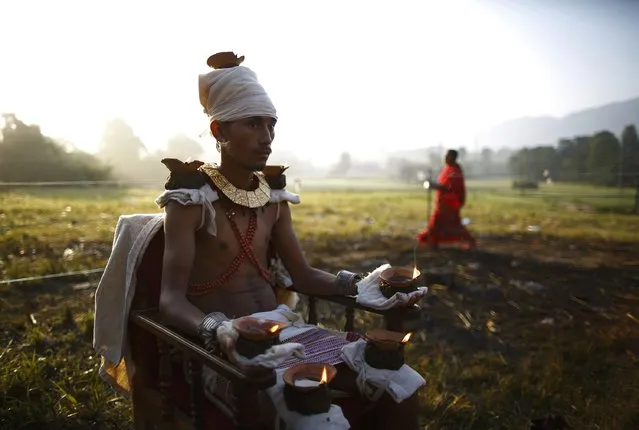
A devotee sits with lighted oil lamps while offering prayers during the “Dashain”, Hinduism's biggest religious festival in Bhaktapur October 3, 2014. Hindus in Nepal celebrate victory over evil during the festival by flying kites, feasting, playing swings, sacrificing animals and worshipping the Goddess Durga as well as other gods and goddess as part of celebrations held throughout the country. (Photo by Navesh Chitrakar/Reuters)

A devotee sits with lighted oil lamps while offering prayers during the “Dashain”, Hinduism's biggest religious festival in Bhaktapur October 3, 2014. Hindus in Nepal celebrate victory over evil during the festival by flying kites, feasting, playing swings, sacrificing animals and worshipping the Goddess Durga as well as other gods and goddess as part of celebrations held throughout the country. (Photo by Navesh Chitrakar/Reuters)
Details
03 Oct 2014 11:30:00
Fishermen row a boat in the algae-filled Chaohu Lake in Hefei, Anhui province, June 19, 2009. The country has invested 51 billion yuan ($7.4 billion) towards the construction of 2,712 projects for the treatment of eight rivers and lakes including Huaihe River, Haihe River, Liaohe River, Chaohu Lake, Dianchi Lake, Songhua River, the Three Gorges region of the Yangtze River and its upstream area, Xinhua News Agency reported. (Photo by Jianan Yu/Reuters)

Growing cities, overuse of fertilizers and factory wastewater have degraded China's water supplies to the extent that half the nation's rivers and lakes are severely polluted. China aims to spend $850 billion to improve filthy water supplies over the next decade, but even such huge outlays may do little to reverse damage caused by decades of pollution and overuse in Beijing's push for rapid economic growth. Photo: Fishermen row a boat in the algae-filled Chaohu Lake in Hefei, Anhui province, June 19, 2009. (Photo by Jianan Yu/Reuters)
Details
03 Aug 2014 08:01:00
Rita Ora attends the Rita Ora “Phoenix” Album Launch Party At Annabel's on November 19, 2018 in London, England. (Photo by David M. BenettGetty Images)

Rita Ora attends the Rita Ora “Phoenix” Album Launch Party At Annabel's on November 19, 2018 in London, England. (Photo by David M. BenettGetty Images)
Details
25 Nov 2018 00:01:00
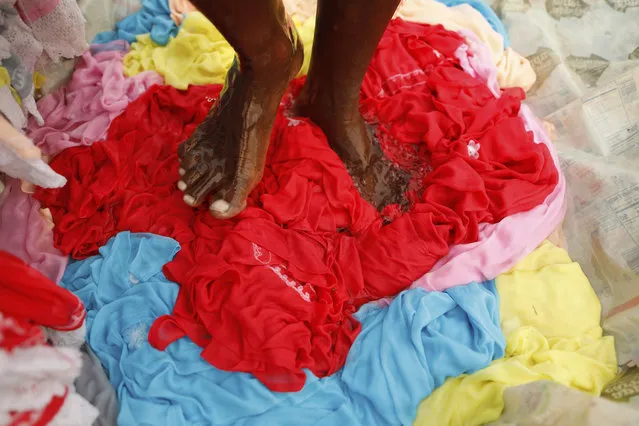
A dhobi, or a washerman washes cloths on the banks of the River Gomti in Lucknow, India, Saturday, September 12, 2020. Dhobis are traditional laundry workers who wash clothes by hand and dry them in the sun, an occupation which has been in existence for generations. Most cities in India have a Dhobi Ghat, or washermen's area, where the city's pile of clothes is laundered. This practice is still popular in India, despite of modern technology. Around 1,000 families work in Lucknow's Dhobi Ghat. However, in light of the novel coronavirus, their wages have decreased drastically. With each family earning around US$100-200 per month. (Photo by Rajesh Kumar Singh/AP Photo)

A dhobi, or a washerman washes cloths on the banks of the River Gomti in Lucknow, India, Saturday, September 12, 2020. Dhobis are traditional laundry workers who wash clothes by hand and dry them in the sun, an occupation which has been in existence for generations. Most cities in India have a Dhobi Ghat, or washermen's area, where the city's pile of clothes is laundered. This practice is still popular in India, despite of modern technology. Around 1,000 families work in Lucknow's Dhobi Ghat. However, in light of the novel coronavirus, their wages have decreased drastically. With each family earning around US$100-200 per month. (Photo by Rajesh Kumar Singh/AP Photo)
Details
25 Sep 2020 00:03:00