Loading...
Done
Tridacna Gigas, or Giant Clams

“The giant clam, Tridacna gigas (known as pā’ua in Cook Islands Māori), is the largest living bivalve mollusc. T. gigas is one of the most endangered clam species. It was mentioned as early as 1825 in scientific reports. One of a number of large clam species native to the shallow coral reefs of the South Pacific and Indian oceans, they can weigh more than 200 kilograms (440 lb) measure as much as 120 cm (47 in) across, and have an average lifespan in the wild of 100 years or more”. – Wikipedia

Photo: Tridacna Gigas, or Giant Clams spew water as a traditional fisherman passes by a small sanctuary on January 23, 2004 near Bolinao in the Northern Philippines. The clams, prime builders for coral reefs and providing shelter for spawning fish and other marine life, are exposed by low tides in the sanctuary. Overfishing and pollution throughout the country are not only threatening food security, but are also starting to choke one of the few working clam sanctuaries in the world. (Photo by David Greedy/Getty Images)
Details
01 Oct 2011 13:10:00
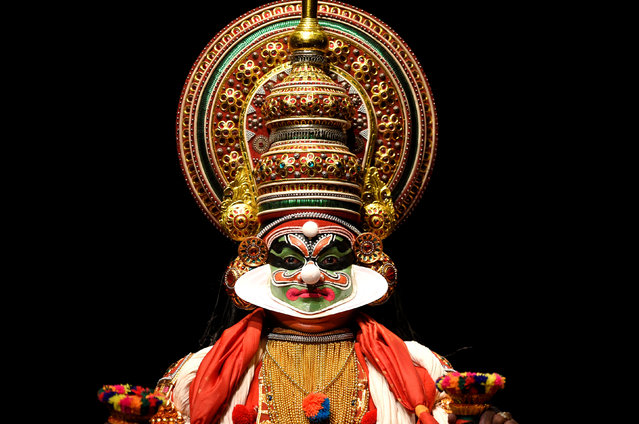
A member of the Indian company Margi Kathakali theatre performs during “Kijote Kathakali”, a Kathakali recital based on the Spanish classic “Don Quixote”, at the Niemeyer Center in Aviles, northern Spain, July 29, 2016. The performance and text captured the essence of the novel while sticking to the format of Kathakali. Kathakali is one of the major forms of classical Indian dance. It is another “story play” genre of art, but one distinguished by its elaborately colorful make-up, costumes and face masks wearing actor-dancers, who have traditionally been all males. (Photo by Eloy Alonso/Reuters)

A member of the Indian company Margi Kathakali theatre performs during “Kijote Kathakali”, a Kathakali recital based on the Spanish classic “Don Quixote”, at the Niemeyer Center in Aviles, northern Spain, July 29, 2016. The performance and text captured the essence of the novel while sticking to the format of Kathakali. Kathakali is one of the major forms of classical Indian dance. (Photo by Eloy Alonso/Reuters)
Details
31 Jul 2016 11:02:00
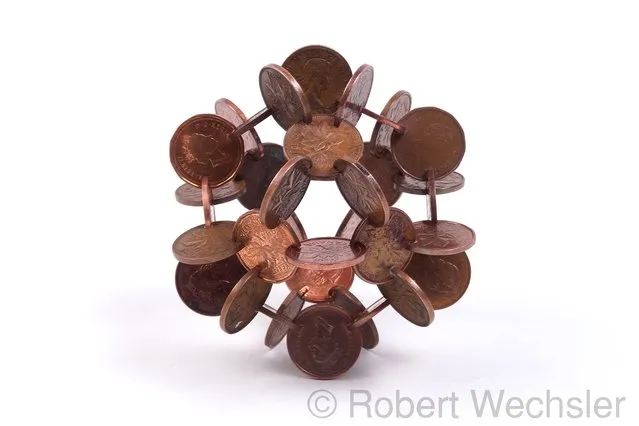
Mendicant By Robert Wechsler

American artist Robert Wechsler has realized a series of sculptural cubes made from thousands of pennies titled “The Mendicant“. Cubes achieved by notching and joining pennies in perfect orientation to one another. Joined at perpendicular angles, the coins create a lattice structure allowing tunnel like passages of light from certain angles. As one moves around them, the cubes seem to fluctuate from material to ethereal. The number of pennies increases exponentially with the size of the cube. Pictured here are three cubes differentiated with subtitles indicating the exact quantity used.
Details
21 Oct 2013 11:18:00
Nightjars And Pooto Bird

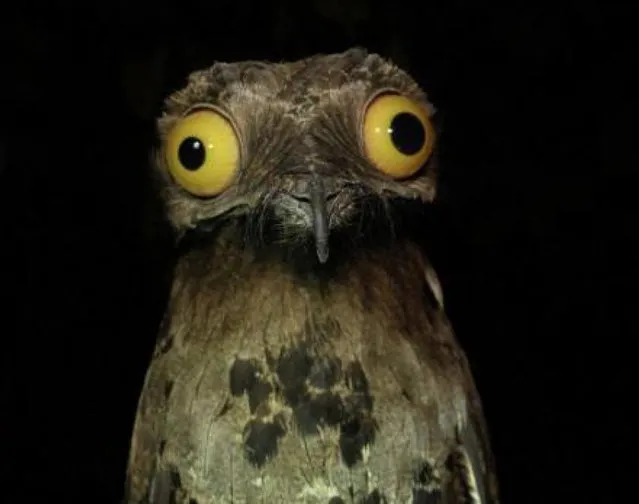
Potoos (family Nyctibiidae) are a group of near passerine birds related to the nightjars and frogmouths. They are sometimes called Poor-me-ones, after their haunting calls. There are seven species in one genus, Nyctibius, in tropical Central and South America.
These are nocturnal insectivores which lack the bristles around the mouth found in the true nightjars. They hunt from a perch like a shrike or flycatcher. During the day they perch upright on tree stumps, camouflaged to look like part of the stump. The single spotted egg is laid directly on the top of a stump.
Details
20 Jan 2014 14:34:00
In this photograph taken on July 10, 2012, a Pakistani worker pulls on a wire he will connect to a thick chain that will in turn be used to peel away a slab of the outer structure of a beached vessel in one of the 127 ship-breaking plots in Geddani, some 40Kms west of Karachi. (Photo by Roberto Schmidt/AFP Photo)

In this photograph taken on July 10, 2012, a Pakistani worker pulls on a wire he will connect to a thick chain that will in turn be used to peel away a slab of the outer structure of a beached vessel in one of the 127 ship-breaking plots in Geddani, some 40Kms west of Karachi. (Photo by Roberto Schmidt/AFP Photo)
Details
23 Jan 2014 11:36:00
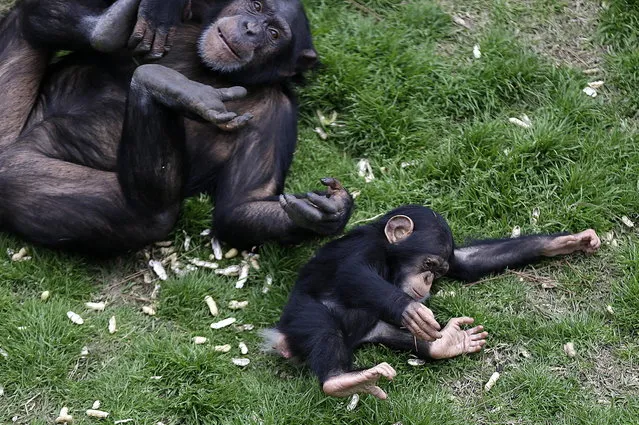
An adult chimp plays with a young chimp at Chimp Haven in Keithville, La., Monday, February 18, 2013. One hundred and eleven chimpanzees will be coming from a south Louisiana laboratory to Chimp Haven, the national sanctuary for chimpanzees retired from federal research. (AP Photo/Gerald Herbert)

An adult chimp plays with a young chimp at Chimp Haven in Keithville, La., Monday, February 18, 2013. One hundred and eleven chimpanzees will be coming from a south Louisiana laboratory to Chimp Haven, the national sanctuary for chimpanzees retired from federal research. (AP Photo/Gerald Herbert)
Details
20 Feb 2013 14:19:00
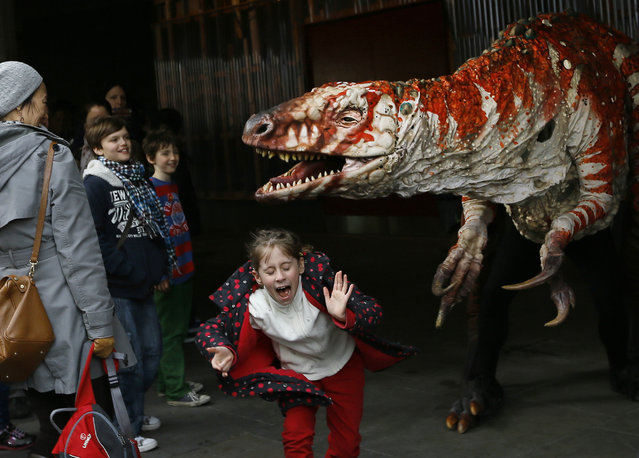
Children react as a carnivorous theropod known as the Australovenator dinosaur walks through crowds along the Southbank, in London, Monday, February 18, 2013. The dinosaur is one of many that can be visited at the Erth's Dinosaur Petting Zoo, visiting from Australia, the creatures can be touched and fed at the Southbank Centre. (Photo by Kirsty Wigglesworth/AP Photo)

Children react as a carnivorous theropod known as the Australovenator dinosaur walks through crowds along the Southbank, in London, Monday, February 18, 2013. The dinosaur is one of many that can be visited at the Erth's Dinosaur Petting Zoo, visiting from Australia, the creatures can be touched and fed at the Southbank Centre. (Photo by Kirsty Wigglesworth/AP Photo)
Details
23 Feb 2013 12:30:00
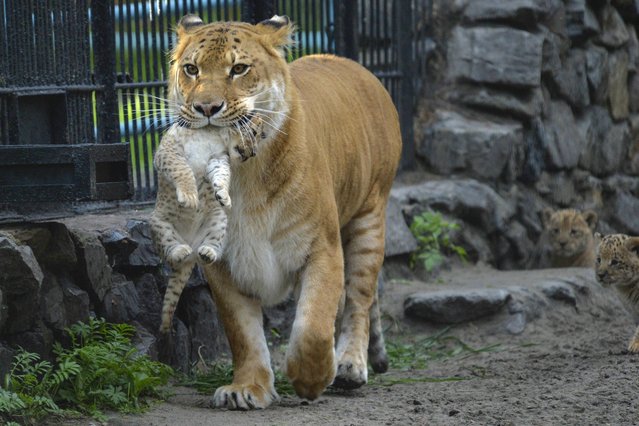
In this Tuesday, June 18, 2013 photo, Zita, a liger – half-lioness, half-tiger – carries her one month-old liliger cub in the Novosibirsk Zoo. The cub's father is a lion, Sam. (Photo by Ilnar Salakhiev/AP Photo)

In this Tuesday, June 18, 2013 photo, Zita, a liger – half-lioness, half-tiger – carries her one month-old liliger cub in the Novosibirsk Zoo. The cub's father is a lion, Sam. (Photo by Ilnar Salakhiev/AP Photo)
Details
21 Jun 2013 12:31:00