Loading...
Done
Ecuador: “More and more tribes of Amazonia are starting to adopt modern clothes for everyday life. But they are still keeping their traditional clothes for important events. I photographed this young woman in her wedding outfit”. (Photo by Mihaela Noroc/The Guardian)

Photographer Mihaela Noroc travelled the world from Ethiopia to the US and from Guatemala to France in search of natural and authentic beauty. She introduces some of the inspiring women she met on her journey. Here: Ecuador. “More and more tribes of Amazonia are starting to adopt modern clothes for everyday life. But they are still keeping their traditional clothes for important events. I photographed this young woman in her wedding outfit”. (Photo by Mihaela Noroc/The Guardian)
Details
27 Sep 2017 08:29:00
World's first forest in the sky, the Bosco Verticale green twin towers

A concept illustration of the world's first forest in the sky, the Bosco Verticale green twin towers currently under construction in Milan, Italy. Towering over the city skyline the world's first forest in the sky will be a sight to behold. With tree equal to one hectare of forest spanning 27 floors these 365 and 260 foot emerald twin towers will be home to an astonishing 730 trees, 5,000 shrubs and 11,000 ground cover plants. (Photo by Boeri Studio)
Details
27 Oct 2011 11:11:00
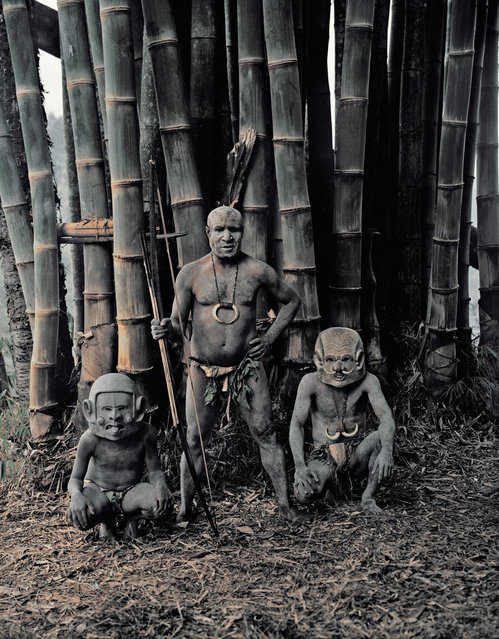
“Asaro from the Eastern Highlands”. The mudmen could not cover their faces with mud because the people of Papua New Guinea thought that the mud from the Asaro river was poisonous. So instead of covering their faces with this alleged poison, they made masks from pebbles that they heated and water from the waterfall, with unusual designs such as long or very short ears either going down to the chin or sticking up at the top, long joined eyebrows attached to the top of the ears, horns and sideways mouths. (Jimmy Nelson)

“Asaro from the Eastern Highlands”. The mudmen could not cover their faces with mud because the people of Papua New Guinea thought that the mud from the Asaro river was poisonous. So instead of covering their faces with this alleged poison, they made masks from pebbles that they heated and water from the waterfall, with unusual designs such as long or very short ears either going down to the chin or sticking up at the top, long joined eyebrows attached to the top of the ears, horns and sideways mouths. (Photo and caption by Jimmy Nelson)
Details
20 Oct 2013 08:54:00
Migrants with a stick, stones and knife fight with each other after a brawl erupted over a place in an overcrowded train heading to the Serbian border at the train station in Gevgelija, The Former Yugoslav Republic of Macedonia, 14 August 2015. (Photo by Georgi Licovski/EPA)

Migrants with a stick, stones and knife fight with each other after a brawl erupted over a place in an overcrowded train heading to the Serbian border at the train station in Gevgelija, The Former Yugoslav Republic of Macedonia, 14 August 2015. The number of migrants passing through Macedonia increases day by day, local sources said. From the beginning of the year to mid-June 2015, nearly 160,000 migrants landed in the southern European countries, mainly Greece and Italy, on their way to wealthier countries in Western and Northern Europe, according to estimates by the International Organization for Migration (IOM). (Photo by Georgi Licovski/EPA)
Details
15 Aug 2015 11:10:00
Young girls take ballet lessons at the New Dreams dance studio in the Luz neighborhood known to locals as Cracolandia (Crackland) in Sao Paulo, Brazil, August 14, 2015. (Photo by Nacho Doce/Reuters)

Young girls take ballet lessons at the New Dreams dance studio in the Luz neighborhood known to locals as Cracolandia (Crackland) in Sao Paulo, Brazil, August 14, 2015. For the young girls learning to jump and plie, the dance studio provides a way forward and out of the difficult environment they have grown up in. Brazil is one of the world's highest consuming countries of crack cocaine, and Cracolandia, or “Crack Land”, located in the outskirts of Sao Paulo, is one of the most intense and brutal hubs. (Photo by Nacho Doce/Reuters)
Details
18 Aug 2015 13:59:00
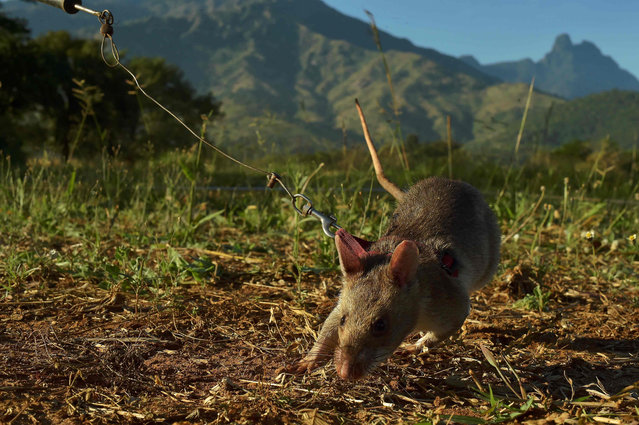
An African giant pouched rat sniffs for traces of landmine explosives at APOPO's training facility in Morogoro on June 17, 2016. (Photo by Carl De Souza/AFP Photo)

An African giant pouched rat sniffs for traces of landmine explosives at APOPO's training facility in Morogoro on June 17, 2016. APOPO trains the rats to detect both tuberculosis and landmines at its facility. Every year landmines kill or maim thousands of people worldwide. The trained rats sniff for explosive and so are able to detect the presence of landmines far faster than conventional methods which involve metal detection. (Photo by Carl De Souza/AFP Photo)
Details
19 Jun 2016 09:52:00
A 19th century bicycle safety lock is displayed in an old frame in the Museum of Domenico Agostinelli in Dragona, near Rome October 30, 2014. (Photo by Tony Gentile/Reuters)

A 19th century bicycle safety lock is displayed in an old frame in the Museum of Domenico Agostinelli in Dragona, near Rome October 30, 2014Italian collector Domenico Agostinelli, 74, has a passion that has led him over the past 60 years to pick up and collect things of all types, from antique art to everyday objects of the past and present. His collection includes a 65-million-year-old dinosaur egg, meteor fragments, a car that once belonged to American mob boss Al Capone, a lock of hair of Italian national hero Giuseppe Garibaldi, toys, weapons, musical instruments of all kinds and many more. (Photo by Tony Gentile/Reuters)
Details
23 Dec 2014 13:29:00
A small section of the expanding remains of the Veil Nebula, a massive star that exploded about 8,000 years ago. The entire nebula is 110 light-years across, covering six full moons on the sky as seen from Earth, and resides about 2,100 light-years away in the constellation Cygnus, the Swan. (Photo by Reuters/NASA/ESA/Hubble)

A small section of the expanding remains of the Veil Nebula, a massive star that exploded about 8,000 years ago. The entire nebula is 110 light-years across, covering six full moons on the sky as seen from Earth, and resides about 2,100 light-years away in the constellation Cygnus, the Swan. (Photo by Reuters/NASA/ESA/Hubble)
Details
29 Feb 2016 11:30:00