Loading...
Done
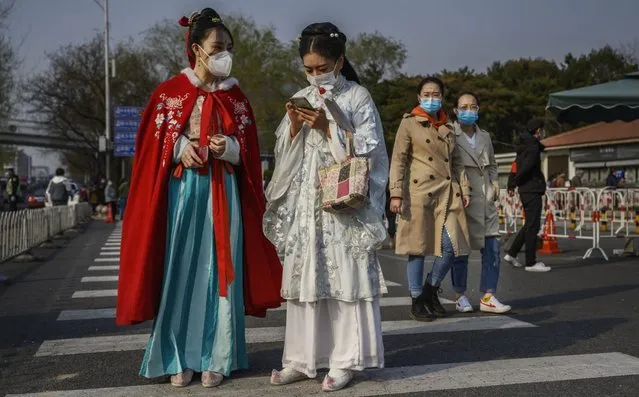
Chinese women wear protective masks as they are dressed in traditional clothing from the Qing Dynasty era outside a park on March 29, 2020 in Beijing, China. A limited section of the iconic tourist site was re-opened to the public this week allowing a smaller number of visitors to reserve tickets online in advance and to enter after passing health screening. With the pandemic hitting hard across the world, China recorded its first day with no new domestic cases of the coronavirus last week, since the government imposed sweeping measures to keep the disease from spreading. For two months, millions of people across China have been restricted in how they move from their homes, while other cities have been locked down in ways that appeared severe at the time but are now being replicated in other countries trying to contain the virus. Officials believe the worst appears to be over in China, though there are concerns of another wave of infections as the government attempts to reboot the worlds second largest economy. In Beijing, it is mandatory to wear masks outdoors, retail stores operate on reduced hours, restaurants employ social distancing among patrons, and tourist attractions at risk of drawing large crowds remain closed. Monitoring and enforcement of virus-related measures and the quarantine of anyone arriving to Beijing is carried out by neighborhood committees and a network of Communist Party volunteers who wear red arm bands. A primary concern for Chinese authorities remains the arrival of flights from Europe and elsewhere, given the exposure of passengers in regions now regarded as hotbeds for transmission. Since January, China has recorded more than 81,000 cases of COVID-19 and at least 3200 deaths, mostly in and around the city of Wuhan, in central Hubei province, where the outbreak first started. (Photo by Kevin Frayer/Getty Images)

Chinese women wear protective masks as they are dressed in traditional clothing from the Qing Dynasty era outside a park on March 29, 2020 in Beijing, China. A limited section of the iconic tourist site was re-opened to the public this week allowing a smaller number of visitors to reserve tickets online in advance and to enter after passing health screening. (Photo by Kevin Frayer/Getty Images)
Details
01 Apr 2020 00:05:00
Peacock Mantis Shrimp

Odontodactylus scyllarus, known as the peacock mantis shrimp, harlequin mantis shrimp or painted mantis shrimp, is a large mantis shrimp native to the Indo-Pacific from Guam to East Africa.

Details
22 Jan 2013 12:29:00
Couples By Reclarkgable

Reclarkgable is a photographer/art director from Madrid, Spain. He has recently created a really fun series showing how versatile appearances really are.
Details
04 Mar 2013 11:21:00
Art Styles By Brano Hlavac

Brano Hlavac aka Gartier Atelier is another one of those artists whose work can be difficult to pinpoint. His artwork jumps from style to style, but it's not such a bad thing considering how well it shows off his talents.
Details
20 Apr 2013 09:33:00
Native American Prints By Kirby Sattler

The work of Kirby Sattler is fueled by an inherent interest in the Indigenous Peoples of the Earth. His current images evolve from the history, ceremony, mythology, and spirituality of the Native American
Details
18 May 2013 08:17:00
Art By Frank Melech

Frank Melech is a digital designer and photographer from Germany. He created his fantastic pictures using Adobe Photoshop.
Details
03 Jun 2013 10:28:00
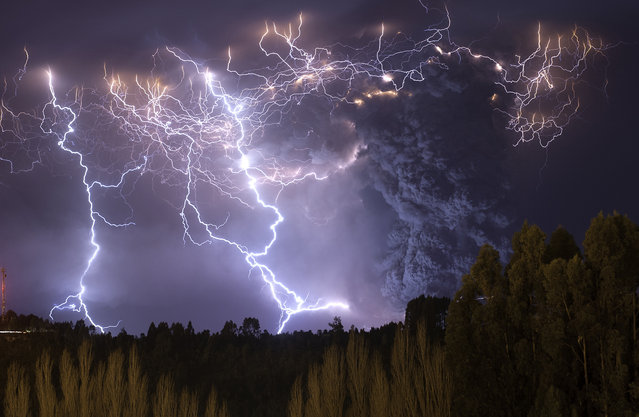
The eruption of Cordon Caulle began on June 4, 2011, located in the Region of Los Rios in Chile. For about 12 months, people and animals became accustomed to living with the daily fall of ash, which also caused problems in the air traffic in South America. The explosions and lightning during first days of the eruption could be seen from hundreds of miles around. This photograph was taken on the second night of eruption from the town of Lago Ranco. (Photo and caption by Francisco Negroni/National Geographic Traveler Photo Contest)

The eruption of Cordon Caulle began on June 4, 2011, located in the Region of Los Rios in Chile. For about 12 months, people and animals became accustomed to living with the daily fall of ash, which also caused problems in the air traffic in South America. The explosions and lightning during first days of the eruption could be seen from hundreds of miles around. This photograph was taken on the second night of eruption from the town of Lago Ranco. (Photo and caption by Francisco Negroni/National Geographic Traveler Photo Contest)

ATTENTION! All pictures are presented in high resolution. To see Hi-Res images – just TWICE click on any picture. In other words, click small picture – opens the BIG picture. Click BIG picture – opens VERY BIG picture.
Details
23 Jun 2013 11:24:00
Art Of Fenghua Zhong

Amazing compositions and attention to detail goes into these conceptual pieces of art from China based artist – Fenghua Zhong
Details
28 Jun 2013 12:26:00