Loading...
Done
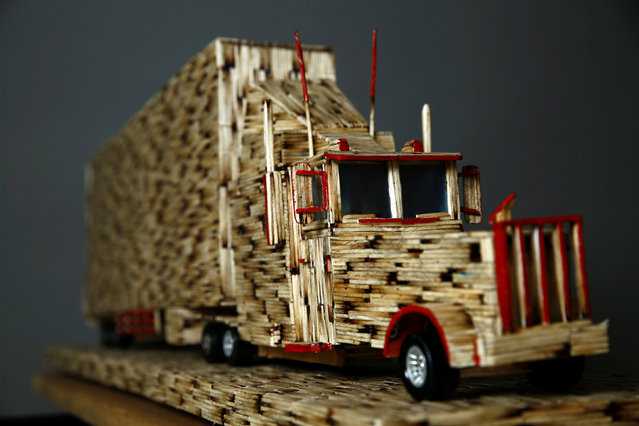
A replica of the truck made from matchsticks by Janusz Urbanski is pictured at his flat in Ruda Slaska, Poland May 4, 2016. (Photo by Kacper Pempel/Reuters)

A replica of the truck made from matchsticks by Janusz Urbanski is pictured at his flat in Ruda Slaska, Poland May 4, 2016. Janusz Urbanski has a one of a kind chessboard he never plays, a personalised guitar he does not strum and a boat he cannot sail. Why? They are all made from tens of thousands of matches. For the last 40 years, the former Polish miner and ironworker has harboured a passion to build replicas of objects, buildings and famous sites with just matchsticks and glue. (Photo by Kacper Pempel/Reuters)
Details
07 May 2016 12:54:00
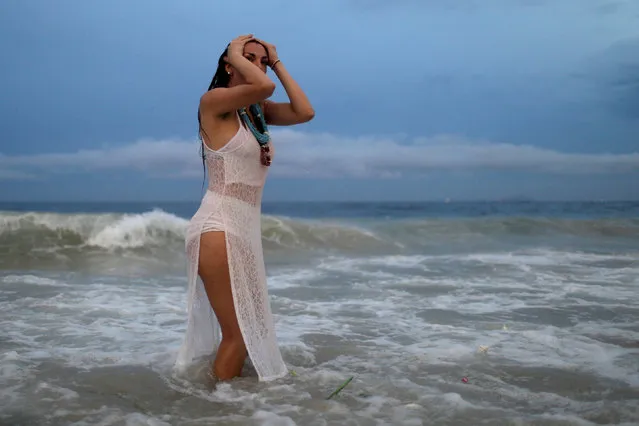
A follower of the Afro-Brazilian religion Umbanda pays tribute for Iemanja, goddess of the sea, in Copacabana Beach in Rio de Janeiro, Brazil December 29, 2017. (Photo by Ricardo Moraes/Reuters)

A follower of the Afro-Brazilian religion Umbanda pays tribute for Iemanja, goddess of the sea, in Copacabana Beach in Rio de Janeiro, Brazil December 29, 2017. Hundreds of practitioners of Brazil's Afro-Brazilian Candomble and Umbanda faiths have gathered at Rio de Janeiro's Copacabana beach to honor Yemanja. Worshippers were mostly dressed in white as they launched their offerings to Iemanja: small boats with flowers and bowls with candles and fruits. (Photo by Ricardo Moraes/Reuters)
Details
30 Dec 2017 06:22:00
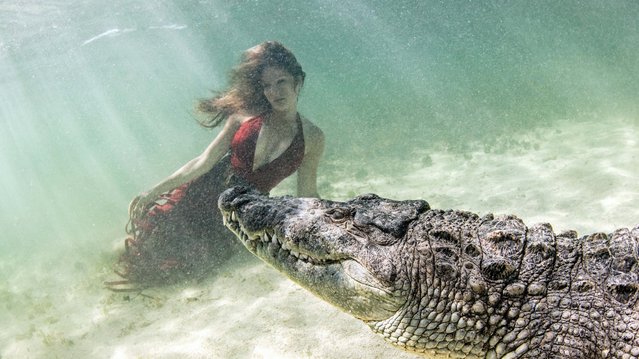
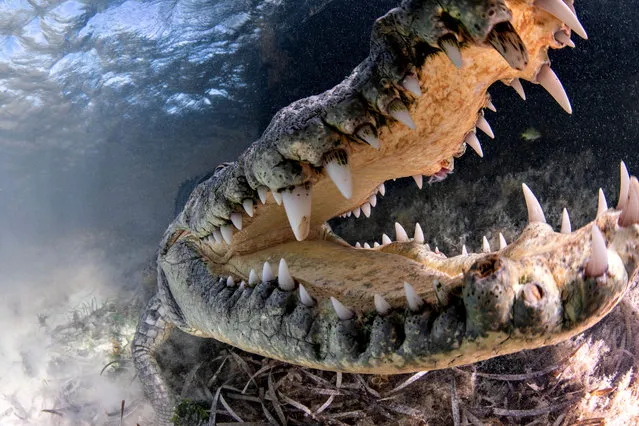
A model poses with a crocodile at Chinchorro Banks, Mexico on June 21, 2018. (Photo by Ken Kiefer/Caters News Agency)

A model poses with a crocodile at Chinchorro Banks, Mexico on June 21, 2018. These crocs had a lot to smile about – sporting huge toothy grins as they posed with stunning models in incredible underwater snaps. The brave models held their breath as they came face to face with the magnificent predators during the daring shoot. Photographer Ken Kiefer took a two hour boat ride to reach the carnivorous crocs at Chinchorro Banks, Mexico, along with his wife and model, Kimber and model, Melodie Trevino. (Photo by Ken Kiefer/Caters News Agency)
Details
25 Jul 2018 08:42:00
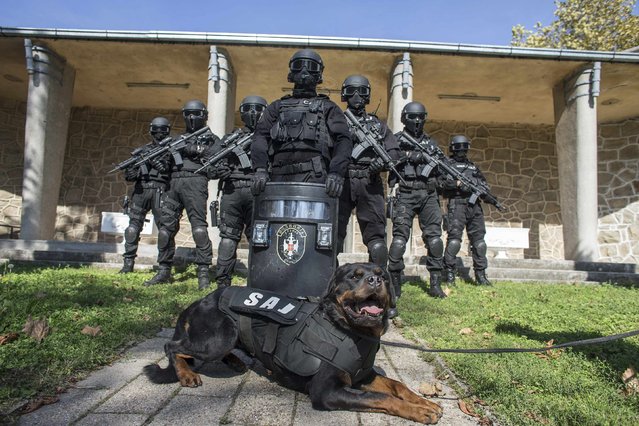
Serbian police officers of the Special Anti-Terrorist Unit pose for a picture in their base outside Belgrade October 8, 2014. (Photo by Marko Djurica/Reuters)

Serbian police officers of the Special Anti-Terrorist Unit pose for a picture in their base outside Belgrade October 8, 2014. When the killing of an unarmed black teenager by a white policeman in Ferguson, Missouri, in August sparked sometimes violent protests, the response of police in camouflage gear and armoured vehicles wielding stun grenades and assault rifles seemed more like a combat operation than a public order measure. Some U.S. police departments have recently acquired U.S. military-surplus hardware from wars abroad, but there are many law enforcers around the world whose rules of engagement also allow the use of lethal force with relatively few restrictions. But for every regulation that gives police wide scope to use firearms, there is another code that sharply limits their use. In Serbia, police may use measures ranging from batons to special vehicles, water cannon and tear gas on groups of people who have gathered illegally and are behaving in a way that is violent or could cause violence, but they may use firearms only when life is endangered. (Photo by Marko Djurica/Reuters)
Details
27 Nov 2014 14:53:00
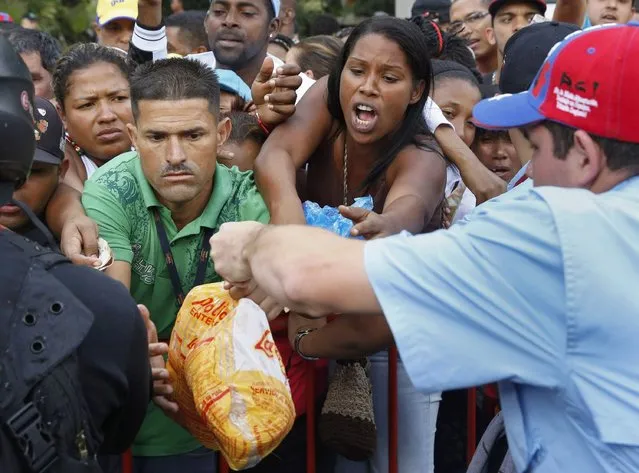
People crowd together in an attempt to buy chickens at a Mega-Mercal, a subsidized state-run street market, in Caracas January 24, 2015. President Nicolas Maduro shook up complex currency controls on Wednesday and also prepared Venezuelans for a rise in the world's cheapest fuel prices in response to a recession worsened by plunging oil revenue. (Photo by Carlos Garcia Rawlins/Reuters)

People crowd together in an attempt to buy chickens at a Mega-Mercal, a subsidized state-run street market, in Caracas January 24, 2015. President Nicolas Maduro shook up complex currency controls on Wednesday and also prepared Venezuelans for a rise in the world's cheapest fuel prices in response to a recession worsened by plunging oil revenue. The socialist-run OPEC member's economy shrank 2.8 percent in 2014 while inflation topped 64 percent, the socialist leader announced in a speech to parliament, in what is almost certainly the worst performance in Latin America. (Photo by Carlos Garcia Rawlins/Reuters)
Details
25 Jan 2015 09:44:00
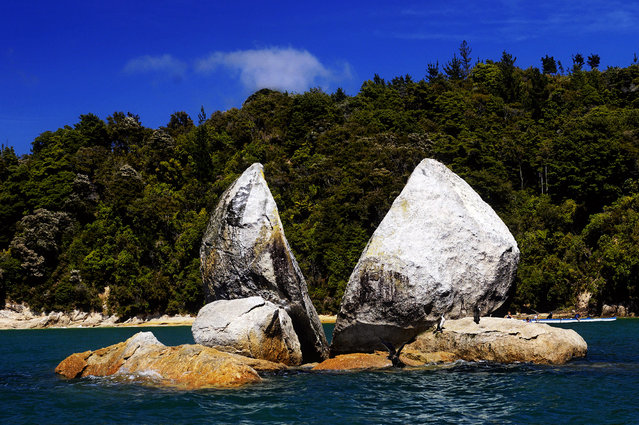
Split Apple Rock

Split Apple Rock is a geological rock formation in The Tasman Bay off the northern coast of the South Island of New Zealand. Made of granite, it is in the shape of an apple which has been cut in half. It is a popular tourist attraction in the waters of the Tasman Sea approximately 50 metres off the coast between Kaiteriteri and Marahau. The rock sits in shallow water at low tide and is accessible by wading. It is also a point of interest for the many tourist boats and pleasure craft which operate along the shores of the Abel Tasman National Park. The cleft to produce two sides of the 'apple' was a natural occurrence. It is unknown when this happened and therefore the cleaving of the rock has attracted mythological explanations.
Details
19 Oct 2013 10:58:00
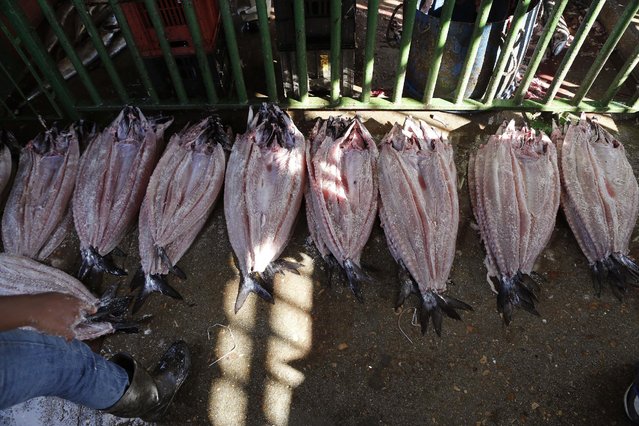
In this photo taken on Saturday, May 16, 2015, Snoek fish with salt on them after they were cleaned  in Lambert's Bay, South Africa. (Photo by Schalk van Zuydam/AP Photo)

In this photo taken on Saturday, May 16, 2015, Snoek fish with salt on them after they were cleaned in Lambert's Bay, South Africa. The boats line up along the jetty, bobbing in the cold south Atlantic waters, bringing in the day's catch in the early afternoon. The long silver snoek fish is one of South Africa's traditional foods, and a main source of income for the town of Lambert's Bay. (Photo by Schalk van Zuydam/AP Photo)
Details
25 May 2015 09:28:00
The trip to get to the reef takes eight hours by car and boat, and there is no luxury hotel at the other end. (Photo by Alex Suh/Caters News Agency)

A photographer with a passion for wild animals was able to get up close and personal with one of nature’s deadliest creatures. Alex Suh has traveled to Mexico’s Banco Chinchorro reef twice in the past three years to get into the waters and capture the crocodiles in their natural habitat after an invitation from Yucatan Dive Trek. (Photo by Alex Suh/Caters News Agency)
Details
24 Aug 2018 00:01:00