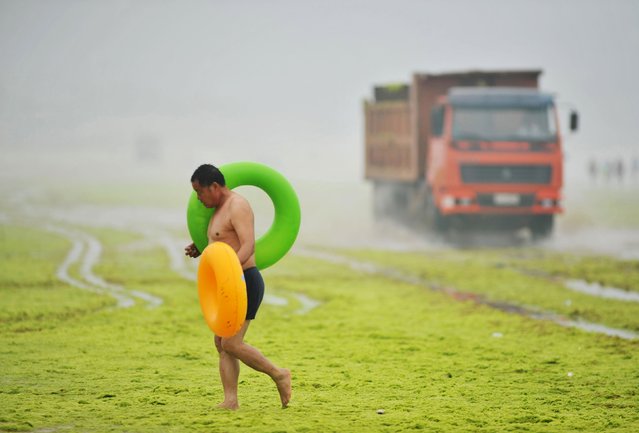
A man carries floats as he walks on an algae covered beach as a truck collecting algae passes by, along the coastline in Qingdao, Shandong province, July 6, 2015. (Photo by Reuters/China Daily)
Soldiers of China's People's Liberation Army (PLA) jump as part of their winter training in temperature of negative 26 degrees Celsius at China's border with Russia in Heihe, Heilongjiang province, December 14, 2015. (Photo by Reuters/Stringer)
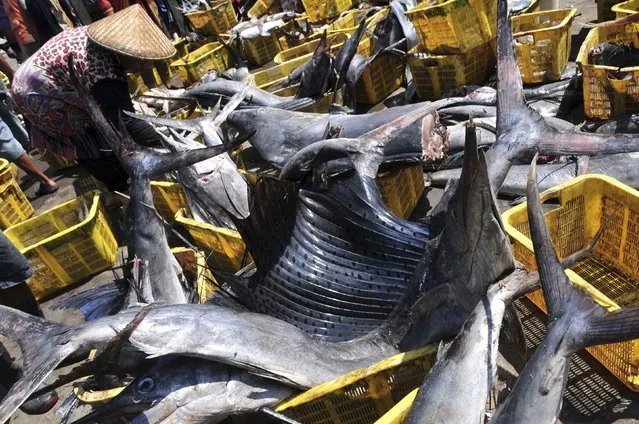
Fishermen prepare marlin and sailfish, destined for Jakarta, for auction at a fish market in Tegal, Central Java November 26, 2014 in this photo taken by Antara Foto. (Photo by Oky Lukmansyah/Reuters/Antara Foto)
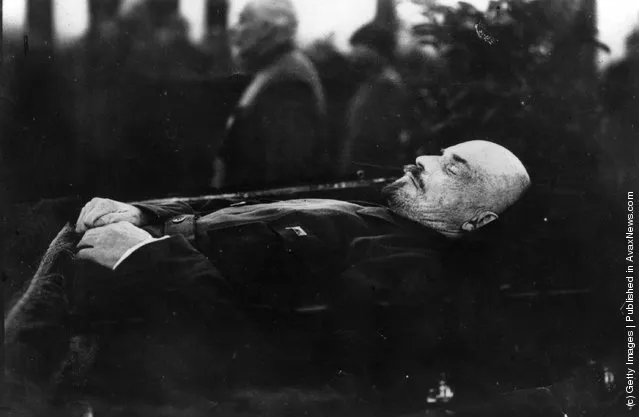
Photo: Vladimir Ilyich Lenin (1870 – 1924) lying in state in the Kremlin. (Photo by Hulton Archive/Getty Images). 1924
Important! For the same article in Russian language click here.
Something quite intriguing is happening within Russian-speaking internet during the last few – should you type a fully academic inquiry (at least, according to Russian academic requirements) in national search engines for "Lenin's mausoleum" – the first thing you get (even in top 10 searches) is website pages talking about black magic and occult. Website authors view this construction differently, but unconditionally agree on one thing: the mausoleum of the "leader of the world proletariat” – the essence of a magical artifact, a sort of “energy vampire”. It was built with a certain purpose: to drain the energy out of miserable Soviet citizens on one hand; and to poison the anthroposphere of one-sixth part of the earth with its vibes (the exact territory that was occupied by the former Soviet Union), depriving the Russian people of will to resist on the other hand. Complete nonsense? No doubt. Nevertheless, an intriguing one. Well, probably because some oddities do exist in mausoleum's history. These oddities are the thing we are going to discuss this time. First, let me refresh you memory on the subject.
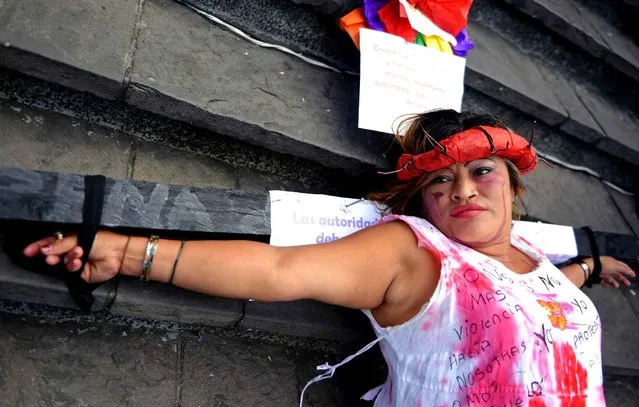
Norma Galicia aka “Pirulina” takes part in a demonstration during the commemoration of the International Day for the Elimination of Violence Against Women, in Guatemala City on November 25, 2013. So far this year, 696 women have died due to violent events in Guatemala. (Photo by Johan Ordonez/AFP Photo)
This Thursday, January 22, 2015 photo made with a long exposure shows the glow from a Noctiluca scintillans algal bloom along the seashore in Hong Kong. The luminescence, also called Sea Sparkle, is triggered by farm pollution that can be devastating to marine life and local fisheries, according to University of Georgia oceanographer Samantha Joye. Noctiluca itself does not produce neurotoxins like other similar organisms do. But its role as both prey and predator tends can eventually magnify the accumulation of toxins in the food chain, according to R. Eugene Turner at Louisiana State University. (Photo by Kin Cheung/AP Photo)
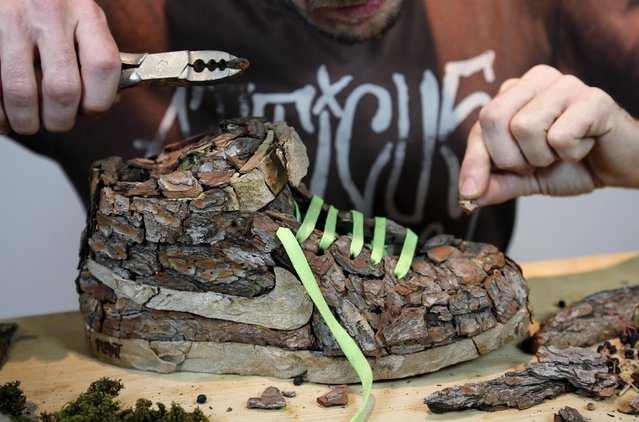
French artist Christophe Guinet, also known as “Mr Plant”, works on his plant shoe creation “Wood”, part of the artistic project “Just Grow It”, in his art gallery in Marseille, November 25, 2014. Guinet transforms name-brand Nike sneakers, cult footwear for urban youth, into vegetable compositions, creating a collection of artwork with trainers modified with tree bark, foam and flowers. (Photo by Jean-Paul Pelissier/Reuters)