Loading...
Done
“Show us our butts! Mucawana tribe – Angola. In Soba village, the Muhacaona (Mucawana) tribe, perhaps the best place i have visited. They use cow dung and fat to make this so nice haircut, and love the beads. They asked me to make pictures of their backs... and butts to see on the camera screen if everything was perfect!”. (Eric Lafforgue)

“Show us our butts! Mucawana tribe – Angola. In Soba village, the Muhacaona (Mucawana) tribe, perhaps the best place i have visited. They use cow dung and fat to make this so nice haircut, and love the beads. They asked me to make pictures of their backs... and butts to see on the camera screen if everything was perfect!”. (Photo and comments by Eric Lafforgue)
Details
09 Nov 2012 15:04:00
Centre of the Heart Nebula by Ivan Eder (Hungary). Situated 7500 light years away in the ‘W’-shaped constellation of Cassiopeia, the Heart Nebula is a vast region of glowing gas, energized by a cluster of young stars at its centre. The image depicts the central region, where dust clouds are being eroded and moulded into rugged shapes by the searing cosmic radiation. (Photo by Ivan Eder)

The competition, which is run by the Royal Observatory Greenwich in association with BBC Sky at Night Magazine, is now in its sixth year and has received over 2,500 entries. Photo: Centre of the Heart Nebula by Ivan Eder (Hungary). Situated 7500 light years away in the “W”-shaped constellation of Cassiopeia, the Heart Nebula is a vast region of glowing gas, energized by a cluster of young stars at its centre. The image depicts the central region, where dust clouds are being eroded and moulded into rugged shapes by the searing cosmic radiation. (Photo by Ivan Eder)
Details
03 Jul 2014 11:59:00
On August 31, 2012, a long filament of solar material that had been hovering in the sun's atmosphere, the corona, erupted out into space at 4:36 p.m. EDT. The coronal mass ejection, or CME, traveled at over 900 miles per second. The CME did not travel directly toward Earth, but did connect with Earth's magnetic environment, or magnetosphere, causing aurora to appear on the night of Monday, September 3. (Photo by NASA/GSFC/SDO)

On August 31, 2012, a long filament of solar material that had been hovering in the sun's atmosphere, the corona, erupted out into space at 4:36 p.m. EDT. The coronal mass ejection, or CME, traveled at over 900 miles per second. The CME did not travel directly toward Earth, but did connect with Earth's magnetic environment, or magnetosphere, causing aurora to appear on the night of Monday, September 3. (Photo by NASA/GSFC/SDO via The Atlantic)
Details
14 Sep 2012 09:01:00
Rescue operations are undergoing to recover the sunken ferry MV Miraj 4 in the Megna River near Munshiganj, Bangladesh, 16 May 2014. The death toll in the Bangladesh ferry disaster rose to 26 on 16 May, including children and women and many more feared dead as the ferry, carrying more than 200 passengers on board, sunk during a storm on 15 may 2014, police authorities said. (Photo by Abir Abdullah/EPA)

Rescue operations are undergoing to recover the sunken ferry MV Miraj 4 in the Megna River near Munshiganj, Bangladesh, 16 May 2014. The death toll in the Bangladesh ferry disaster rose to 26 on 16 May, including children and women and many more feared dead as the ferry, carrying more than 200 passengers on board, sunk during a storm on 15 may 2014, police authorities said. (Photo by Abir Abdullah/EPA)
Details
18 May 2014 10:28:00
“Forest lights”. Aurora Borealis over the forest of the Pyhae Luosto National Park, Finland. (Photo and caption by Nicholas Roemmelt/National Geographic Traveler Photo Contest)

The 26th annual National Geographic Traveler Photo Contest is now accepting submissions. Official categories include: “Travel Portraits”, “Outdoor Scenes”, “Sense of Place” and “Spontaneous Moments”. The contest is accepting entries until June 30. Photo: “Forest lights”. Aurora Borealis over the forest of the Pyhae Luosto National Park, Finland. (Photo and caption by Nicholas Roemmelt/National Geographic Traveler Photo Contest)
Details
30 Mar 2014 08:02:00
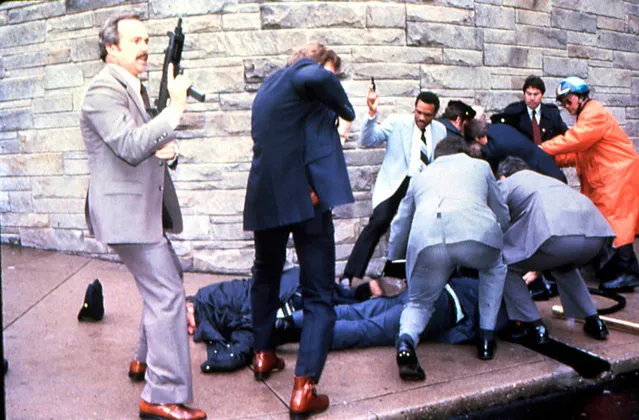
James Brady and a police officer are seen lying on the ground after being shot while the suspect John Hinckley Jr. is apprehended,at right, moments after the attempted assassination of President Ronald Reagan, Washington, DC, March 30, 1981. (Photo by Dirck Halstead/Getty Images)

James Brady and a police officer are seen lying on the ground after being shot while the suspect John Hinckley Jr. is apprehended,at right, moments after the attempted assassination of President Ronald Reagan, Washington, DC, March 30, 1981. (Photo by Dirck Halstead/Getty Images)
Details
29 Jul 2016 12:28:00
Women walk through the snow on Wimbledon common with their dogs on February

Women walk through the snow on Wimbledon common with their dogs on February 10, 2012 in London, England. The Met Office cold weather alert remains at Level 3 as southern parts of England continue to suffer from cold weather and freezing conditions, with further snowfall overnight. (Photo by Peter Macdiarmid/Getty Images)
Details
11 Feb 2012 13:54:00


“The Sumatran Rhinoceros (Dicerorhinus sumatrensis) is a member of the family Rhinocerotidae and one of five extant rhinoceroses. It is the only extant species of the genus Dicerorhinus. It is the smallest rhinoceros, standing about 120–145 centimetres (3.9–4.76 ft) high at the shoulder, with a body length of 250 centimetres (8.2 ft) and weight of 500–800 kilograms (1,100–1,800 lb). Like the African species, it has two horns; the larger is the nasal horn, typically 15–25 centimetres (5.9–9.8 in), while the other horn is typically a stub. A coat of reddish-brown hair covers most of the Sumatran Rhino's body”. – Wikipedia

Photo: Emi, a Sumatran rhinoceros lies in the mud with her three-week-old female calf at the Cincinnati Zoo and Botanical Garden August 19, 2004 in Cincinnati, Ohio. Emi made history by becoming the first Sumatran rhino to produce two calves in captivity. (Photo by Mike Simons/Getty Images)
Details
22 Jun 2011 12:37:00