Loading...
Done
Game Of Thrones: Season 4 Visual Effects

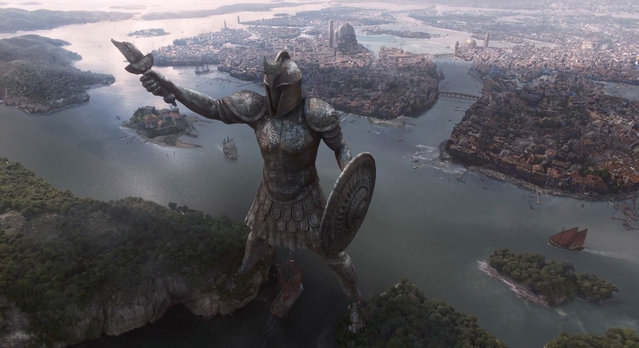
The characters fighting for Westeros in Game of Thrones are fighting mostly for CGI backdrops. Like many others TV series and movies, visual effects is a huge part of the production process as it handles details both great and small. A great credit to Game of Thrones is that the story is so good that we forget about the effects, and another great credit goes to the VFX team because their work is seamless. If you want to see the seams, you have to get a visual breakdown of how the shots are put together.
Details
30 Jul 2014 18:47:00
Photographers: LSD AKA marco*paolo

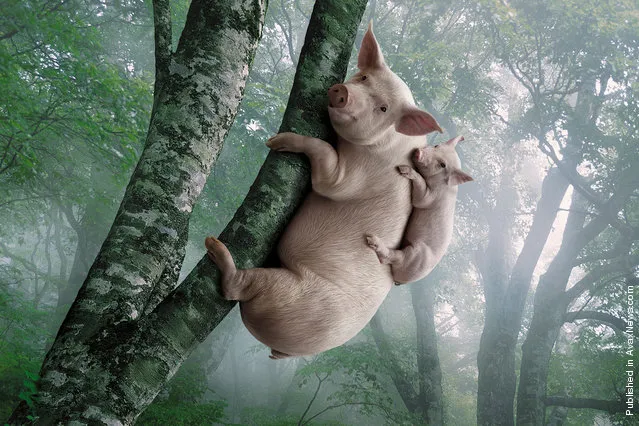
“LSD Photo Advertising Studio is comprised of Marco and Paolo. They are photographers who compose, shoot and post-produce all of their images together. For over ten years, they have been creating images from start to finish. Marco and Paolo have different backgrounds of experience: Paolo started as an illustrator then a photographer, and now he’s at Marco’s side and in his head throughout shooting. In turn, Paolo does all the post-production with Marco in his head and at his side. Marco has always worked as photographer”. – Tim Mitchell
Details
23 Feb 2012 10:07:00
A youth poses while holding two fishes before his face in Iraq's southern port city of al-Faw, 90 kilometres south of Basra near the Shatt al-Arab and the Gulf, on May 18, 2020. In Iraq, a national lockdown to halt the COVID-19 coronavirus pandemic has found some unexpected fans: local businesses who no longer have to compete with Turkish, Iranian or Chinese imports. Those countries, as well as Saudi Arabia, Jordan and Kuwait, typically flood Iraqi markets with inexpensive products at prices local producers can't compete with. (Photo by Hussein Faleh/AFP Photo)

A youth poses while holding two fishes before his face in Iraq's southern port city of al-Faw, 90 kilometres south of Basra near the Shatt al-Arab and the Gulf, on May 18, 2020. In Iraq, a national lockdown to halt the COVID-19 coronavirus pandemic has found some unexpected fans: local businesses who no longer have to compete with Turkish, Iranian or Chinese imports. Those countries, as well as Saudi Arabia, Jordan and Kuwait, typically flood Iraqi markets with inexpensive products at prices local producers can't compete with. (Photo by Hussein Faleh/AFP Photo)
Details
02 Jul 2020 00:01:00
The oldest car to wear the Porsche badge goes on view at Sotheby's on May 21, 2019 in London, England. The only surviving 1939 Porsche Type 64 Berlin-Rome, No. 3, this rare piece of motoring history was the personal car of Ferdinand and Ferry Porsche, predating the first production Porsche, the 356. The car is on view at Sotheby's in London from 21st -24th May prior to being offered for sale by RM Sotheby's in Monterey, California, 15-17th August 2019, with an estimate in excess of $20 million. (Photo by Tristan Fewings/Getty Images for Sotheby's)

The oldest car to wear the Porsche badge goes on view at Sotheby's on May 21, 2019 in London, England. The only surviving 1939 Porsche Type 64 Berlin-Rome, No. 3, this rare piece of motoring history was the personal car of Ferdinand and Ferry Porsche, predating the first production Porsche, the 356. The car is on view at Sotheby's in London from 21st -24th May prior to being offered for sale by RM Sotheby's in Monterey, California, 15-17th August 2019, with an estimate in excess of $20 million. (Photo by Tristan Fewings/Getty Images for Sotheby's)
Details
23 May 2019 00:07:00
An Afghani man sells bread on a roadside in Kandahar, Afghanistan, 23 April 2024.  A recent World Bank report reveals a 26% decrease in Afghanistan's gross output over the past year, primarily attributed to a 1.3 billion USD income reduction for farmers due to the ban on drug cultivation. Although tax revenue saw a modest increase of 13% in 2023, exports experienced a 15% decline specifically to Pakistan. Afghan officials highlighted efforts to spur domestic production, improve trade, stabilize the national currency, and initiate key economic projects. (Photo by Qudratullah Razwan/EPA/EFE)

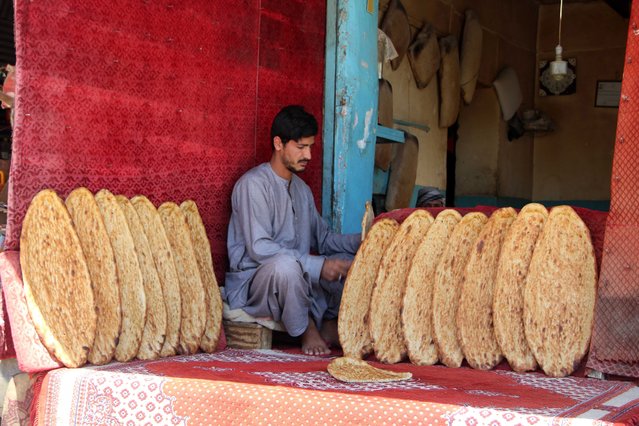
An Afghani man sells bread on a roadside in Kandahar, Afghanistan, 23 April 2024. A recent World Bank report reveals a 26% decrease in Afghanistan's gross output over the past year, primarily attributed to a 1.3 billion USD income reduction for farmers due to the ban on drug cultivation. Although tax revenue saw a modest increase of 13% in 2023, exports experienced a 15% decline specifically to Pakistan. Afghan officials highlighted efforts to spur domestic production, improve trade, stabilize the national currency, and initiate key economic projects. (Photo by Qudratullah Razwan/EPA/EFE)
Details
22 May 2024 03:16:00
World War Two veteran Abla Begaliyev, 91, is seen in an undated handout picture (L), poses for a picture in Arashan (Top R) and at home in Kyrgyzstan April 14, 2015. Begaliyev served in the border guard cavalry from February 1942 until April 1947. Originally from Kyrgyzstan, he fought on the Ukrainian front and relocated to the border with Afghanistan at the end of World War Two. (Photo by Vladimir Pirogov/Reuters/Family handout (L))

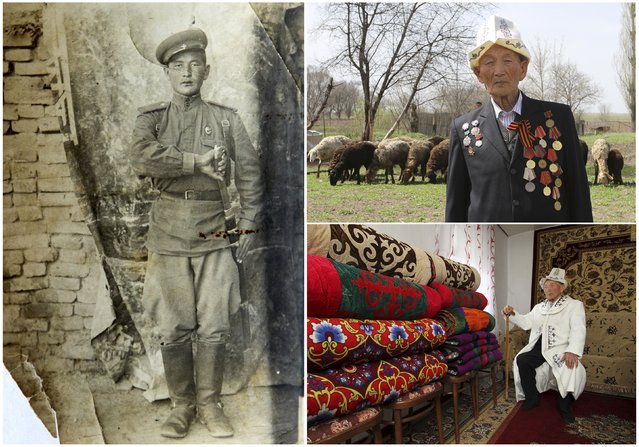
World War Two veteran Abla Begaliyev, 91, is seen in an undated handout picture (L), poses for a picture in Arashan (Top R) and at home in Kyrgyzstan April 14, 2015. Begaliyev served in the border guard cavalry from February 1942 until April 1947. Originally from Kyrgyzstan, he fought on the Ukrainian front and relocated to the border with Afghanistan at the end of World War Two. As the world marks the 70th anniversary of the end of World War Two, Reuters photographers the length and breadth of the former Soviet republics (CCCP) captured portraits of Red Army veterans, mostly now in their 80s and 90s, today and through archive pictures at the time. More than 20 million Soviet citizens were killed in the war. (Photo by Vladimir Pirogov/Reuters/Family handout (L))
Details
08 May 2015 14:22:00
A mudlark uses a torch to look for items on the bank of the River Thames in London, Britain June 06, 2016. Mudlarking is believed to trace its origins to the 18th and 19th century, when scavengers searched the Thames' shores for items to sell. These days, history and archaeology fans are the ones hoping to find old relics such as coins, ceramics, artifacts or everyday items from across centuries. They wait for the low tide and then scour specific areas of exposed shores. "If you're in a field you could be out all day long, with the river you're restricted to about two or three hours," mudlark Nick Stevens said. While many just use the naked eye for their searches, others rely on metal detectors for which a permit from the Port of London Authority is needed. Digging also requires consent. (Photo by Neil Hall/Reuters)

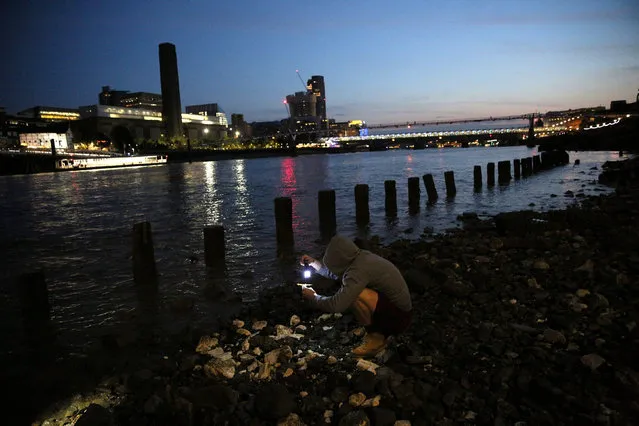
A mudlark uses a torch to look for items on the bank of the River Thames in London, Britain June 06, 2016. Mudlarking is believed to trace its origins to the 18th and 19th century, when scavengers searched the Thames' shores for items to sell. These days, history and archaeology fans are the ones hoping to find old relics such as coins, ceramics, artifacts or everyday items from across centuries. their finds with the Portable Antiquities Scheme. Any item over 300 years old must be recorded. (Photo by Neil Hall/Reuters)
Details
27 Aug 2016 10:43:00
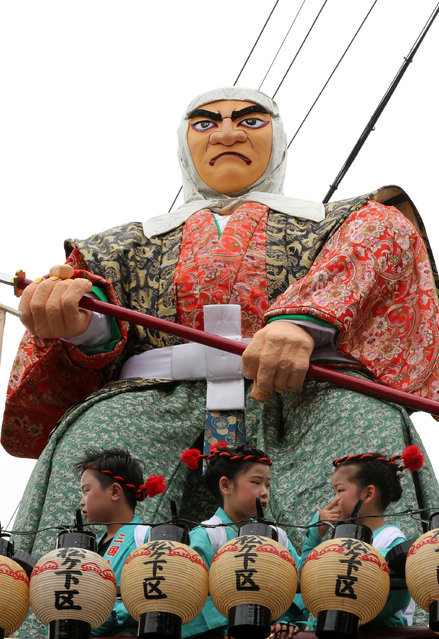
Children dressed in festival costume sit on the huge paper doll of historical Japanese figure named Hashi-Benkeii on the carts during the Mikuini annual festival on May 20, 2014 in Sakai, Japan. The annual festival takes place from May 19-21 and is attended by thousands of visitors. During the festival people dressed in traditional Japanese costumes pull carts carrying 6 meter high dolls of Japanese historical figures through the narrow streets. The origins of the festival are unclear but its history can be traced back more than 250 years. (Photo by Buddhika Weerasinghe/Getty Images)

Children dressed in festival costume sit on the huge paper doll of historical Japanese figure named Hashi-Benkeii on the carts during the Mikuini annual festival on May 20, 2014 in Sakai, Japan. The annual festival takes place from May 19-21 and is attended by thousands of visitors. During the festival people dressed in traditional Japanese costumes pull carts carrying 6 meter high dolls of Japanese historical figures through the narrow streets. The origins of the festival are unclear but its history can be traced back more than 250 years. (Photo by Buddhika Weerasinghe/Getty Images)
Details
21 May 2014 08:49:00