Loading...
Done
A vendor (C) cuts slaughtered dogs for sale at his roadside stall in Duong Noi village, outside Hanoi December 16, 2011. While animal rights activists have condemned eating dog meat as cruel treatment of the animals, it is still an accepted popular delicacy for some Vietnamese, as well in some other Asian countries. (Photo by Reuters/Kham)

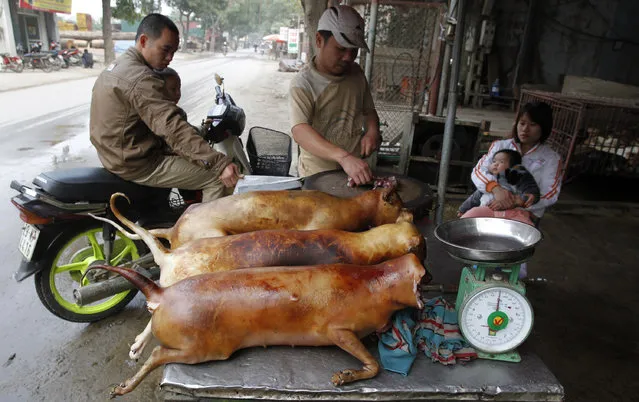
A vendor (C) cuts slaughtered dogs for sale at his roadside stall in Duong Noi village, outside Hanoi December 16, 2011. While animal rights activists have condemned eating dog meat as cruel treatment of the animals, it is still an accepted popular delicacy for some Vietnamese, as well in some other Asian countries. Duong Noi is well-known as a dog-meat village, where hundreds of dogs are killed each day for sale as popular traditional food. Dog-eating as a custom is rooted in Vietnam and was developed as a result of poverty. One kilogram of dog meat costs about 130,000 dongs ($6.2). (Photo by Reuters/Kham)
Details
16 Jul 2013 11:40:00
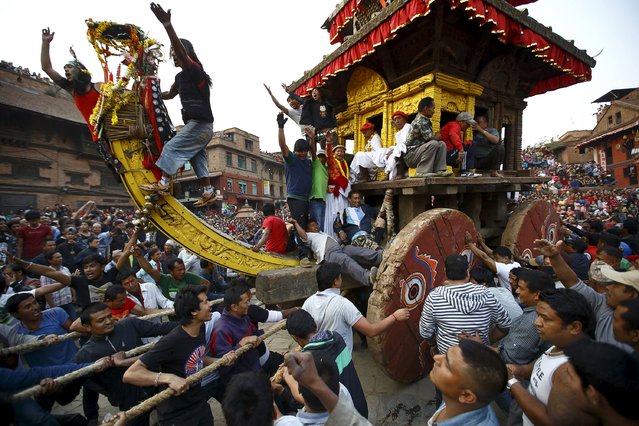
The chariot of God Bhairab is pulled through the city centre of Bhaktapur near Kathmandu during the Bisket festival April 10, 2015. The festival, which runs for more than a week and coincides with the Nepalese New Year, involves devotees offering prayers and the pulling of two chariots, one carrying the idol of God Bhairab and the other with the idol of Goddess Bhadrakali, around the ancient city of Bhaktapur. (Photo by Navesh Chitrakar/Reuters)

The chariot of God Bhairab is pulled through the city centre of Bhaktapur near Kathmandu during the Bisket festival April 10, 2015. The festival, which runs for more than a week and coincides with the Nepalese New Year, involves devotees offering prayers and the pulling of two chariots, one carrying the idol of God Bhairab and the other with the idol of Goddess Bhadrakali, around the ancient city of Bhaktapur. Devotees participate in the festival with the belief that they will be blessed with good health, fortune and harvest for the coming year. (Photo by Navesh Chitrakar/Reuters)
Details
12 Apr 2015 07:52:00
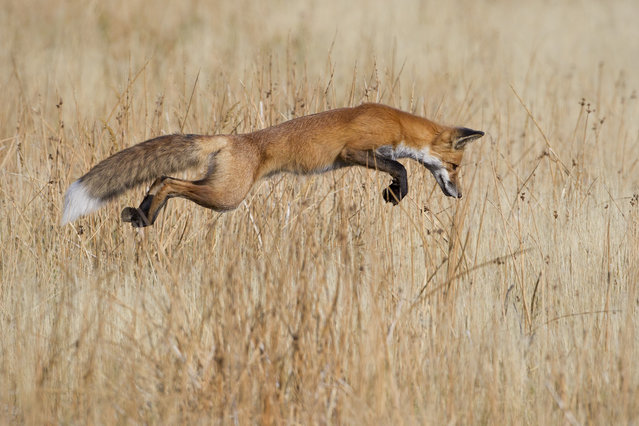
Canada: “Lucky pounce”. (Photo by Connor Stefanison/Wildlife Photographer of the Year 2013)

The winners of The London’s Natural History Museum's prestigious Wildlife Photographer of the Year for 2013 have finally been unveiled. Selected from almost 43,000 entries from 96 countries, the winners offer a glimpse of the stunning array of natural beauty on our planet. Photo: Canada: “Lucky pounce”. “Anticipating the pounce – that was the hardest part”, says Connor, who had come to Yellowstone National Park, Wyoming, USA, in search of wildlife as much as the spectacular landscape. He had found this fox, his first ever, on his last day in the park. It was so absorbed in hunting that Connor had plenty of time to get out of the car and settle behind a rock. It quartered the grassland, back and forth, and then started staring intently at a patch of ground, giving Connor just enough warning of the action to come. When it sprung up, Connor got his shot. And when it landed, the fox got his mouse. (Photo by Connor Stefanison/Wildlife Photographer of the Year 2013)
Details
17 Oct 2013 08:12:00
Kathy Hilton

Socialite Kathy Hilton attends the Prudential Financial Grand Prix Hamptons Classic Horse Show August 31, 2003 in Bridgehampton, New York.
Details
12 Mar 2011 19:15:00
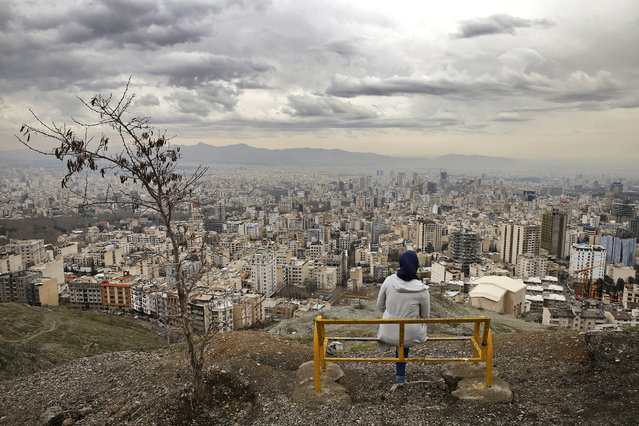
A woman spends her time outdoors to observe the ancient festival of Sizdeh Bedar, an annual public picnic day on the 13th day of the Iranian new year, at the Tochal mountainous area northern Tehran, Iran, Sunday, April, 2, 2017. Sizdeh Bedar, which comes from the Farsi words for “thirteen” and “day out”, is a legacy from Iran's pre-Islamic past that hard-liners in the Islamic Republic never managed to erase from calendars. (Photo by Ebrahim Noroozi/AP Photo)

A woman spends her time outdoors to observe the ancient festival of Sizdeh Bedar, an annual public picnic day on the 13th day of the Iranian new year, at the Tochal mountainous area northern Tehran, Iran, Sunday, April, 2, 2017. Sizdeh Bedar, which comes from the Farsi words for “thirteen” and “day out”, is a legacy from Iran's pre-Islamic past that hard-liners in the Islamic Republic never managed to erase from calendars. (Photo by Ebrahim Noroozi/AP Photo)
Details
21 Apr 2017 07:38:00
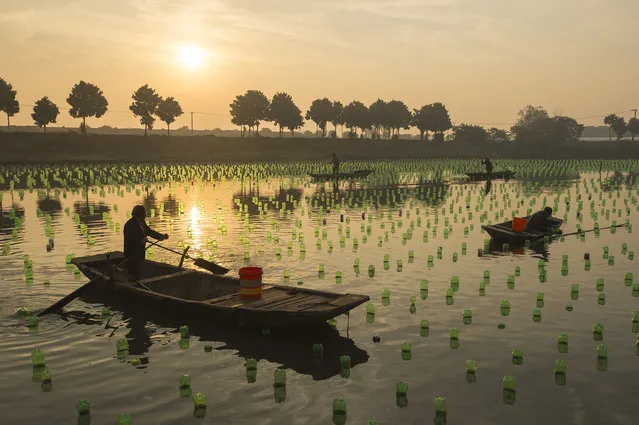
Local people check the growth of mussels at a river in Haian County on November 2, 2017 in Nantong, Jiangsu Province of China. Fish, shrimp, crab and mussel farming cleans the river and increases the villagers' income at Haian county in Jiangsu. (Photo by VCG/VCG via Getty Images)

Local people check the growth of mussels at a river in Haian County on November 2, 2017 in Nantong, Jiangsu Province of China. Fish, shrimp, crab and mussel farming cleans the river and increases the villagers' income at Haian county in Jiangsu. (Photo by VCG/VCG via Getty Images)
Details
03 Nov 2017 07:51:00
A tourist clad in Japanese kimono takes a picture in front of s portrait shop in Tokyo's Asakusa district, Thursday, February 15, 2018. Asakusa is a popular district four tourists in the capital. (Photo by Shizuo Kambayashi/AP Photo)

A tourist clad in Japanese kimono takes a picture in front of s portrait shop in Tokyo's Asakusa district, Thursday, February 15, 2018. Asakusa is a popular district four tourists in the capital. (Photo by Shizuo Kambayashi/AP Photo)
Details
16 Feb 2018 07:39:00
Starlings are seen at their nesting box in a private garden in the town of Bobruisk, Belarus, April 8, 2018. (Photo by Vasily Fedosenko/Reuters)

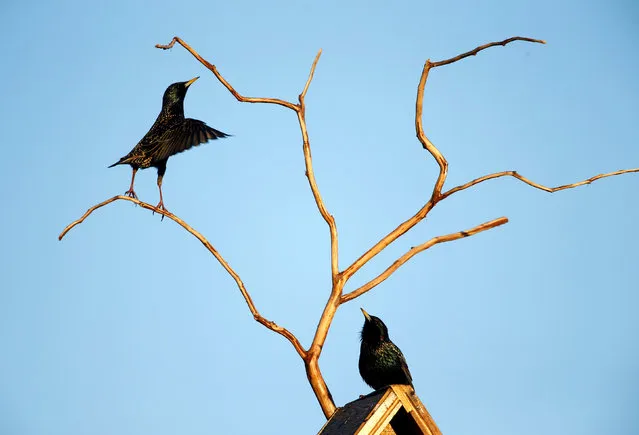
Starlings are seen at their nesting box in a private garden in the town of Bobruisk, Belarus, April 8, 2018. (Photo by Vasily Fedosenko/Reuters)
Details
15 Apr 2018 00:03:00