Loading...
Done
Camp dwellers pump water from a well at Malkohi refugee camp in Jimeta, Adamawa State, Nigeria on February 19, 2019, four days ahead of the country's General elections set for February 23 after a last-minute rescheduling. Malkohi is a camp for internal displaced who fled their homes as Boko Haram insurgents advanced across north-eastern Nigeria. From their homes on the outskirts of Yola, capital of presidential candidate Atiku Abubakar's home state Adamawa, Malkohi residents say they feel forgotten. (Photo by Luis Tato/AFP Photo)

Camp dwellers pump water from a well at Malkohi refugee camp in Jimeta, Adamawa State, Nigeria on February 19, 2019, four days ahead of the country's General elections set for February 23 after a last-minute rescheduling. Malkohi is a camp for internal displaced who fled their homes as Boko Haram insurgents advanced across north-eastern Nigeria. From their homes on the outskirts of Yola, capital of presidential candidate Atiku Abubakar's home state Adamawa, Malkohi residents say they feel forgotten. (Photo by Luis Tato/AFP Photo)
Details
02 Mar 2019 00:05:00
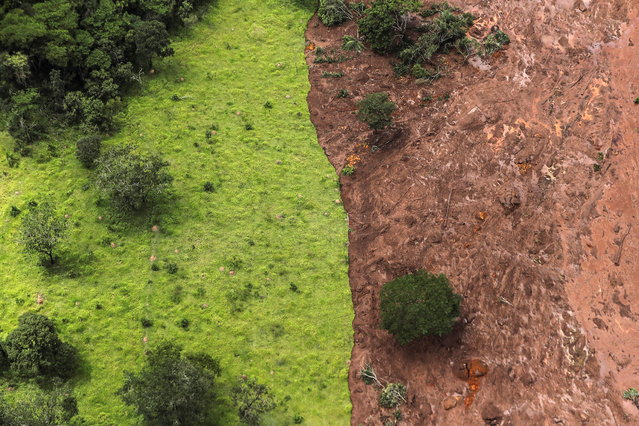
Aerial view over mud and waste from the disaster caused by dam spill in Brumadinho, Minas Gerais, Brazil, 26 January 2019. At least nine people have died and 300 are missing after a tailings dam burst at the Feijao mine in southeastern Brazil owned by Vale, the world's largest iron-ore producer, the Minas Gerais state government said. The dam in Brumadinho near Belo Horizonte broke on 25 January at around mid-day, unleashing a river of sludge that destroyed some nearby houses. (Photo by Antonio Lacerda/EPA/EFE)

Aerial view over mud and waste from the disaster caused by dam spill in Brumadinho, Minas Gerais, Brazil, 26 January 2019. At least nine people have died and 300 are missing after a tailings dam burst at the Feijao mine in southeastern Brazil owned by Vale, the world's largest iron-ore producer, the Minas Gerais state government said. The dam in Brumadinho near Belo Horizonte broke on 25 January at around mid-day, unleashing a river of sludge that destroyed some nearby houses. (Photo by Antonio Lacerda/EPA/EFE)
Details
29 Jan 2019 00:03:00
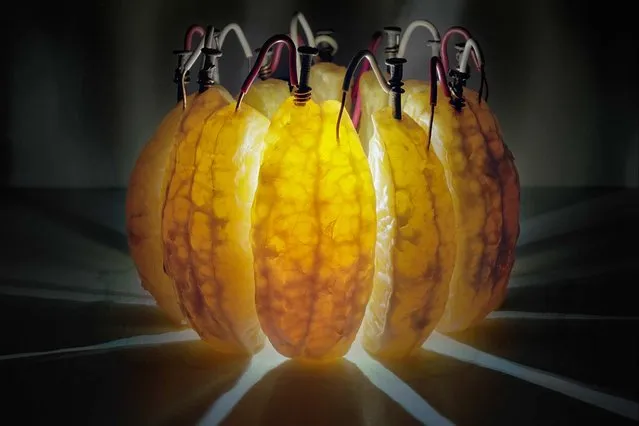
Wedges of an orange generate enough current and electrical juice – 3.5 volts – to power an LED. The fruit’s citric acid helps electrons flow from galvanized nails to copper wire in this 14-hour exposure. This image was published in September’s Visions of Earth, a trio of photos that appear in each issue of National Geographic. (Photo by Caleb Charland/National Geographic)

Wedges of an orange generate enough current and electrical juice – 3.5 volts – to power an LED. The fruit’s citric acid helps electrons flow from galvanized nails to copper wire in this 14-hour exposure. This image was published in September’s Visions of Earth, a trio of photos that appear in each issue of National Geographic. (Photo by Caleb Charland/National Geographic)
Details
06 Jan 2014 12:09:00
Sculpture By Ervin Loranth Herve

There are not many sculptures in the world that were purposely made to be grotesque, especially on such a large scale. Thus, a Hungarian artist Ervin Loránth Hervé has apparently decided that there isn’t enough horror in this world and created the Feltépve – a sculpture of a stone giant ripping apart the earth in order to break free. However, when we look from another perspective this sculpture might depict a grouchy giant trying to cover himself with a blanket of earth so that everyone would leave him alone. The latter interpretation of this sculpture was probably not intended by the sculptor; however, the way the arms of the giant are positioned makes it look as if it was truly the case.
Details
04 Nov 2014 11:49:00
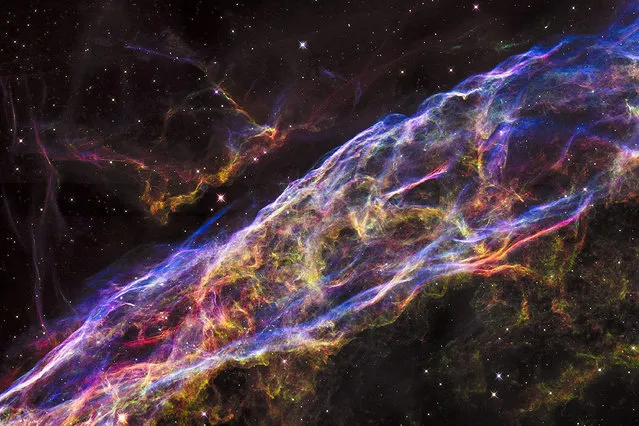
A small section of the expanding remains of the Veil Nebula, a massive star that exploded about 8,000 years ago. The entire nebula is 110 light-years across, covering six full moons on the sky as seen from Earth, and resides about 2,100 light-years away in the constellation Cygnus, the Swan. (Photo by Reuters/NASA/ESA/Hubble)

A small section of the expanding remains of the Veil Nebula, a massive star that exploded about 8,000 years ago. The entire nebula is 110 light-years across, covering six full moons on the sky as seen from Earth, and resides about 2,100 light-years away in the constellation Cygnus, the Swan. (Photo by Reuters/NASA/ESA/Hubble)
Details
29 Feb 2016 11:30:00
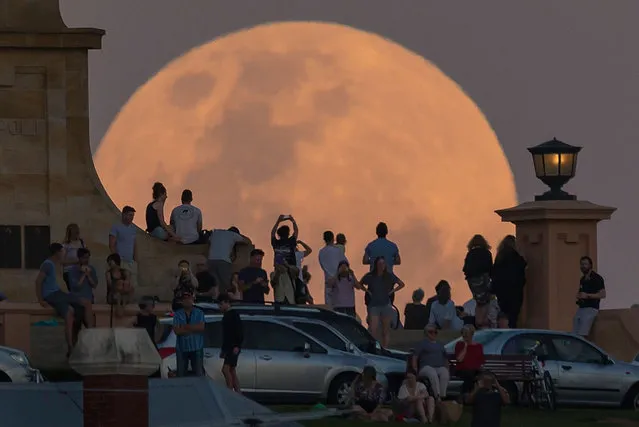
Crowds look on as the super moon rises behind the Fremantle War Memorial at Monument Hill on November 14, 2016 in Fremantle, Australia. A super moon occurs when a full moon passes closes to earth than usual, with the November 14th moon expected to be closer than it has been in over 70 years. (Photo by Paul Kane/Getty Images)

Crowds look on as the super moon rises behind the Fremantle War Memorial at Monument Hill on November 14, 2016 in Fremantle, Australia. A super moon occurs when a full moon passes closes to earth than usual, with the November 14th moon expected to be closer than it has been in over 70 years. (Photo by Paul Kane/Getty Images)
Details
15 Nov 2016 11:30:00
Indigenous people march during the annual Free Earth camp, where they discuss rights, territorial protection and their role in COP30, which will take place for the first time in the Amazon, in Brasilia, Brazil, Tuesday, April 8, 2025. (Photo by Eraldo Peres/AP Photo)

Indigenous people march during the annual Free Earth camp, where they discuss rights, territorial protection and their role in COP30, which will take place for the first time in the Amazon, in Brasilia, Brazil, Tuesday, April 8, 2025. (Photo by Eraldo Peres/AP Photo)
Details
15 Jun 2025 04:21:00
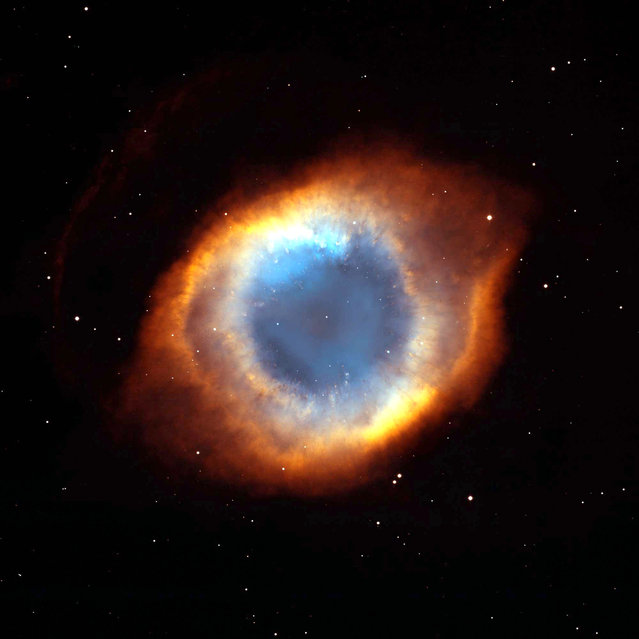
A coil-shaped Helix Nebula showing a fine web of filamentary “bicycle-spoke” features embedded in the colorful red and blue ring of gas. At 650 light-years away, the Helix is one of the nearest planetary nebulae to Earth. A planetary nebula is the glowing gas around a dying, Sun-like star. (Photo by Reuters/NASA)

A coil-shaped Helix Nebula showing a fine web of filamentary “bicycle-spoke” features embedded in the colorful red and blue ring of gas. At 650 light-years away, the Helix is one of the nearest planetary nebulae to Earth. A planetary nebula is the glowing gas around a dying, Sun-like star. (Photo by Reuters/NASA)
Details
22 Oct 2014 14:01:00