Loading...
Done
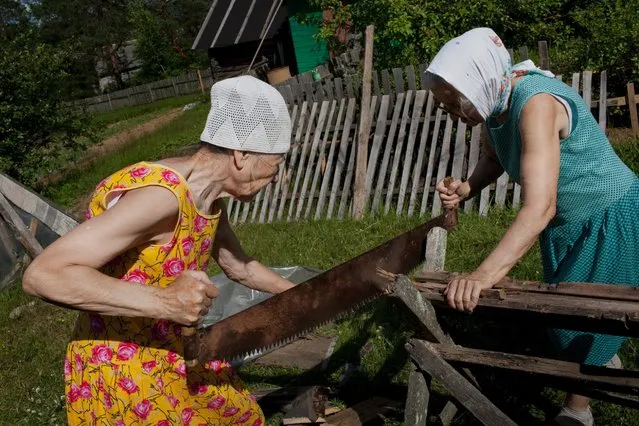
“Two-Handed Saw, 2014”. “Most of the neighbors have switched to power tools to run their households, the buzz of chain saws and weed-whackers overpowering the quieter sounds of country life, but my aunts hold on to the two-handed saw that's decades old, the sickle and scythe that need to be sharpened and polished after each use, the old axe that's becoming heavier each year. Each of these objects is familiar, holding memories of their brother, who succumbed to cancer a few years ago, of days before my grandfather lost his vision in the 50's, of busier days and longer futures”, Sablin told. (Photo by Nadia Sablin)

In northwest Russia, in a small village called Alekhovshchina, Nadia Sablin's aunts spend the warmer months together in the family home and live as the family has always lived, chopping wood to heat the house and making their own clothes. Sablin's book of photographs, “Aunties: The Seven Summers of Alevtina and Ludmila”, is published by Duke University Press. Here: “Two-Handed Saw, 2014”. (Photo by Nadia Sablin)
Details
25 Feb 2016 12:12:00
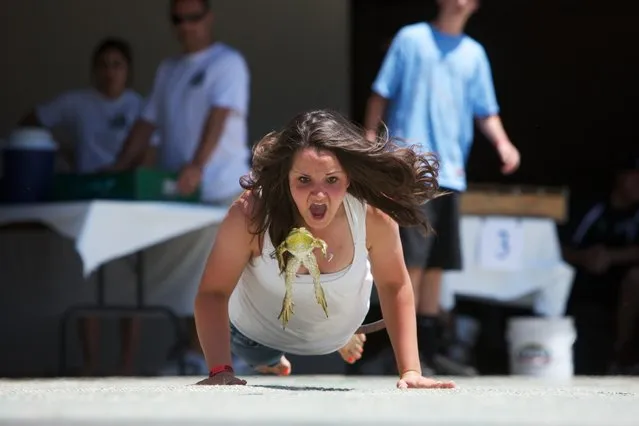
Breanna Ziehlke encourages her frog to get on with it at the Calaveras County Fair & Jumping Frog Jubilee. (Photo by Sol Neelman)

Since 2005, photographer Sol Neelman, has photographed people having fun. More specifically, Neelman has documented the wacky and wildly diverse world of “weird sports”. Photo: Breanna Ziehlke encourages her frog to get on with it at the Calaveras County Fair & Jumping Frog Jubilee. (Photo by Sol Neelman)
Details
07 Apr 2014 09:17:00
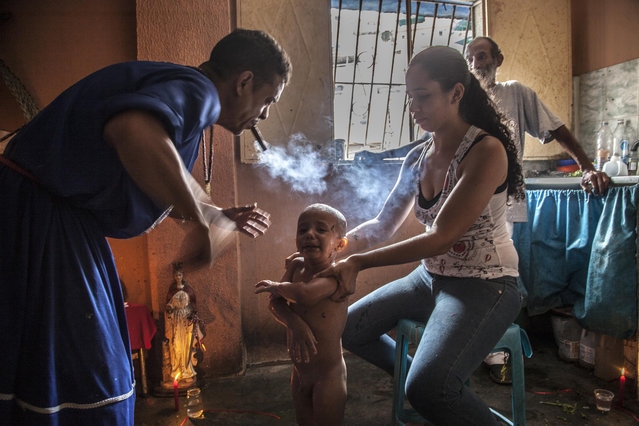
The known as “callejón de los brujos” has become an alternative for the sick in Venezuela. (Photo by Alvaro Fuente/NurPhoto via Getty Images)

The known as “callejón de los brujos” has become an alternative for the sick in Venezuela. The health crisis that affects hundreds of Venezuelans who face every day the serious shortage of medicines, lack of medical supplies and the high costs of medicines that are unattainable for the population. However, many Venezuelans have resorted to alternative methods to science in recent years. (Photo by Alvaro Fuente/NurPhoto via Getty Images)
Details
25 Dec 2017 05:57:00
Black women in Brazil sit at the intersection of racism and misogyny, and have in recent years been at the forefront of a movement that challenges issues ranging from sexual and domestic violence to police brutality and stereotyping. Kolor Collective considers itself to be a part of this movement and questions expectations imposed on black women with satirical and subversive images, as seen here. (Photo by Kolor Art Collective/The Guardian)

Photographer Pol Kurucz’s vivid collection of photos explores issues faced by black Brazilian women, from political misrepresentation to unrealistic beauty standards. Kolor Collective is a Rio de Janeiro-based creative group that challenges the struggle faced by black women in Brazil through theatrical and provocative art. It was founded in 2015 by Franco-Hungarian photographer Pol Kurucz, who often touches on his own experiences of discrimination to call out sensitive social problems. (Photo by Kolor Art Collective/The Guardian)
Details
28 Dec 2016 07:24:00
A vegetarian festival devotee gets medical attention after a parade at Jui Tui shrine on September 30, 2014 in Phuket, Thailand. (Photo by Borja Sanchez-Trillo/Getty Images)

A vegetarian festival devotee gets medical attention after a parade at Jui Tui shrine on September 30, 2014 in Phuket, Thailand. (Photo by Borja Sanchez-Trillo/Getty Images)
Details
07 Oct 2016 09:12:00
Patients from the Larco Herrera Psychiatric Hospital wear costumes in the likeness of the first governor and founder of the Inca civilization, Manco Capac, right, and his wife Mama Ocllo, during the hospital's Independence Day parade in Lima, Peru, Wednesday, July 22, 2015. (Photo by Martin Mejia/AP Photo)

Patients from the Larco Herrera Psychiatric Hospital wear costumes in the likeness of the first governor and founder of the Inca civilization, Manco Capac, right, and his wife Mama Ocllo, during the hospital's Independence Day parade in Lima, Peru, Wednesday, July 22, 2015. The parade is held on the hospital's campus every year ahead of the Andean nation's official Independence Day celebrations on July 28. (Photo by Martin Mejia/AP Photo)
Details
23 Jul 2015 10:52:00
Dancer Megan changes costume as she performs in the review “Feerie” at the Moulin Rouge in Paris, France, July 3, 2018. Each show requires 1,000 outfits, all crafted in the workshops that have been supplying the Moulin Rouge for decades. Each dancer has to make between 10 and 15 costume changes per show, with about 90 seconds to complete each one before they have to be back out on stage. (Photo by Philippe Wojazer/Reuters)

Dancer Megan changes costume as she performs in the review “Feerie” at the Moulin Rouge in Paris, France, July 3, 2018. Each show requires 1,000 outfits, all crafted in the workshops that have been supplying the Moulin Rouge for decades. Each dancer has to make between 10 and 15 costume changes per show, with about 90 seconds to complete each one before they have to be back out on stage. (Photo by Philippe Wojazer/Reuters)
Details
05 Oct 2019 00:03:00
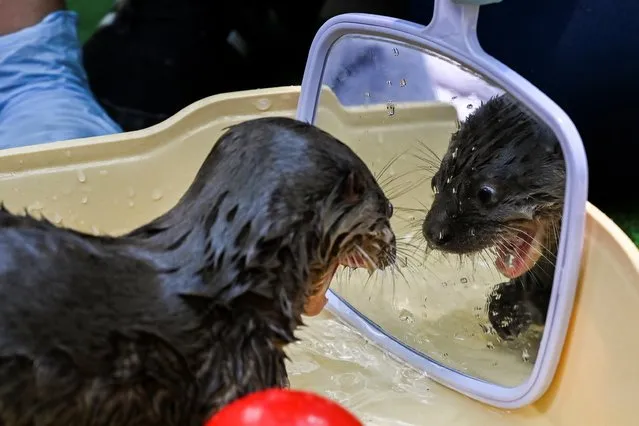
A river otter (lontra longicaudis) of 6-weeks-old looks in the mirror during a bath in the Animal Welfare Unit of the Zoo in Cali, Colombia, on October 22, 2019. The baby otter was found abandoned brought to the Cali Zoo for breeding, for its extensive experience in raising these species. According to the International Union for Conservation of Nature the river otter (lontra longicaudis) are in danger of extinction, because of mining, agriculture, pollution of rivers and housing construction in their habitat. (Photo by Luis Robayo/AFP Photo)

A river otter (lontra longicaudis) of 6-weeks-old looks in the mirror during a bath in the Animal Welfare Unit of the Zoo in Cali, Colombia, on October 22, 2019. The baby otter was found abandoned brought to the Cali Zoo for breeding, for its extensive experience in raising these species. According to the International Union for Conservation of Nature the river otter (lontra longicaudis) are in danger of extinction, because of mining, agriculture, pollution of rivers and housing construction in their habitat. (Photo by Luis Robayo/AFP Photo)
Details
27 Oct 2019 00:03:00