Loading...
Done
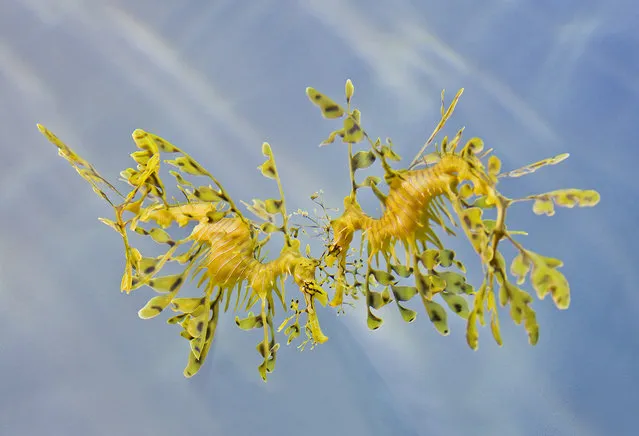
Leafy sea dragon

The leafy seadragon or Glauert's seadragon, Phycodurus eques, is a marine fish in the family Syngnathidae, which also includes the seahorses. It is the only member of the genus Phycodurus. It is found along the southern and western coasts of Australia. The name is derived from the appearance, with long leaf-like protrusions coming from all over the body. These protrusions are not used for propulsion; they serve only as camouflage. The leafy seadragon propels itself by means of a pectoral fin on the ridge of its neck and a dorsal fin on its back closer to the tail end. These small fins are almost completely transparent and difficult to see as they undulate minutely to move the creature sedately through the water, completing the illusion of floating seaweed.
Details
05 Sep 2012 08:51:00
1925: Hitler posing to a recording of one of his speeches after his release from Landsberg Prison. (Photo by Heinrich Hoffmann/Keystone Features)

Adolf Hitler (1889–1945), leader of the National Socialist German Workers' Party (NSDAP), strikes a pose for photographer Heinrich Hoffmann whilst listening to a recording of his own speeches, 1925. After seeing the photographs, Hitler ordered Hoffmann to destroy the negatives, but he disobeyed. (Photo by Heinrich Hoffmann). P.S. All pictures are presented in high resolution.
Details
15 Sep 2012 09:08:00
The Ballerina Project by Photographer Dane Shitagi

For over 14 years, photographer Dane Shitagi has been photographing beautiful, strong, and powerful women dancing all over New York City. The juxtaposition of the incredible strength of the dancers’ bodies plus a seemingly devoid urban landscape creates a captivating visual experience. When social media emerged, Shitagi took advantage, creating pages for his photo series on Facebook, Instagram, Tumblr, Pinterest, and Twitter. Currently, it is the largest dance photography page on Facebook with 850,000 “likes” and its Instagram account has about 500,000 followers. (Photo by Dane Shitagi)
Details
06 Aug 2014 10:58:00
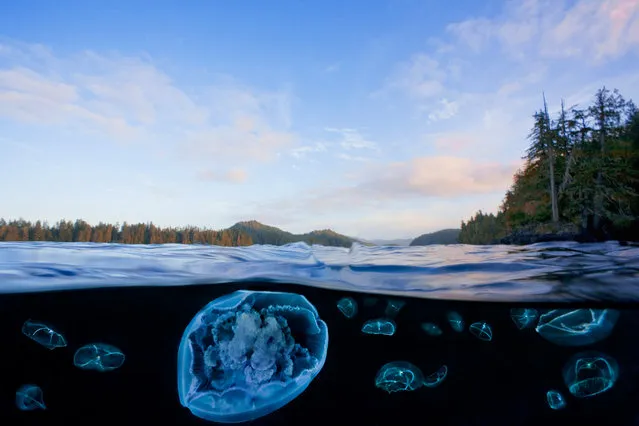
Moon jellyfish and cross jellies. (Photo by David Hall)

David Hall’s photographs of scenery and creatures off the coast of Canada in the Pacific Northwest portray serenity under the water, which belie the extreme challenges he faces to get his images. For each shoot, Hall wears a dry suit, a neoprene body suit that covers all of his body but his head and traps air inside to keep him warm. Water temperature in Canada’s British Columbia typically ranges between 45 and 50 degrees Fahrenheit. Photo: Moon jellyfish and cross jellies. (Photo by David Hall)
Details
16 Sep 2014 12:57:00
Living Paintings By Alexa Meade

Creators of Mini Cooper continue on with their innovative way of promoting their product. First, it was the huge cardboard boxes, which looked like packaging for full sized Mini Coopers, left all over Amsterdam. Now they’ve hired a famous artist Alexa Meade, who is known for making 3-D objects look as if they are 2-D paintings. For this project, Alexa had to fly to Japan, where she turned a whole Mini Cooper into a “drawing”. Even if you know that what you’re seeing on the picture are 3-D objects, your brain refuses to accept this, making you think that Alexa is standing near a sloppy picture of a Mini Cooper.
Details
13 Nov 2014 13:48:00
Animal Beards By David Kiefaber

Are you a fan of beards? If you are, have you ever thought that it might look like some sort of furry animal? David Kiefaber thought of the same thing when he participated in the “Free Your Skin” campaign, organized by Y&R New Zealand. You might think that you look all rugged and manly while wearing that luscious beard. But in reality, you simply look like a guy with a dead squirrel on his face. Or a raccoon… if you’re a greying middle-aged man. Hopefully, you’re not one of those people whose beard looks and/or smells like a skunk.
Details
02 Dec 2014 11:39:00
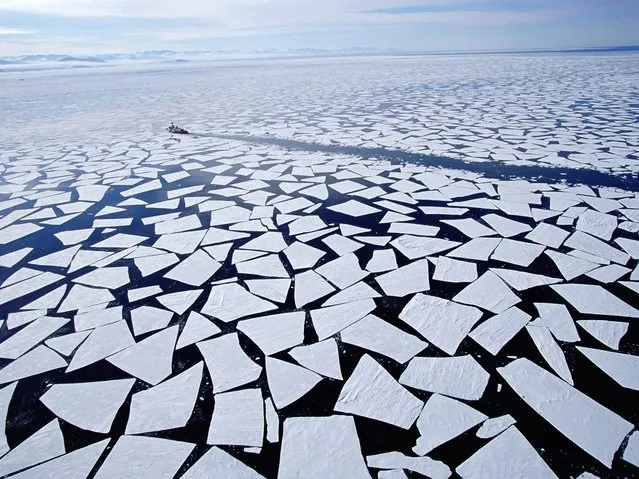
McMurdo Station Antarctic

McMurdo Station is a U.S. Antarctic research centre located on the southern tip of Ross Island, which is in the New Zealand-claimed Ross Dependency on the shore of McMurdo Sound in Antarctica. It is operated by the United States through the United States Antarctic Program, a branch of the National Science Foundation. The station is the largest community in Antarctica, capable of supporting up to 1,258 residents, and serves as the United States Antarctic science facility. All personnel and cargo going to or coming from Amundsen–Scott South Pole Station first pass through McMurdo.
Details
05 Sep 2013 10:18:00
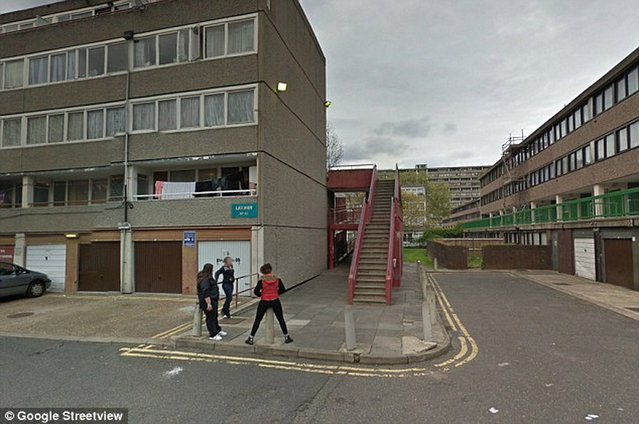
Bad Part of Town By Google Street View

Take a walk on the wild side around some of the most down right dangerous places in the world - and all without leaving your desk, courtesy of Google Street View. Since 2007, Google's amazing technology has given people the chance to visit the Eiffel Tower, peer out over San Francisco's Golden Gate Bridge or walk along a beach in the Bahamas. But as well as mapping the tourist-friendly hotspots, Google also ventured into places you really wouldn't want to find yourself. Here is a collection of some the most notorious areas captured by the infamous roaming camera cars from around the UK and the world.
Details
03 Oct 2013 11:05:00