Loading...
Done
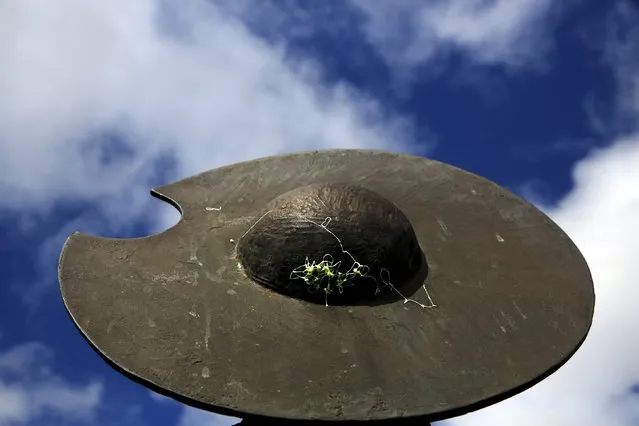
A sculpture of Don Quixote shows him wearing the basin he mistook for the enchanted helmet of the fictional Moorish king Mambrino in Alcazar de San Juan, Spain, April 5, 2016. (Photo by Susana Vera/Reuters)

A sculpture of Don Quixote shows him wearing the basin he mistook for the enchanted helmet of the fictional Moorish king Mambrino in Alcazar de San Juan, Spain, April 5, 2016. The arid central Spanish region of La Mancha is the setting for “Don Quixote”, the seventeenth-century novel by Miguel de Cervantes. Four hundred years after his death, references to the characters of Don Quixote, his loyal squire Sancho Panza and his beautiful lady Dulcinea abound in the surrounding villages from sweet treats to theatre productions involving livestock. Cervantes did not give away the name of the birthplace of Don Quixote, a middle-aged gentleman who becomes obsessed with chivalrous ideals. But many identify the village of Argamasilla de Alba as his hometown. The anniversary of Cervantes’ death is marked on the 23 April. (Photo by Susana Vera/Reuters)
Details
21 Apr 2016 12:32:00
What the World Eats By Peter Menzel And Faith D'Aluisio Part 2

A stunning photographic collection featuring portraits of people from 30 countries and the food they eat in one day. In this fascinating study of people and their diets, 80 profiles are organized by the total number of calories each person puts away in a day. Featuring a Japanese sumo wrestler, a Massai herdswoman, world-renowned Spanish chef Ferran Adria, an American competitive eater, and more, these compulsively readable personal stories also include demographic particulars, including age, activity level, height, and weight. Essays from Harvard primatologist Richard Wrangham, journalist Michael Pollan, and others discuss the implications of our modern diets for our health and for the planet. This compelling blend of photography and investigative reportage expands our understanding of the complex relationships among individuals, culture, and food.
Details
02 May 2014 09:20:00
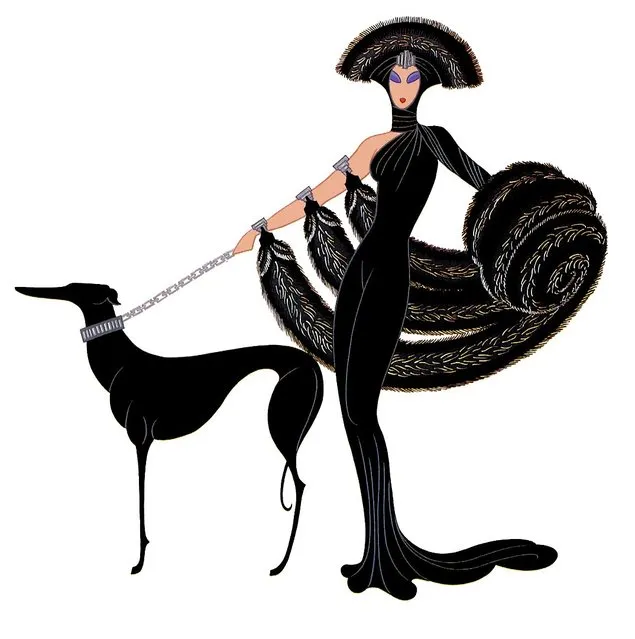
Romain de Tirtoff (Erte) – Symphony In Black

“Romain de Tirtoff (23 November 1892 – 21 April 1990) was a Russian-born French artist and designer known by the pseudonym Erté, the French pronunciation of his initials, R.T. He was a diversely talented 20th-century artist and designer who flourished in an array of fields, including fashion, jewellery, graphic arts, costume and set design for film, theatre, and opera, and interior decor”. – Wikipedia. Photo: Romain de Tirtoff (Erte) – “Symphony In Black” (please click to enlarge).
Details
29 Jan 2014 13:34:00
Syrian refugees sit behind barbed wire as they wait to cross into Macedonia at the Greek-Macedonian border, near the village of Idomeni, August 21, 2015. (Photo by Yannis Behrakis/Reuters)

Syrian refugees sit behind barbed wire as they wait to cross into Macedonia at the Greek-Macedonian border, near the village of Idomeni, August 21, 2015. (Photo by Yannis Behrakis/Reuters)
Details
12 Dec 2015 08:01:00
In this photo provided by Jean Revillard, Solar Impulse 2, a plane powered by the sun's rays and piloted by Andre Borschberg, approaches Kalaeloa Airport near Honolulu, Friday, July 3, 2015. (Photo by Jean Revillard/Global Newsroom via AP Photo)

In this photo provided by Jean Revillard, Solar Impulse 2, a plane powered by the sun's rays and piloted by Andre Borschberg, approaches Kalaeloa Airport near Honolulu, Friday, July 3, 2015. His 120-hour voyage from Nagoya, Japan broke the record for the world's longest nonstop solo flight, his team said. (Photo by Jean Revillard/Global Newsroom via AP Photo)
Details
04 Jul 2015 11:37:00
Two Chinese farmers got more than they bargained for when they pulled up the root of a fleece flower – and came face-to-face with the doppelganger of Homer Simpson, on May 17, 2013. The large root appears to have two bulging eyes and a prominent nose – giving it an uncanny resemblance to the famous cartoon character. With two offshoot roots shaped like arms, it even looks like it is pondering or confused – just what you would expect from the real Homer. (Photo by ImagineChina)

Two Chinese farmers got more than they bargained for when they pulled up the root of a fleece flower – and came face-to-face with the doppelganger of Homer Simpson, on May 17, 2013. The large root appears to have two bulging eyes and a prominent nose – giving it an uncanny resemblance to the famous cartoon character. With two offshoot roots shaped like arms, it even looks like it is pondering or confused – just what you would expect from the real Homer. (Photo by ImagineChina)
Details
18 May 2013 11:52:00
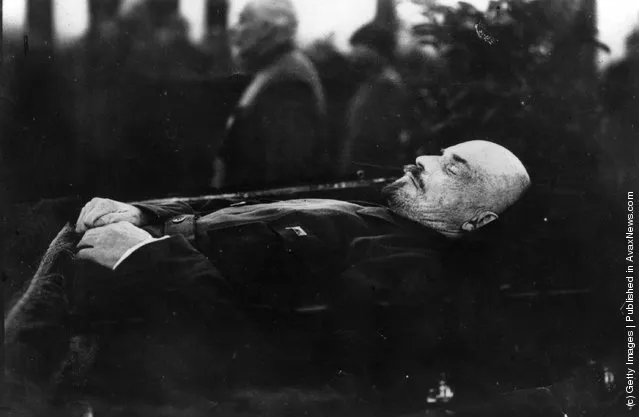
1924:  Vladimir Ilyich Lenin lying in state in the Kremlin

Photo: Vladimir Ilyich Lenin (1870 – 1924) lying in state in the Kremlin. (Photo by Hulton Archive/Getty Images). 1924

Important! For the same article in Russian language click here.

Something quite intriguing is happening within Russian-speaking internet during the last few – should you type a fully academic inquiry (at least, according to Russian academic requirements) in national search engines for "Lenin's mausoleum" – the first thing you get (even in top 10 searches) is website pages talking about black magic and occult. Website authors view this construction differently, but unconditionally agree on one thing: the mausoleum of the "leader of the world proletariat” – the essence of a magical artifact, a sort of “energy vampire”. It was built with a certain purpose: to drain the energy out of miserable Soviet citizens on one hand; and to poison the anthroposphere of one-sixth part of the earth with its vibes (the exact territory that was occupied by the former Soviet Union), depriving the Russian people of will to resist on the other hand. Complete nonsense? No doubt. Nevertheless, an intriguing one. Well, probably because some oddities do exist in mausoleum's history. These oddities are the thing we are going to discuss this time. First, let me refresh you memory on the subject.
Details
16 Oct 2011 11:27:00
The Hubble Space Telescope is shown following its release from the space shuttle Discovery Wednesday, February 19, 1997. The Hubble Space Telescope, one of NASA'S crowning glories, marks its 25th anniversary on Friday, April 24, 2015. With more than 1 million observations, including those of the farthest and oldest galaxies ever beholden by humanity, no man-made satellite has touched as many minds or hearts as Hubble. (Photo by AP Photo/NASA)

The Hubble Space Telescope is shown following its release from the space shuttle Discovery Wednesday, February 19, 1997. The Hubble Space Telescope, one of NASA'S crowning glories, marks its 25th anniversary on Friday, April 24, 2015. With more than 1 million observations, including those of the farthest and oldest galaxies ever beholden by humanity, no man-made satellite has touched as many minds or hearts as Hubble. (Photo by AP Photo/NASA)
Details
24 Apr 2015 11:25:00