Three young women in their 20s brawling on a busy street on the route from the track to the town centre during day four of the William Hill St Leger Festival at Doncaster Racecourse, England on September 14, 2019. (Photo by Nb press ltd)
Murad Khydyrov, horse and monkey trainer at the Great Moscow State Circus, and chimpanzee named Micky get ready for a rehearsal of the show called “History” as the circus prepares for its new season, which is to begin on September 19, in Moscow on September 17, 2020. (Photo by Natalia Kolesnikova/AFP Photo)
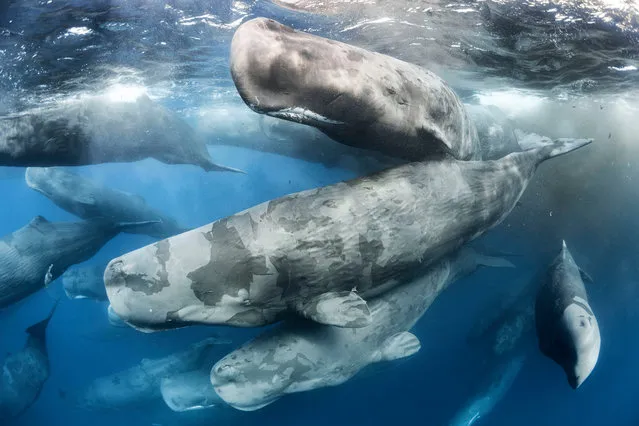
Behaviour: Mammals category. Giant Gathering by Tony Wu, USA. Dozens of sperm whales mingled noisily off Sri Lanka’s northeast coast, stacked as far down as Tony could see. This was a congregation of dozens of social units, like a gathering of the clans. Aggregations like this could be a critical part of the whales’ rich social lives but are rarely reported. Some two thirds of the population was wiped out before commercial whaling was banned in 1986. This kind of major gathering could be “a sign that populations are recovering”, says Tony. (Photo by Tony Wu/Wildlife Photographer of the Year 2017)
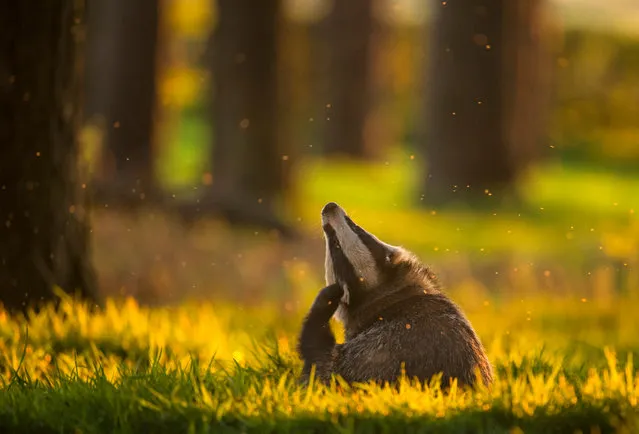
Andrew Parkinson, animal behaviour category winner: Crepuscular Contentment, Derbyshire. “In 15 years of working with badgers I’ve never seen a badger sit out in the open to have a scratch. I was sat concealed behind a tree and downwind so it was especially nice that the badger had his back to me, demonstrating just how inconspicuous and inconsequential my presence was”. (Photo by Andrew Parkinson/British Wildlife Photography Awards 2017)
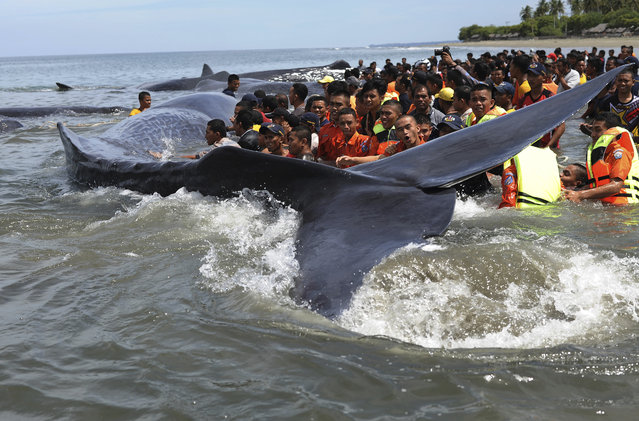
Rescuers attempt attempt to push stranded whales back into the ocean at Ujong Kareng beach in Aceh province, Indonesia, Monday, November 13, 2017. An official said a small pod of whales was stranded at the beach and attracted hundreds of onlookers who posed for pictures with them. (Photo by AP Photo/Zulkarnaini)
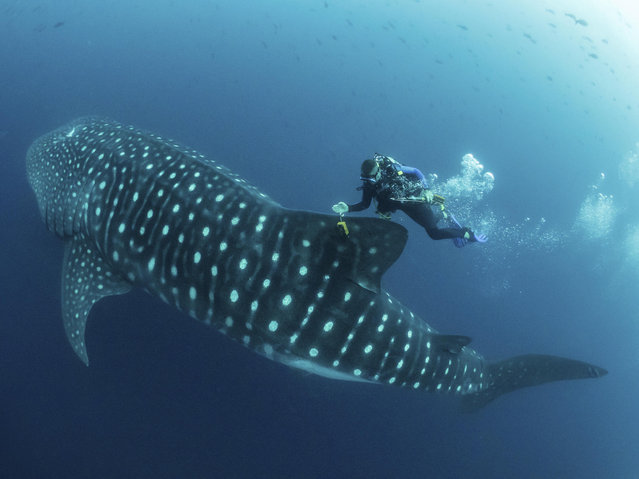
In this 2017 photo provided by Simon Pierce, Jonathan Green checks on a fin-mounted satellite tag on a whale shark in the Galapagos Islands area of Ecuador. Despite typically being bigger than a double-decker bus, the elusive whale shark has only tiny, almost useless teeth. It's also one of the least understood animals in the ocean. (Photo by Simonjpierce.com via AP Photo)