Loading...
Done
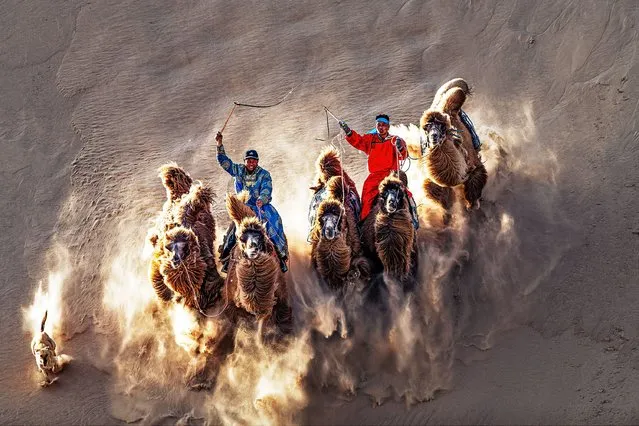
Camels kick up clouds of sand as they race down a steep dune. The camels can reach speeds of up to 40 kilometres per hour as they descend the ten-metre tall dunes on April 20, 2022. The photos were taken by photographer Qian Guo in Naiman Banner, near the city of Tongliao in the Inner Mongolia region of northeastern China. The 58 year old said: “These are local Mongolian farmers, and two of them are a father and a son. They have more than ten camels which they farm and train”. (Photo by Qian Guo/Solent News & Photo Agency)

Camels kick up clouds of sand as they race down a steep dune. The camels can reach speeds of up to 40 kilometres per hour as they descend the ten-metre tall dunes on April 20, 2022. The photos were taken by photographer Qian Guo in Naiman Banner, near the city of Tongliao in the Inner Mongolia region of northeastern China. The 58 year old said: “These are local Mongolian farmers, and two of them are a father and a son. They have more than ten camels which they farm and train”. (Photo by Qian Guo/Solent News & Photo Agency)
Details
25 Apr 2022 04:34:00
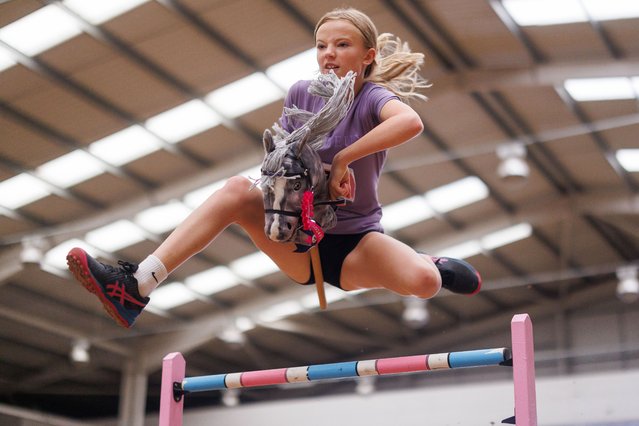
Competitors practice their moves before taking part in the UK Hobby Horse championship at Bury Farm Equestrian Centre on September 08, 2024 in Slapton, United Kingdom. While hobby horsing as a form of play has been around for centuries, the modern-day interpretation of the sport originated in Finland. Hobby horse competitions feature young enthusiasts trotting, galloping, and cantering on toy horses in various disciplines such as jumping and dressage. Its popularity has surged in recent years, especially during covid, and is growing in appeal. Young equine enthusiasts take advantage of its inclusivity, and enjoy the physical activity required, creativity and freedom of expression. The sport has also been found to help young people suffering with autism and ADHD, giving them a chance to connect with other young people with a love of horses. (Photo by Dan Kitwood/Getty Images)

Competitors practice their moves before taking part in the UK Hobby Horse championship at Bury Farm Equestrian Centre on September 08, 2024 in Slapton, United Kingdom. While hobby horsing as a form of play has been around for centuries, the modern-day interpretation of the sport originated in Finland.(Photo by Dan Kitwood/Getty Images)
Details
30 Sep 2024 04:38:00
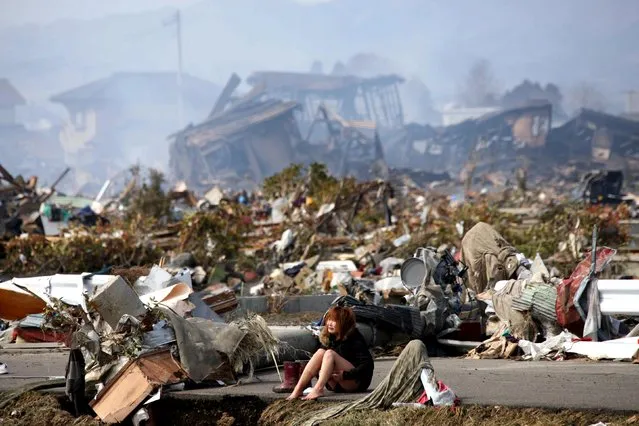
A woman cries while sitting on a road amid the destroyed city of Natori, Miyagi Prefecture in northern Japan March 13, 2011, after a massive earthquake and tsunami that are feared to have killed more than 10,000 people. (Photo by Asahi Shimbun/Reuters)

A woman cries while sitting on a road amid the destroyed city of Natori, Miyagi Prefecture in northern Japan March 13, 2011, after a massive earthquake and tsunami. Five years on from the tsunami that triggered meltdowns at Japan's Fukushima nuclear plant, the page is anything but turned. A magnitude 9 earthquake and towering tsunami on March 11, 2011 killed nearly 16,000 people along Japan's northeastern coast and left more than 2,500 missing. The 10-metre (33-foot) tsunami swept away everything in its path, including houses, ships, cars and farm buildings. (Photo by Asahi Shimbun/Reuters)
Details
09 Mar 2016 12:40:00
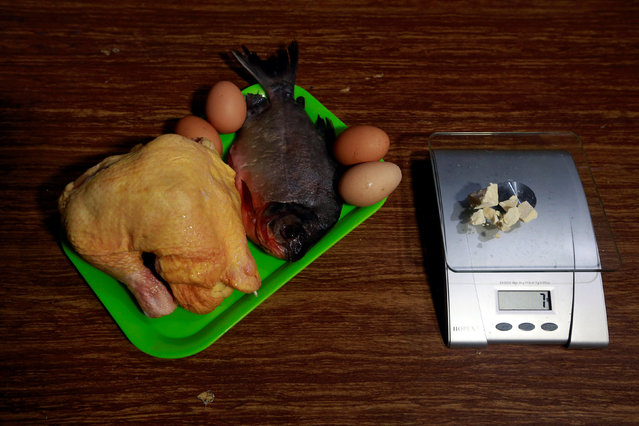
Chicken, fish and eggs lie next to coca paste worth $14,000 Colombian pesos at a local store in Guyabero Region, Guaviare, Colombia, May 24, 2016. (Photo by John Vizcaino/Reuters)

Chicken, fish and eggs lie next to coca paste worth $14,000 Colombian pesos at a local store in Guyabero Region, Guaviare, Colombia, May 24, 2016. As the government nears a historic peace deal with the rebels of the Revolutionary Armed Forces of Colombia (FARC), the nation's authorities are struggling to tame an increase in farming of coca, the raw material used to make cocaine. In the Guyabero Region, where many people work on coca plantations, locals barter coca paste to buy groceries at the local shop. (Photo by John Vizcaino/Reuters)
Details
03 Jun 2016 12:46:00
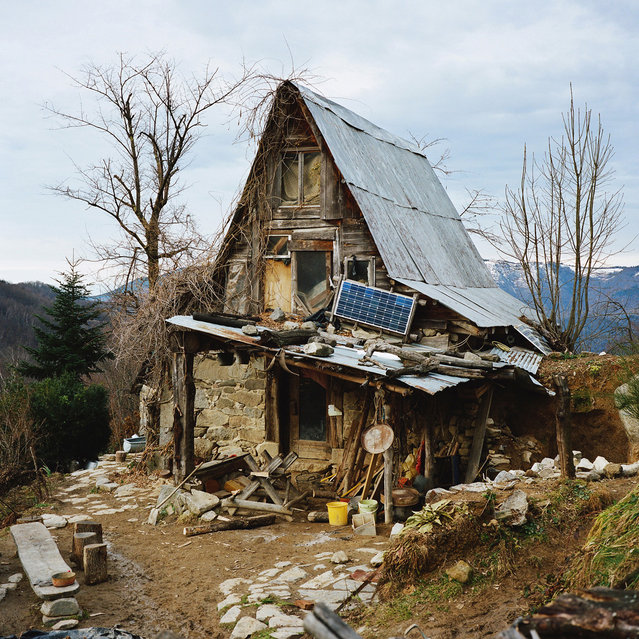
This property in the French Pyrenees is owned by a German man, who moved with his family here 25 years ago. He has since renovated the shack to be a completely self-sufficient house. There are no electrical appliances, but the solar panel powers small lights in the house. (Photo by Antoine Bruy)

Back in 2010, French photographer Antoine Bruy began hitchhiking around Europe without any fixed route. Along his travels, he met people who had entirely abandoned city life in favour of an isolated country existence they found more fulfilling. Bruy began seeking out people who lived off-the-grid. After three years on the road, staying in makeshift houses and on community farms, he has released Scrublands, a documentation of the lifestyle. While each living situation is different, Bruy found that all the people he met shared a common desire to escape the rat race and achieve a quieter life in harmony with nature. (Photo by Antoine Bruy)
Details
13 Aug 2014 09:45:00
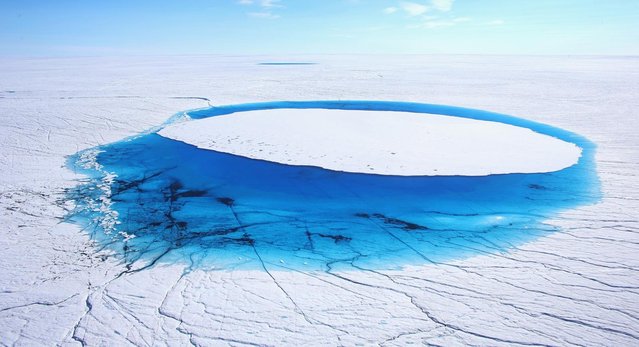
Water is seen on part of the glacial ice sheet that covers about 80 percent of the country is seen on July 17, 2013 on the Glacial Ice Sheet, Greenland. (Photo by Joe Raedle/Getty Images via The Atlantic)

Water is seen on part of the glacial ice sheet that covers about 80 percent of the country is seen on July 17, 2013 on the Glacial Ice Sheet, Greenland. As the sea levels around the globe rise, researchers affilitated with the National Science Foundation and other organizations are studying the phenomena of the melting glaciers and its long-term ramifications. The warmer temperatures that have had an effect on the glaciers in Greenland also have altered the ways in which the local populace farm, fish, hunt and even travel across land. In recent years, sea level rise in places such as Miami Beach has led to increased street flooding and prompted leaders such as New York City Mayor Michael Bloomberg to propose a $19.5 billion plan to boost the citys capacity to withstand future extreme weather events by, among other things, devising mechanisms to withstand flooding. (Photo by Joe Raedle)
Details
02 Aug 2013 10:51:00
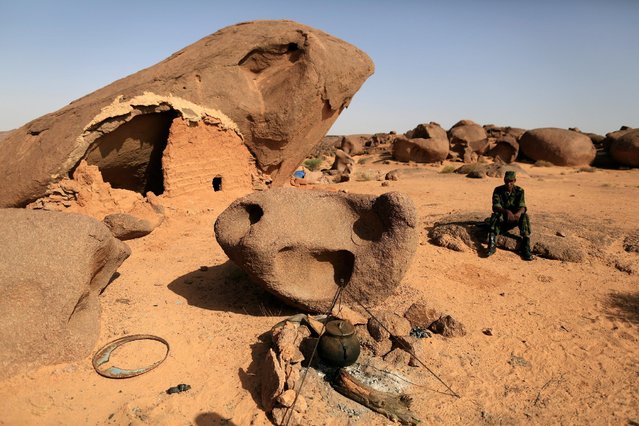
A Polisario fighter sits on a rock at a forward base on the outskirts of Tifariti, Western Sahara, September 9, 2016. At a rocky outpost in Western Sahara, a new generation of soldiers who have never known war are mobilising as tensions resurface in one of Africa's oldest disputes after a quarter century of uneasy peace. Young Sahrawi troops man new desert posts for the Polisario Front, which for more than 40 years has sought independence for the vast desert region - first in a guerrilla war against Morocco and then politically since a ceasefire deal in 1991. Now a standoff with Morocco, which controls the majority of Western Sahara, is renewing pressure for a diplomatic solution to ensure foot soldiers don't return to fighting as the last generation of commanders once did. The standoff since August has brought Moroccan and Polisario forces within 200 metres of each other in a narrow strip of land near the Mauritanian border. Rich in phosphate, Western Sahara has been contested since 1975 when Spanish colonial powers left. Morocco claimed the territory and fought the 16-year war with Polisario. (Photo by Zohra Bensemra/Reuters)

A Polisario fighter sits on a rock at a forward base on the outskirts of Tifariti, Western Sahara, September 9, 2016. At a rocky outpost in Western Sahara, a new generation of soldiers who have never known war are mobilising as tensions resurface in one of Africa's oldest disputes after a quarter century of uneasy peace. (Photo by Zohra Bensemra/Reuters)
Details
04 Nov 2016 12:09:00
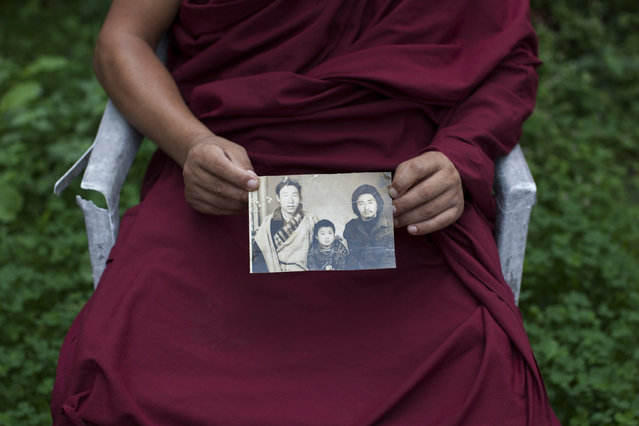
In this Saturday, September 27, 2014 photo, Tibetan monk Dorjee, 38, displays a photograph of his father, left, and himself, center, taken in Tibet, in Dharamsala, India. Dorjee said he held back his tears when he spoke with his parents on the phone after a separation period of 27 years. He exchanged a few words with his father but said his mother fainted on hearing his voice. (Photo by Tsering Topgyal/AP Photo)

“When I was 8 years old, my parents paid a smuggler to take me across the Himalayas, a weekslong walk over the mountains from Tibet to India. It was a trek that tens of thousands of other Tibetans have taken since the Dalai Lama fled a failed 1959 uprising against Chinese rule. My parents must have had their reasons to send me here; they must have had the best of intentions. But 18 years later, I still don't know why they did it. They are not political people. They are small farmers who raise barley and a few yak in a rural area not far from Lhasa, the Tibetan capital. I have not seen them since I left...”. – Tsering Topgyal via The Associated Press. (Photo by Tsering Topgyal/AP Photo)
Details
05 Nov 2014 12:27:00